

Adolescent Physical Inactivity: Lancet Global Health Study

Adolescent Physical Inactivity: Lancet Global Health Study
Source: Hindustan Times
Syllabus: GS II: Health, issues relating to children and women. GS I: Social issues
Why in news?
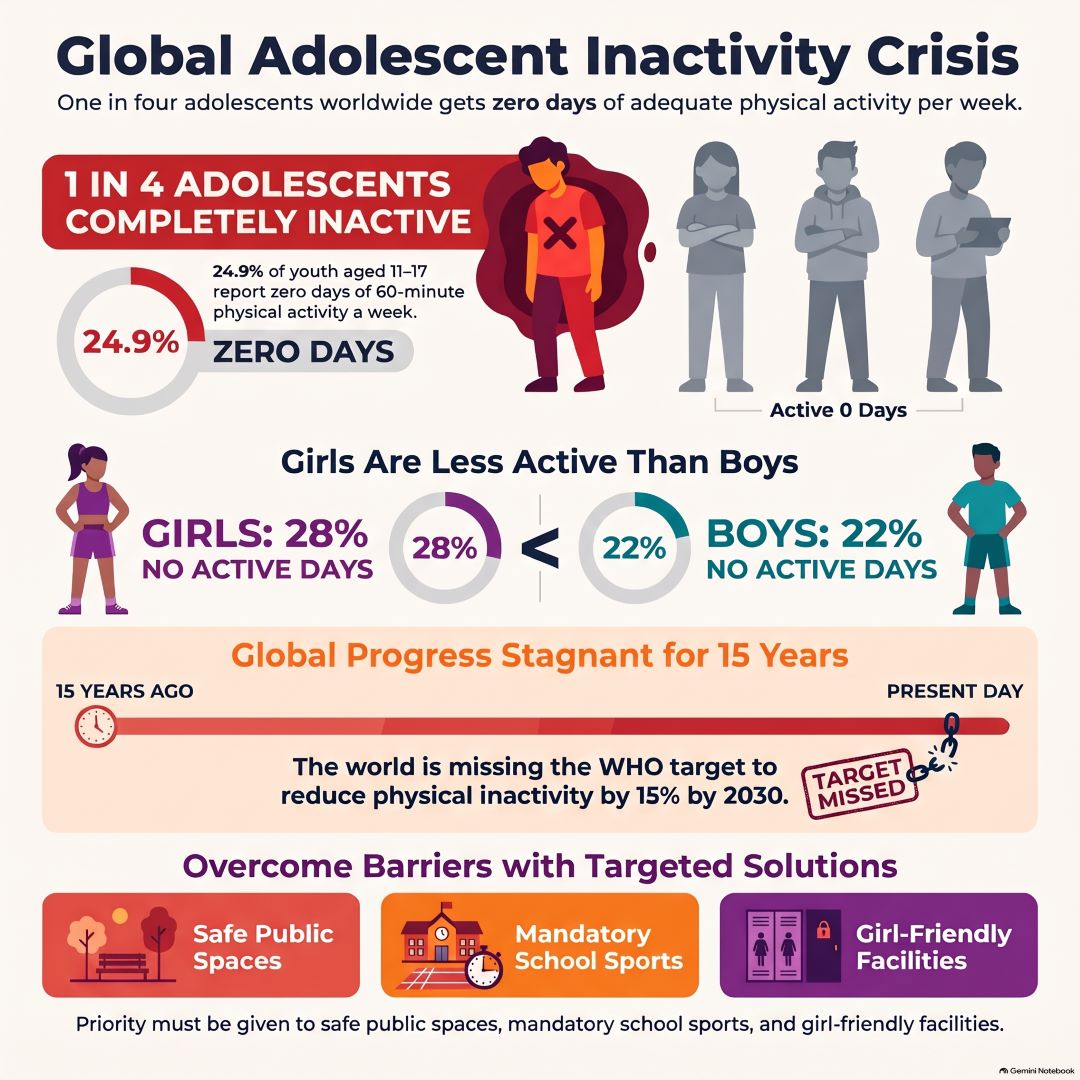
A new global study in The Lancet Global Health finds that one in four adolescents does not get even 60 minutes of physical activity on any day of the week, and girls are significantly less active than boys.
Key findings
- In 2025, about 240 million adolescents (24.9% of those aged 11-17) reported no active days in a week.
- Overall activity levels have stayed largely unchanged over 15 years.
- Active day: At least 60 minutes of moderate-to-vigorous physical activity (MVPA), meaning activity that raises heart or breathing rate, such as sports, exercise, walking or cycling.
- Gender gap: About 28% of girls reported no active days, against 22% of boys. Girls were less active in all regions.
- Income gap: Most low- and middle-income regions had more adolescents with no activity and lower average activity.
- Better performers: High-income western, central and eastern Europe, Central Asia, and East Asia and the Pacific had fewer adolescents with zero to two active days and small improvements over time.
- Method: Pooled 389 surveys with 3.2 million participants from 140 countries, covering 59% of the global adolescent population. The estimates will be adopted as official WHO statistics.
Policy benchmarks
- WHO 2020 guidelines: An average of 60 minutes of MVPA a day for adolescents.
- 2018 global target: WHO member states agreed to cut adolescent physical inactivity by 15% of 2010 levels by 2030. The study shows the world is off track.
- This target comes from the WHO Global Action Plan on Physical Activity 2018-2030.
|
Government Initiatives Addressing Adolescent Mental Health in India
|
Way forward
- Use targeted, context-specific approaches that prioritise the least active, as the authors say.
- Run population-wide action on social, cultural and environmental barriers, such as safe public spaces, school sports time and girl-friendly facilities.
- Track progress with regular, comparable surveys.