

AI Summit: India makes strong start, yet to arrive
Indian Express
I. Core Context
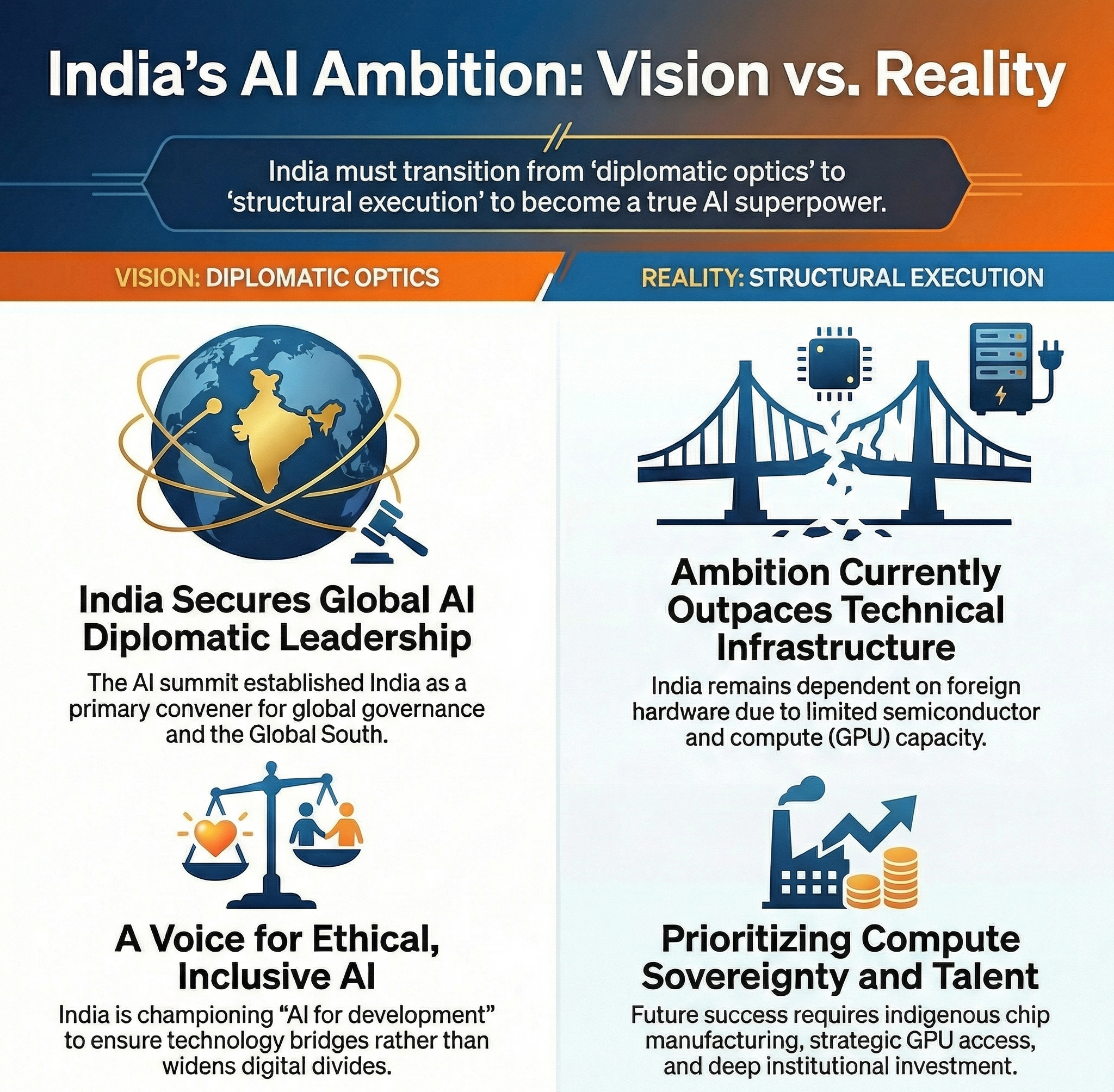
The article evaluates India’s hosting of a major AI Summit, describing it as a diplomatically successful event that positioned India prominently in global AI discourse. However, it argues that while optics were strong, structural capacity and long-term execution remain works in progress.
The summit is framed as:
- A diplomatic and convening success
- A declaration-heavy platform
- A beginning rather than culmination
II. Key Arguments Presented
1. Diplomatic Achievement
The article acknowledges:
- High-level participation
- International visibility
- India’s growing role in AI governance conversations
India demonstrated its ability to convene global stakeholders, especially from the Global South.
2. Normative Positioning: Inclusive AI
The summit emphasised:
- Ethical AI
- Inclusive growth
- AI for development
- Bridging digital divides
India projected itself as a voice of responsible and democratic AI.
3. Investment Announcements
The piece notes:
- Commitments in AI infrastructure and research
- Focus on compute capacity
- Public-private partnerships
However, it cautions that announcements do not equal implementation.
4. Capacity Gaps Remain
The central critique is that:
- India lacks cutting-edge semiconductor capability
- GPU and compute infrastructure is limited
- Domestic foundational AI models are still nascent
The ecosystem remains dependent on foreign hardware and platforms.
5. From Vision to Execution
The article suggests that:
- Declarations are aspirational
- Institutional follow-through is uncertain
- Policy coherence is yet to mature
India’s AI ambition exceeds its current industrial base.
III. Author’s Stance
The tone is balanced but gently sceptical.
The author appreciates:
- Diplomatic symbolism
- Strategic positioning
Yet questions:
- Implementation capacity
- Depth of technological autonomy
- Sustainability of commitments
The stance reflects cautious optimism.
IV. Possible Biases and Limitations
1. Emphasis on Gaps
The article may understate:
- India’s rapid startup growth
- Digital public infrastructure advantage
- Strong IT talent base
2. Hardware-Centric Lens
While compute infrastructure is vital, AI leadership also depends on:
- Data governance
- Regulatory innovation
- Application-layer ecosystems
The analysis leans heavily toward hardware constraints.
3. Summit Fatigue Bias
There is an implicit scepticism about global summits producing tangible change. While valid, not all diplomatic platforms are performative.
V. Pros and Cons of India’s Position
Pros
• Strong diplomatic convening power
• Normative leadership in ethical AI
• Growing private sector participation
• Digital public infrastructure foundation
Cons
• Limited semiconductor ecosystem
• GPU and compute shortages
• Execution challenges
• Fragmented institutional capacity
VI. Policy Implications
1. Compute Sovereignty
India must prioritise:
- Indigenous chip manufacturing
- Strategic GPU access agreements
- Public AI compute infrastructure
2. AI Governance Framework
Clear regulatory pathways must balance:
- Innovation
- Privacy
- Accountability
- Competition policy
3. Talent Development
Sustained investment in:
- Advanced AI research
- PhD-level innovation
- Interdisciplinary AI ethics training
4. Public Sector AI Integration
AI should be embedded into:
- Agriculture advisories
- Healthcare diagnostics
- Urban planning
- Judicial and administrative efficiency
Execution will determine credibility.
VII. Real-World Impact
Short-term:
- Enhanced global visibility
- Investor signalling
- Startup ecosystem enthusiasm
Medium-term:
- Policy experimentation
- Expansion of AI infrastructure
Long-term:
- Potential strategic autonomy in digital technologies
- Increased geopolitical leverage
Failure to build capacity could lead to:
- Continued hardware dependency
- AI consumption without AI creation
VIII. UPSC Relevance
GS Paper II
• Global governance of emerging technologies
• India’s foreign policy leadership
• Digital public infrastructure diplomacy
GS Paper III
• Artificial Intelligence
• Semiconductor policy
• Innovation ecosystems
GS Paper IV
• Ethics of AI
• Responsible innovation
• Accountability in automated governance
Essay Themes
• Technology and sovereignty
• Innovation vs implementation
• Leadership in the digital age
IX. Balanced Conclusion and Future Perspective
The AI Summit marks a credible beginning for India’s global AI ambition. The country has demonstrated convening capacity and articulated a normative vision rooted in inclusion and development.
Yet leadership in AI demands:
- Compute depth
- Institutional coherence
- Long-term investment
- Execution discipline
India has made a strong start. Whether it “arrives” as an AI power will depend not on summit optics but on sustained structural transformation.
Ambition has been declared. Delivery must follow.
