

Ambedkar backed UCC, with a rider – can initially be voluntary
Indian Express
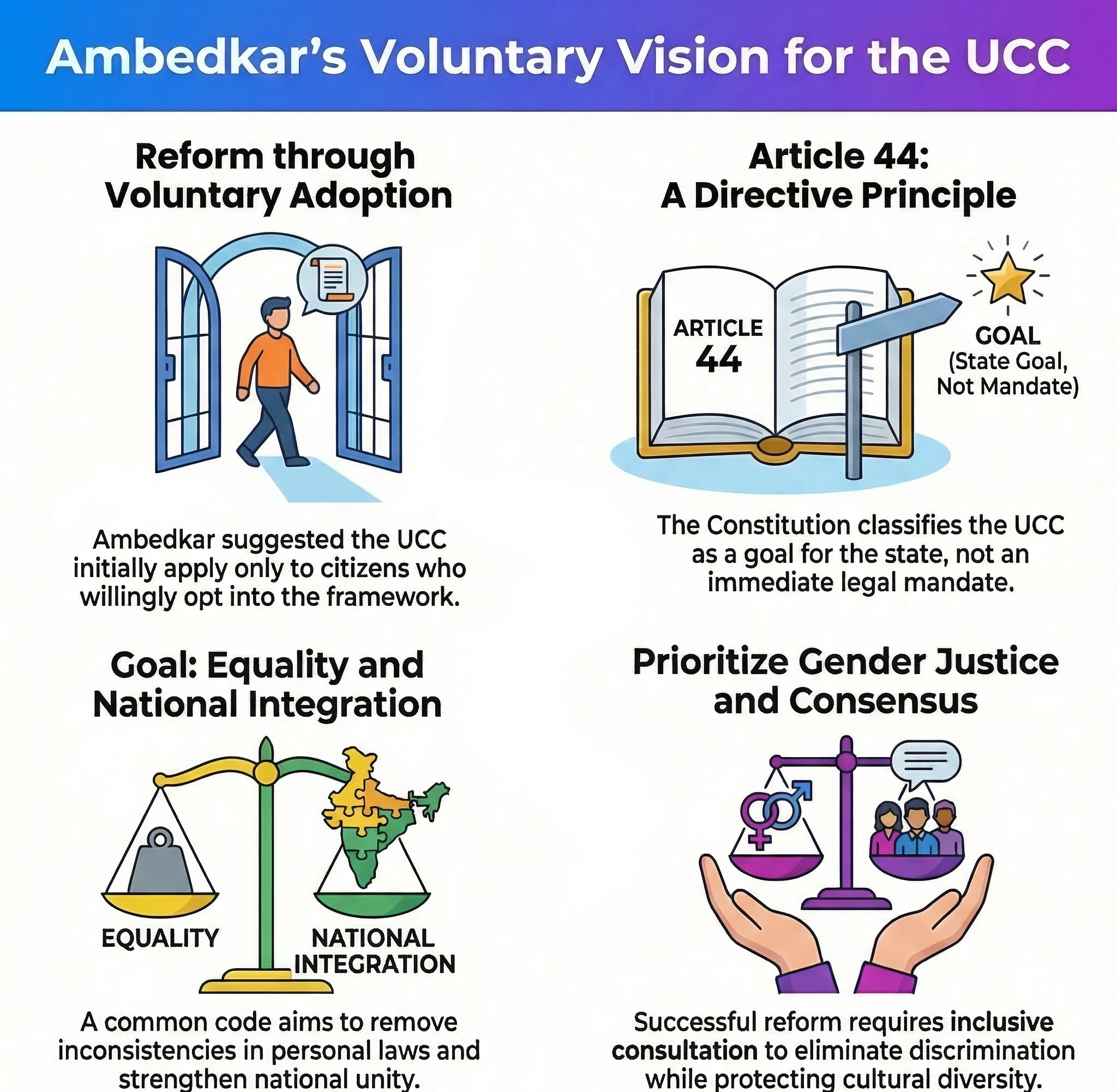
Key Arguments of the Article
Ambedkar’s Support for the Uniform Civil Code
The article asserts that Dr. B.R. Ambedkar supported the idea of a Uniform Civil Code as a means to ensure equality and remove legal inconsistencies in personal laws.
He believed that a common civil law framework would strengthen national integration and promote uniform legal standards across communities.
Proposal for a Gradual and Voluntary Approach
The article highlights that Ambedkar suggested a voluntary introduction of the Uniform Civil Code. According to the argument presented, the code could initially apply only to those citizens who willingly opted into it.
This approach aimed to avoid social resistance and allow gradual acceptance of legal reforms.
Historical Context of Personal Laws
During the Constituent Assembly debates, personal laws were deeply intertwined with religious identity. Minority groups expressed concerns that a uniform civil code might interfere with their religious practices.
The voluntary approach was therefore seen as a compromise between reformist aspirations and cultural sensitivities.
Directive Principle Under Article 44
The Constitution eventually included the Uniform Civil Code as a Directive Principle of State Policy under Article 44. This provision encourages the state to work towards a common civil code but does not mandate immediate implementation.
The article suggests that this arrangement reflects the cautious approach adopted by the Constitution’s framers.
Misinterpretation of Constitutional Debates
The author argues that contemporary debates on the Uniform Civil Code often overlook the nuanced position taken during the Constitution-making process.
Ambedkar’s emphasis on gradual implementation indicates that the framers recognised the complexity of reforming personal laws in a diverse society.
Author’s Stance
The author adopts a historically interpretive stance that emphasises Ambedkar’s nuanced position on the Uniform Civil Code. The article suggests that constitutional debates should be understood in their historical context rather than simplified for contemporary political narratives.
The tone emphasises moderation, gradual reform, and historical accuracy.
Possible Biases
Historical Interpretation Bias
The article relies heavily on constitutional debates to interpret present-day policy discussions.
Reform-Oriented Perspective
The discussion supports the idea of legal reform but emphasises a gradual and consensual approach.
Selective Emphasis
The article highlights Ambedkar’s statements supporting voluntary implementation but may not fully explore other perspectives within the Constituent Assembly debates.
Advantages of a Gradual UCC Approach
Social Consensus
Gradual reforms allow communities to adapt to legal changes without social conflict.
Protection of Cultural Diversity
Voluntary adoption respects India’s pluralistic social structure.
Legal Harmonisation
Over time, a common civil framework can reduce legal inconsistencies across personal laws.
Gender Justice
Uniform legal standards can help address gender discrimination in personal law systems.
Challenges and Concerns
Political Polarisation
Debates over the Uniform Civil Code often become politically contentious.
Implementation Complexity
Designing a civil code acceptable to diverse communities is a difficult task.
Minority Rights Concerns
Some communities fear that uniform laws may erode cultural and religious autonomy.
Legal Transition
Moving from multiple personal law systems to a uniform code requires significant legal restructuring.
Policy Implications
Gradual Legal Reform
Incremental reforms in personal laws can help align them with constitutional principles.
Inclusive Consultation
Engagement with religious leaders, civil society, and legal experts is essential.
Focus on Gender Equality
Legal reforms should prioritise eliminating gender discrimination in personal laws.
Legislative Responsibility
Parliament must lead the process of reform while respecting constitutional values and social sensitivities.
Real-World Impact
If reforms are implemented gradually:
• Greater social acceptance of legal changes
• Reduction in gender discrimination in family laws
• Improved legal uniformity across communities
If the issue remains unresolved:
• Continued legal fragmentation
• Ongoing constitutional debates
• Persistent social and political tensions
Alignment with UPSC GS Papers
GS Paper II
Uniform Civil Code, constitutional provisions, Directive Principles of State Policy, role of the Constituent Assembly.
GS Paper I
Indian society, diversity, social reform movements.
GS Paper IV
Ethics in governance, equality, justice, and balancing competing social values.
Balanced Assessment
The article highlights that the Uniform Civil Code debate is deeply rooted in India’s constitutional history and social diversity. Ambedkar’s position reflects a pragmatic approach that supports legal reform while recognising the need for gradual implementation and social consensus.
Understanding the historical context of constitutional debates is essential for informed policy discussions.
Future Perspective
As India continues to debate the implementation of a Uniform Civil Code, policymakers will need to balance constitutional values, gender justice, and cultural diversity. A gradual and consultative approach may offer a viable pathway toward legal harmonisation while maintaining social stability.
For civil services aspirants and policymakers, the issue demonstrates how constitutional ideals, historical context, and contemporary political realities interact in shaping public policy.
