

Amrit Bharat Station Scheme Latest News

Amrit Bharat Station Scheme Latest News
Source: IE
Why in News?
Recently, the Prime Minister of India inaugurated five redeveloped railway stations in Tamil Nadu which have been modernised under the Amrit Bharat Station Scheme (ABSS).
About Amrit Bharat Station Scheme
· It was launched in 2022.
· It aims at development and upgradation of stations over the Indian Railways (IR) network.
· It was launched to improve railway stations and make them cleaner, more comfortable and passenger-friendly.
· The ABSS has a long-term vision that involves creating master plans, promoting multimodal connectivity, better station accessibility for passengers, etc.
· Features of Amrit Bharat Station Scheme
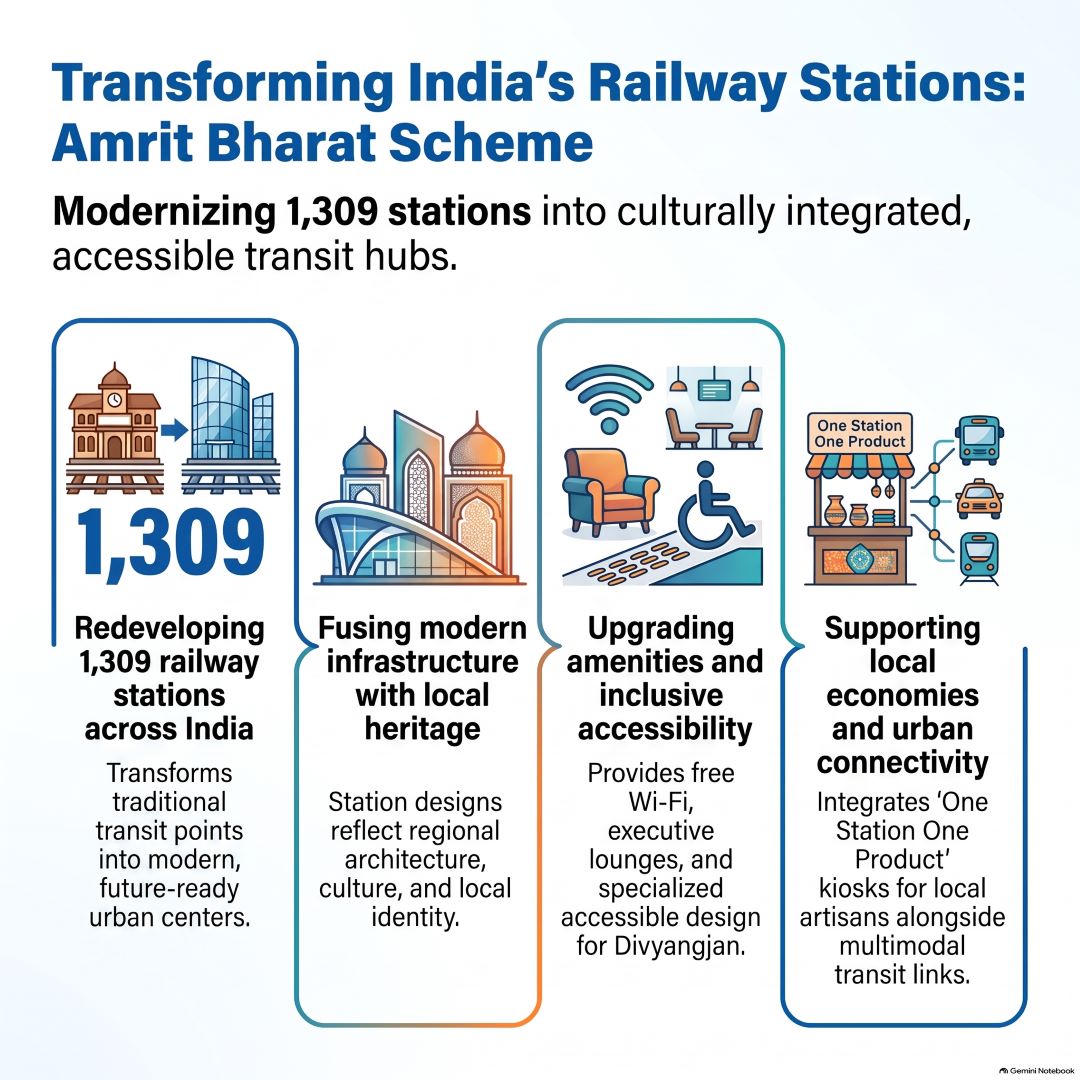
· Design: One of the significant features of this scheme is that designs of redeveloped station buildings are inspired by local culture, heritage and architecture.
· Amenities: Under the scheme, stations are being upgraded with better waiting halls, toilets, lifts, escalators, free Wi-Fi, executive lounges, improved access roads and landscaping. Some stations may also have designated spaces for business meetings.
· The facilities are planned according to the needs of each station.
· Local Economy Support: Local products will be sold at kiosks under the ‘One Station One Product’ scheme, and efforts will be made to make stations look greener and more attractive.
Amrit Bharat Station Scheme (ABSS)
|
Aspect |
Details |
|
About |
Launched by the Ministry of Railways in December 2022, the Amrit Bharat Station Scheme aims to redevelop 1,309 railway stations across India into modern, integrated transport hubs. |
|
Redevelopment Approach |
Follows a phased, station-specific approach, with plans tailored to local requirements, passenger footfall and future growth needs. |
|
Customised and Culturally Integrated Redevelopment |
Combines modern infrastructure with local heritage, culture and regional architectural styles to preserve the identity of each station. |
|
Passenger Amenities and Modern Facilities |
Provides improved entry and exit points, modern waiting halls, covered platforms, clean toilets, lifts, escalators, free Wi-Fi, executive lounges, business areas, food courts, kiosks and improved passenger information systems. It also includes aesthetically designed façades, roof plazas, landscaping, better lighting, parking and improved circulation areas. |
|
Inclusive and Accessible Design |
Aligned with the Accessible India Campaign (Sugamya Bharat Abhiyan), it provides facilities for Divyangjan and passengers with reduced mobility, including ramps, accessible parking, low-height counters, Braille signage, tactile pathways, accessible toilets and lifts in subways and foot overbridges. |
|
Local Economic Promotion |
Integrates the One Station One Product (OSOP) initiative by providing kiosks and outlets for local artisans, weavers, tribal communities and small producers to sell handicrafts, handlooms and region-specific food products. |
|
Urban Connectivity |
Develops stations as multimodal transport centres by improving integration with bus and metro networks, where applicable, and facilitating connectivity between both sides of cities through better station planning. |
|
Sustainability |
Incorporates green spaces, sustainable infrastructure and improved environmental planning. |
|
Significance |
Seeks to transform railway stations from mere transit points into vibrant urban centres by improving passenger convenience, promoting local economies, preserving regional identity and developing future-ready transport infrastructure. |