

Apple’s India Manufacturing: Scale Outpacing Governance

Apple’s India Manufacturing: Scale Outpacing Governance
GS3: Industry, Economy | GS2: Labour, Governance
Source: IE
Context
Three contract workers died at Tata Electronics’ Hosur factory in Tamil Nadu while doing maintenance at an effluent treatment plant, apparently after inhaling toxic gases in a nano-filtration tank. The plant is operated by Nalco Water, an Ecolab subsidiary. The State government has ordered an inquiry, and Apple and Tata are running their own. The incident comes as India produces about 25% of global iPhones.
Background: How India Became Central to Apple
- Beginning: Apple began iPhone assembly in India in 2017.
- Drivers: The “China plus one” strategy to reduce dependence on China amid geopolitical tension and supply disruption, and the Production Linked Incentive (PLI) scheme for large-scale electronics manufacturing (2020), which gives incentives on incremental sales.
- Players: Tata Group makes about 40% of domestic iPhone assembly, after acquiring Wistron’s Indian operations (2023) and taking over Pegatron’s. Foxconn handles the rest.
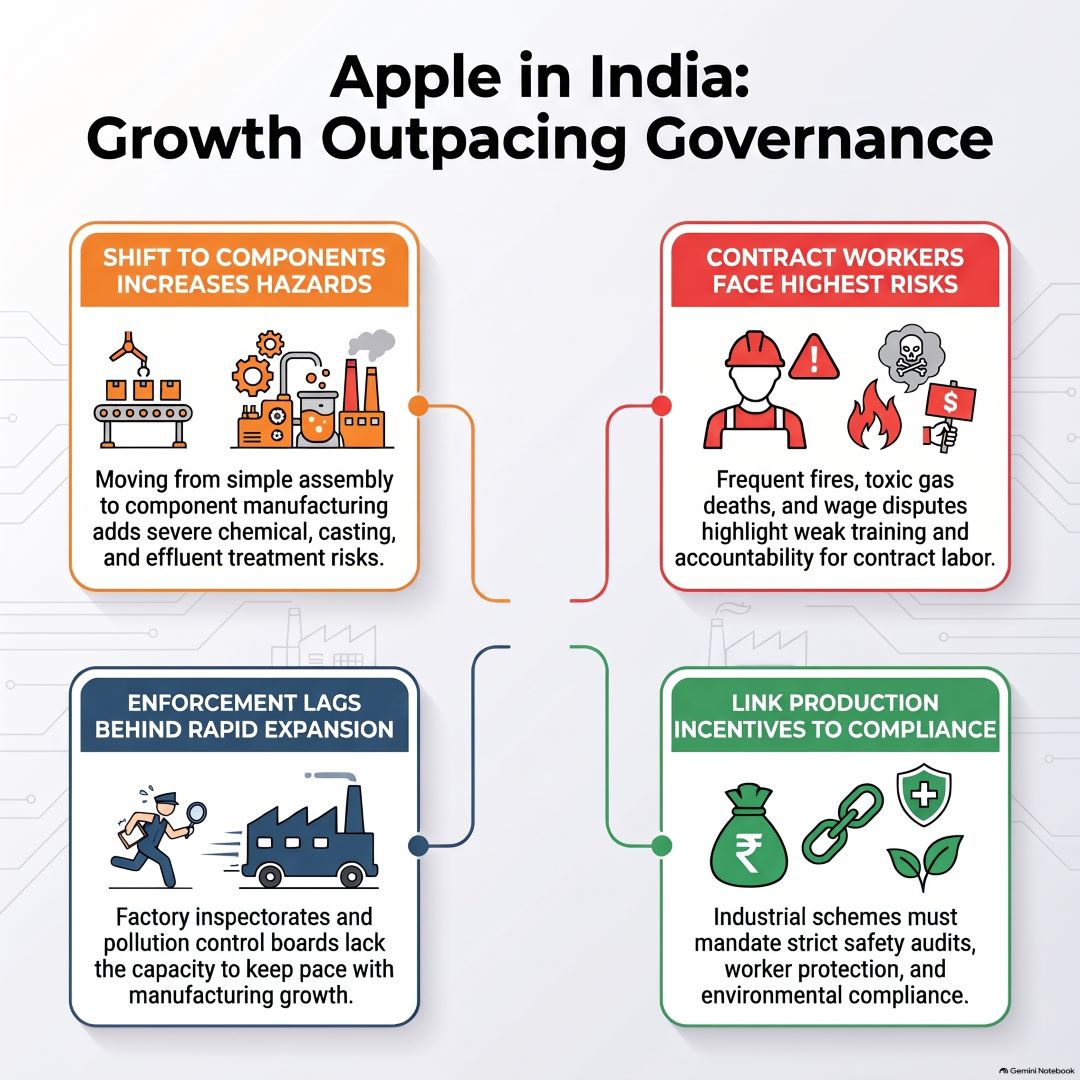
- Value-chain shift: Tata’s Hosur plant makes precision metal casings and back panels. India is moving from assembly of imported parts to component manufacturing, the objective of Make in India, the Electronics Component Manufacturing Scheme and the India Semiconductor Mission. Component making adds chemical, casting and effluent risks that pure assembly did not carry.
The Pattern of Failures
- Safety: Fires at Tata Hosur (2024, chemical storage), Pegatron Chennai (2023) and Foxlink, Andhra Pradesh (2023).
- Labour unrest: Foxconn near Chennai (2021), where about 250 workers fell ill and the plant shut for over three weeks. Wistron Narsapura (2020), where unpaid wages led to vandalism and a three-month shutdown.
- Discrimination: Foxconn Sriperumbudur was alleged to exclude married women (Reuters, 2024-25). The NHRC criticised the labour officials’ inquiry, but a later government probe cleared the firm, and Foxconn dropped age, gender and marital-status criteria from job adverts.
- Environment: TNPCB warned of closure over alleged groundwater contamination (2026), then dropped action after accepting Tata’s explanation.
- Cybersecurity: A June 2026 ransomware attack leaked over 200,000 files from Tata Hosur, including supplier details and images of the unreleased iPhone 18 Pro.
Analysis: Legal and Policy Dimensions
- Labour safety law: The Factories Act 1948 and the Contract Labour (Regulation and Abolition) Act 1970 are being subsumed into the Occupational Safety, Health and Working Conditions (OSH) Code 2020. Contract workers, who were the victims here, are the group where training and accountability are weakest.
- Constitutional basis: Article 21 (life and dignity), Articles 14-16 (non-discrimination in hiring), and Directive Principles 39(e), 42 and 43 (worker health, humane conditions, living wage).
- Liability: M.C. Mehta v. Union of India (Oleum gas leak, 1986) laid down absolute liability for hazardous industries, so the manufacturer cannot escape through a contractor. The Public Liability Insurance Act 1991 follows the same line.
- Environment: The Water Act 1974 and Environment (Protection) Act 1986 require State Pollution Control Board consent for effluent discharge.
- Cyber and data: IT Act 2000 (CERT-In) and the Digital Personal Data Protection Act 2023.
- Shared responsibility: Safety duty is spread across the brand (Apple), the manufacturer (Tata, Foxconn) and the service vendor (Nalco Water). This is the core of the responsible business conduct debate (National Guidelines on Responsible Business Conduct, 2019; UN Guiding Principles on Business and Human Rights).
Challenges
- Enforcement capacity of factory inspectorates and pollution boards has not kept pace with rapid expansion.
- Heavy use of contract labour with unequal training and safety standards.
- Hazardous work such as effluent treatment and confined spaces without strict permit-to-work and rescue protocols.
- Repeated incidents create reputational risk and may push firms to diversify to other countries.
- Incentives under PLI are tied to sales and investment, not to compliance records.
Way Forward
- Third-party safety audits and strict confined-space and permit-to-work protocols.
- Equal safety standards and training for contract and permanent workers.
- Link PLI-type incentives to safety, labour and environmental compliance.
- Fast, transparent inquiries with compensation for victims’ families.
- Stronger cybersecurity norms for suppliers in sensitive supply chains.
Conclusion: Manufacturing scale has outpaced safety and governance systems. India’s electronics ambitions will be sustainable only if enforcement of safety, labour rights and environmental norms keeps pace with its growing share of global production