

Before salt, there was water: why Mahad Satyagraha deserves its centenary
The Hindu
1. Key Arguments
A. Mahad as a Milestone in Anti-Caste Struggle
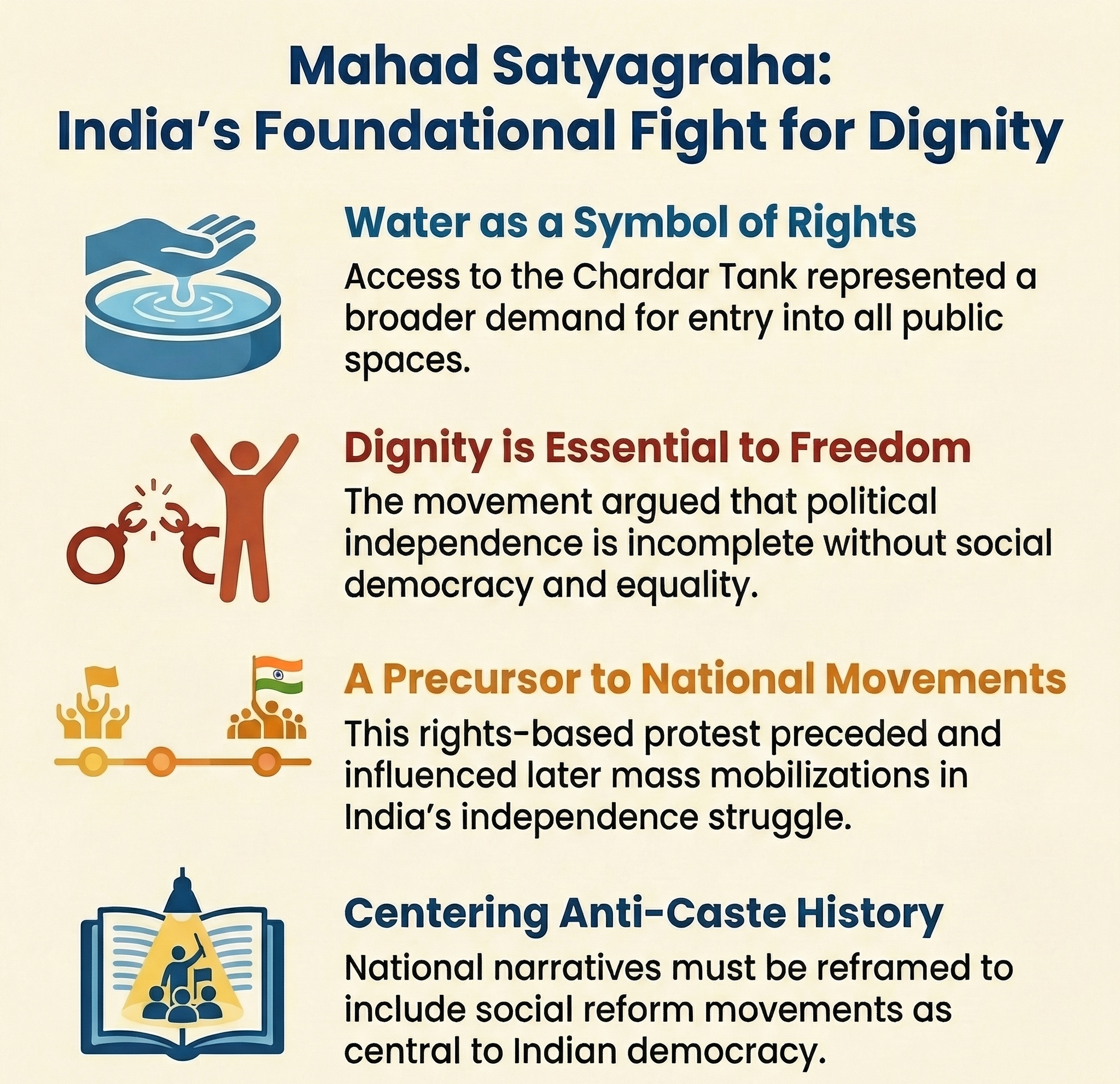
Assertion of the right to access public water symbolised a broader fight for equality.
Led by B.R. Ambedkar, the movement challenged entrenched caste hierarchies and untouchability.
B. Precursor to Larger National Movements
Mahad preceded and influenced later Gandhian mass mobilisations.
It demonstrated the power of organised, rights-based protest.
C. Centrality of Dignity over Mere Political Freedom
The movement foregrounded social democracy alongside political independence.
Ambedkar emphasised that freedom without equality is incomplete.
D. Symbolism of Water as a Rights Issue
Access to water represented access to public spaces and civic rights.
Denial of water highlighted systemic exclusion of Dalits.
E. Need for Historical Recognition
Mahad remains underrepresented in mainstream narratives.
The article calls for greater institutional and public acknowledgment.
2. Author’s Stance
Strongly pro-Ambedkarite and social justice-oriented
Reclaiming historical narrative
Positions Mahad as equally significant as mainstream nationalist movements.
Normative emphasis on equality and dignity
Advocates recognition of caste struggles as central to Indian democracy.
3. Biases and Limitations
Selective emphasis on Ambedkarite perspective
May underplay contributions of other parallel movements or leaders.
Limited counter-view
Does not engage with differing interpretations of nationalist priorities.
Emotional tone at places
Narrative leans towards moral persuasion rather than purely analytical discourse.
4. Strengths (Pros)
Restores neglected historical significance
Brings attention to a critical but under-discussed event.
Strong ethical and constitutional grounding
Links Mahad to values of dignity, equality, and justice.
Contemporary relevance
Connects historical exclusion with ongoing caste-based inequalities.
5. Weaknesses (Cons)
Lack of historiographical depth
Limited engagement with academic debates on Ambedkar vs Gandhi approaches.
Insufficient policy linkage
Does not deeply explore how Mahad informs current governance frameworks.
Over-symbolisation
Focus on symbolism may overshadow structural analysis.
6. Policy Implications
A. Strengthening Social Justice Frameworks
Effective implementation of anti-discrimination laws
SC/ST (Prevention of Atrocities) Act, equality provisions.
B. Inclusive Access to Public Resources
Ensuring universal access to water, sanitation, and public spaces
Addressing caste-based exclusion in practice.
C. Educational Reforms
Incorporating diverse historical narratives
Highlighting social reform movements in curricula.
D. Institutional Accountability
Monitoring discrimination in local governance
Panchayats, municipalities, and service delivery systems.
E. Social Awareness and Sensitisation
Promoting constitutional values
Campaigns against caste-based discrimination.
7. Real-World Impact
Social Equality
Empowerment of marginalised communities
Recognition of rights-based struggles strengthens social justice.
Governance
Improved inclusivity in public service delivery
Ensures equitable access to resources.
Cultural Consciousness
Reframing national history
Broader understanding of India’s freedom struggle.
Persistent Challenges
Continued caste-based discrimination
Indicates incomplete realisation of Mahad’s ideals.
8. UPSC GS Paper Linkages
GS Paper I (History & Society)
- Social reform movements
- Role of Ambedkar
- Caste and social justice
GS Paper II (Polity & Governance)
- Fundamental Rights (Equality, non-discrimination)
- Social justice policies
GS Paper IV (Ethics)
- Human dignity
- Justice and equality
- Moral leadership
Anthropology Optional (Paper II)
- Caste system
- Social change and reform movements
9. Balanced Conclusion
Mahad Satyagraha represents a foundational moment in India’s journey towards social democracy.
While the article rightly elevates its significance, a balanced perspective must integrate it within the broader spectrum of nationalist and social reform movements.
10. Future Perspective
From symbolic recognition to substantive equality
Focus on translating ideals into ground realities.
Inclusive historiography
Broadening narratives to include diverse voices.
Strengthening constitutional morality
Embedding equality and dignity in governance and society.
Bridging past and present
Using historical lessons to address contemporary caste inequalities.
Final Insight
Mahad was not just about water—it was about reclaiming humanity, dignity, and equal citizenship in India’s social order.
