

BRICS Carbon Markets Partnership: What It Needs

BRICS Carbon Markets Partnership: What It Needs
Source: IE
Syllabus: GS II: International groupings, India's foreign policy. GS III: Environment, climate change, economy
Why in news?
At the 18th BRICS Summit (New Delhi, 12 September 2026), members reaffirmed the BRICS Carbon Markets Partnership. National rules, accounting methods and verification standards differ, so markets remain disconnected. The editorial argues India should push for a common regulatory rulebook, not an immediate unified trading platform.
Why BRICS carbon markets matter?
- Eight BRICS members reportedly run voluntary carbon markets. Brazil, China, India and Indonesia hold over one-third of registered carbon credit projects worldwide.
- China: Its Emissions Trading System (ETS) now covers steel, cement and aluminium.
- India: The Carbon Credit Trading Scheme (CCTS) has notified emission-intensity targets for 490 entities in nine sectors, with an offset mechanism.
- Brazil: Set up its SBCE in 2024 on an absolute emissions cap.
- Despite this, markets stay disconnected, so common principles are needed for transparency and interoperability.
- Indonesia joined BRICS as a full member in January 2025.
Divergence across domestic markets
|
Feature |
China and India |
Brazil |
|
Design |
Output-based emissions-intensity benchmarks |
Absolute emissions cap |
|
Offset eligibility |
China: domestic certified credits. India: projects started after 1 January 2025 |
Accredited methodologies |
|
Legal status of units |
India: certificates traded on power exchanges under CERC rules |
Regulated by securities authorities |
The same emissions reduction can therefore be a different legal instrument in each country.
External pressure: carbon border measures
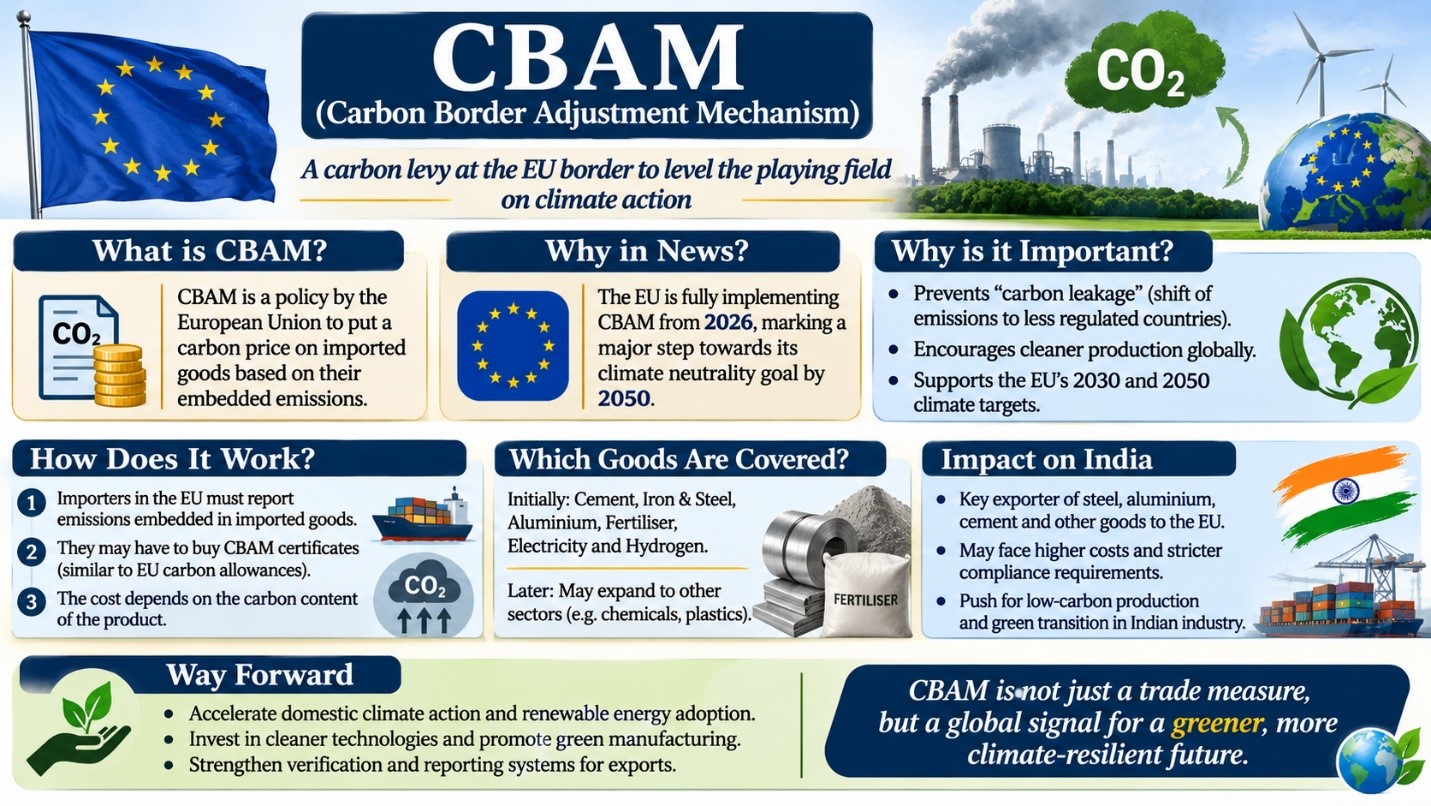
- The EU's Carbon Border Adjustment Mechanism (CBAM) entered its definitive phase in January 2026, and the UK follows in January 2027.
- They put carbon costs on imports of steel, aluminium, cement, fertilisers and hydrogen. Carbon prices paid by exporters are recognised only with verified evidence.
- The UK's recognition of India's CCTS in August 2026 shows why accredited verification matters.
- Exporters without reliable data risk punitive default values. A common BRICS framework would raise collective bargaining power and cut compliance costs.
- India has opposed CBAM as unilateral and inconsistent with the principle of common but differentiated responsibilities (CBDR).
|
|
Steps to link domestic carbon projects
|
1. A common rulebook
2. A pilot carbon credit exchange
|
Way forward: use existing institutions
- The New Development Bank (NDB) could host a shared registry data facility or a purchasing mechanism for pilot units.
- Part of the transfer proceeds could fund climate adaptation, giving countries with limited mitigation potential a reason to join.
- Obstacles: China's scale could make it the price-setter, sanctions may complicate settlement, and steel and aluminium export competition may discourage integration.
- Full integration of compliance markets is therefore neither realistic nor desirable now. Common MRV and limited pilots are a practical alternative that preserves autonomy.