

CARDIFF PACT

CARDIFF PACT
Why In News?
Leading nationalist parties from Scotland, Wales, and Northern Ireland signed a tripartite Memorandum of Understanding (MoU)—termed the Cardiff Pact.
What is the Cardiff Pact?
The Cardiff Pact is an inter-party cooperative accord signed in Cardiff (Wales) by pro-sovereignty leaders representing the three non-English constituent nations of the United Kingdom.
|
Aspect |
Details |
|
Signatories |
John Swinney (Scotland, SNP); Rhun ap Iorwerth (Wales, Plaid Cymru); Michelle O’Neill (Northern Ireland, Sinn Féin Vice President); also attended by Mary Lou McDonald, Sinn Féin President |
|
Nature of Pact |
Political memorandum of understanding, not a legally binding treaty; expresses shared intent for self-determination and referendums on independence or reunification |
|
Core Objectives |
1. Demand Westminster to “prepare, plan and facilitate constitutional change” |
|
EU Vision |
Scotland and Wales would seek EU membership as new states; Northern Ireland would rejoin the EU through unification with the Republic of Ireland |
|
Political Context |
All three devolved administrations are led by pro-independence parties, marking the first time since devolution that the UK’s outlying governments share a common separatist agenda |
|
Westminster Response |
PM Andy Burnham rejected claims of majority support for independence votes but acknowledged that “constitutional dialogue is inevitable” |
|
Public Impact |
Seen as the most coordinated challenge to the UK’s union structure since the Good Friday Agreement |
About United Kingdom (UK)
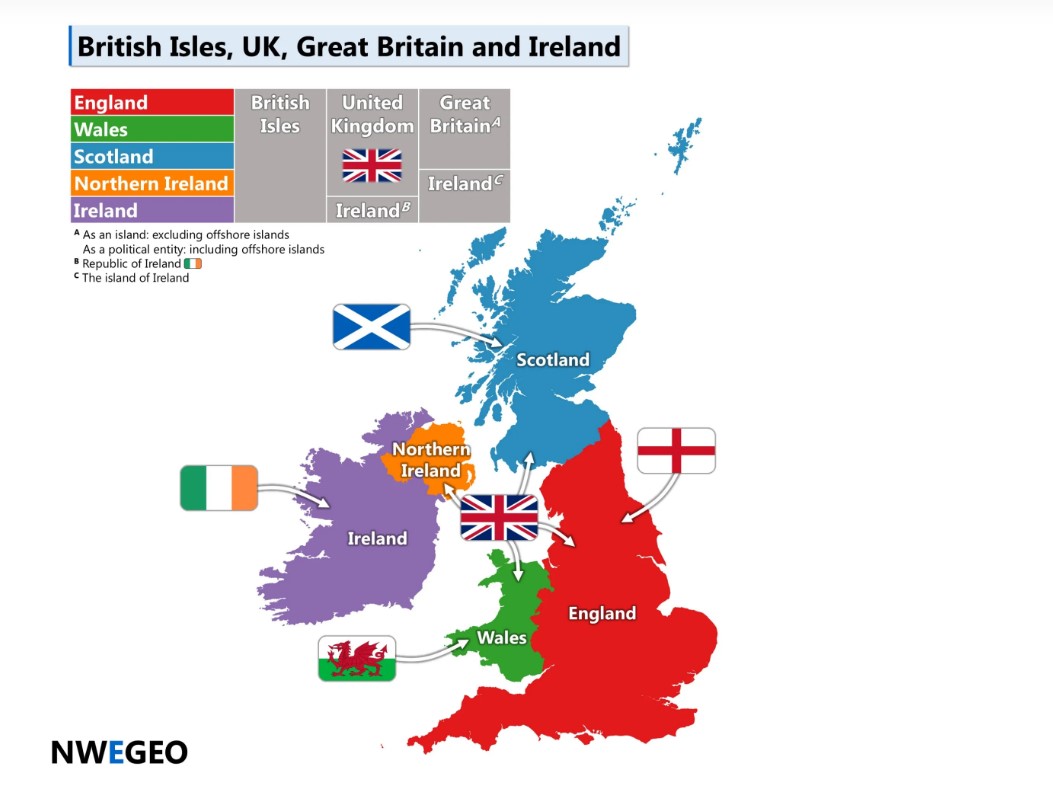
The United Kingdom (UK) is a sovereign island nation in north‑western Europe, comprising England, Scotland, Wales, and Northern Ireland
|
Phase |
Key Developments |
|
Formation (1535–1920) |
• Wales annexed by England in the 16th century. |
|
Devolution Era (Late 1990s) |
• Scotland Act 1998: Created Scottish Parliament with significant domestic powers. |
|
Current Friction (Post-Brexit) |
• Brexit: Scotland (62% Remain) and Northern Ireland (55.8% Remain) left the EU despite majority Remain votes. |
|
Catalyst for Cardiff MoU (2026) |
• Devolved nations increasingly demand self-determination and closer European integration. |
|
|
|
Lessons for India
· Constitutional Asymmetry as a Stabilizer: India’s use of Articles 371 to 371-J and the Fifth and Sixth Schedules demonstrates how tailored constitutional autonomy addresses diverse regional aspirations without fracturing national unity.
· Supremacy of a Written Constitution: India's written constitution and independent judiciary protect state powers under the Seventh Schedule, preventing arbitrary central revocation of powers unlike Westminster's uncodified model.
· Indestructible Union of Destructible Units (Article 1): The Indian model accommodates linguistic and regional identities via state reorganization (Article 3) while firmly preserving national territorial integrity.
· Institutionalized Intergovernmental Forums: Forums like the Inter-State Council (Article 263), the NITI Aayog Governing Council, and the GST Council show that regular consensus-building prevents sub-national alienation.
