

Caste Census: Why Accurate Enumeration Matters

Caste Census: Why Accurate Enumeration Matters
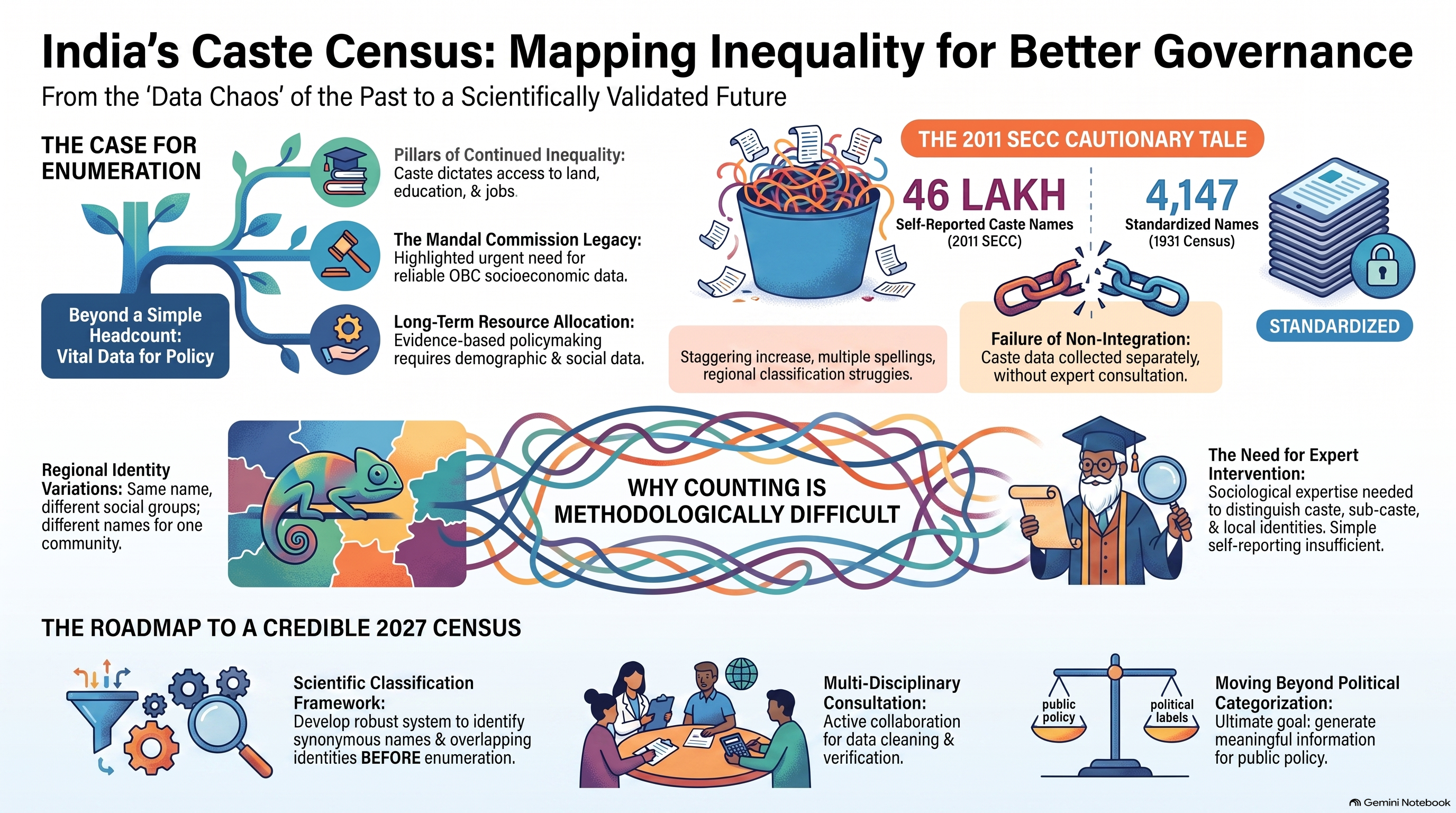
India is conducting its decennial Census after the exercise scheduled for 2021 was delayed. The Census is far more than a headcount; it provides demographic, social and economic information required for policymaking, resource allocation and long-term planning.
The renewed focus on caste enumeration has brought back questions about how caste should be identified, classified and used for public policy.
Why Census Data Matters for Governance?
The Census captures a wide range of characteristics, including:
- Age and population structure
- Gender
- Religion
- Language
- Occupation
- Social categories
Such information helps governments understand patterns of inequality and design policies accordingly.
Census categories can also influence how communities perceive themselves and how identities are politically articulated. Historical examples show that enumeration can sometimes strengthen or even reshape social identities.
The Historical Exclusion of Caste from the Census
Caste was enumerated during the colonial period, but regular caste enumeration was discontinued after 1931.
After Independence, the Census continued to enumerate Scheduled Castes because of their relevance to constitutional safeguards and reservation policies. Broader caste enumeration was avoided partly because policymakers viewed caste as a social institution that should gradually disappear from a modern democratic society.
However, caste persisted as an important structure of social and economic inequality.
Caste as a Continuing Source of Inequality
Caste has undergone substantial transformation since Independence, particularly due to education, urbanisation, economic change and democratic politics.
Yet it continues to influence:
- Access to land and economic resources
- Educational opportunities
- Occupational mobility
- Urban spatial inequalities
- Social networks and political mobilisation
- Access to opportunities and social status
The political mobilisation of Dalits and backward communities has further transformed the meaning of caste. Democratic politics has provided greater representation to historically disadvantaged groups, while also making caste a significant basis for political claims.
Mandal Politics and the Demand for Caste Data
The implementation of the Mandal Commission recommendations in 1990 brought the concerns of Other Backward Classes (OBCs) to the centre of national politics.
Limited availability of reliable caste data became an important issue in assessing the socioeconomic position of different communities.
The demand for a caste Census is therefore linked not merely to identity politics but also to questions concerning:
- Representation
- Reservation
- Distribution of resources
- Educational opportunities
- Socioeconomic mobility
- Evidence-based welfare policies
What Went Wrong with the 2011 Caste Exercise?
Ahead of the 2011 Census, the Union Government decided to collect caste information separately through the Socio-Economic and Caste Census (SECC).
However, caste enumeration was not integrated into the main Census exercise. Respondents were largely asked to report their caste without adequate prior standardisation and classification.
The exercise reportedly produced around 46 lakh caste names, compared with about 4,147 caste names recorded in the 1931 Census.
This enormous variation raised fundamental questions about:
- Multiple names and spellings for the same caste
- Regional differences in caste identities
- Sub-castes and local classifications
- The methodology used for verification
- National-level comparability of caste categories
The absence of adequate expert consultation and classification mechanisms weakened the usefulness of the exercise.
Why Caste Enumeration Is Methodologically Difficult?
Caste is not a uniform national category. Its social meaning and classification vary considerably across regions.
A single community may have different names in different States, while the same name may refer to different communities in different regions.
Therefore, simply asking respondents to state their caste may produce a very large number of self-reported identities without generating reliable policy categories.
A meaningful caste Census requires:
- Standardised classification
- Regional sociological expertise
- Clear treatment of caste and sub-caste identities
- Verification and data-cleaning mechanisms
- Consultation with experts and communities
- Comparability across States and regions
India already has experience in enumerating Scheduled Castes and Scheduled Tribes, which could provide methodological lessons for broader social classification.
Concerns About the 2027 Census
The proposed 2027 Census includes a caste-related question for people who do not fall within the Scheduled Caste or Scheduled Tribe categories.
However, the absence of an explicit OBC category in the schedule has raised concerns about whether the exercise will generate sufficiently meaningful data on backward communities.
Simply collecting self-reported caste names without a robust classification framework could reproduce the weaknesses associated with the 2011 SECC.
What Should Be Done?
A credible caste enumeration should move beyond merely collecting caste names.
The government should:
- Develop a scientifically designed classification framework.
- Consult sociologists, anthropologists and statisticians before enumeration.
- Account for regional variations in caste structures.
- Create mechanisms for identifying synonymous and overlapping caste names.
- Distinguish caste, sub-caste and community identities appropriately.
- Ensure reliable data verification and cleaning.
- Use the resulting data for evidence-based policy rather than political categorisation alone.
Conclusion
Caste remains an important axis of social and economic inequality despite major changes in Indian society since Independence.
A caste Census can provide valuable evidence for understanding representation, inequality and access to opportunities. However, poor methodology can produce large volumes of data without generating meaningful information.
The key challenge is therefore not simply to count caste identities but to create a scientifically credible classification system that reflects India’s regional diversity and produces reliable data for public policy.
