

Centre’s focus shifts from selling PSUs to earning more from them
The Hindu
Core Theme of the Article
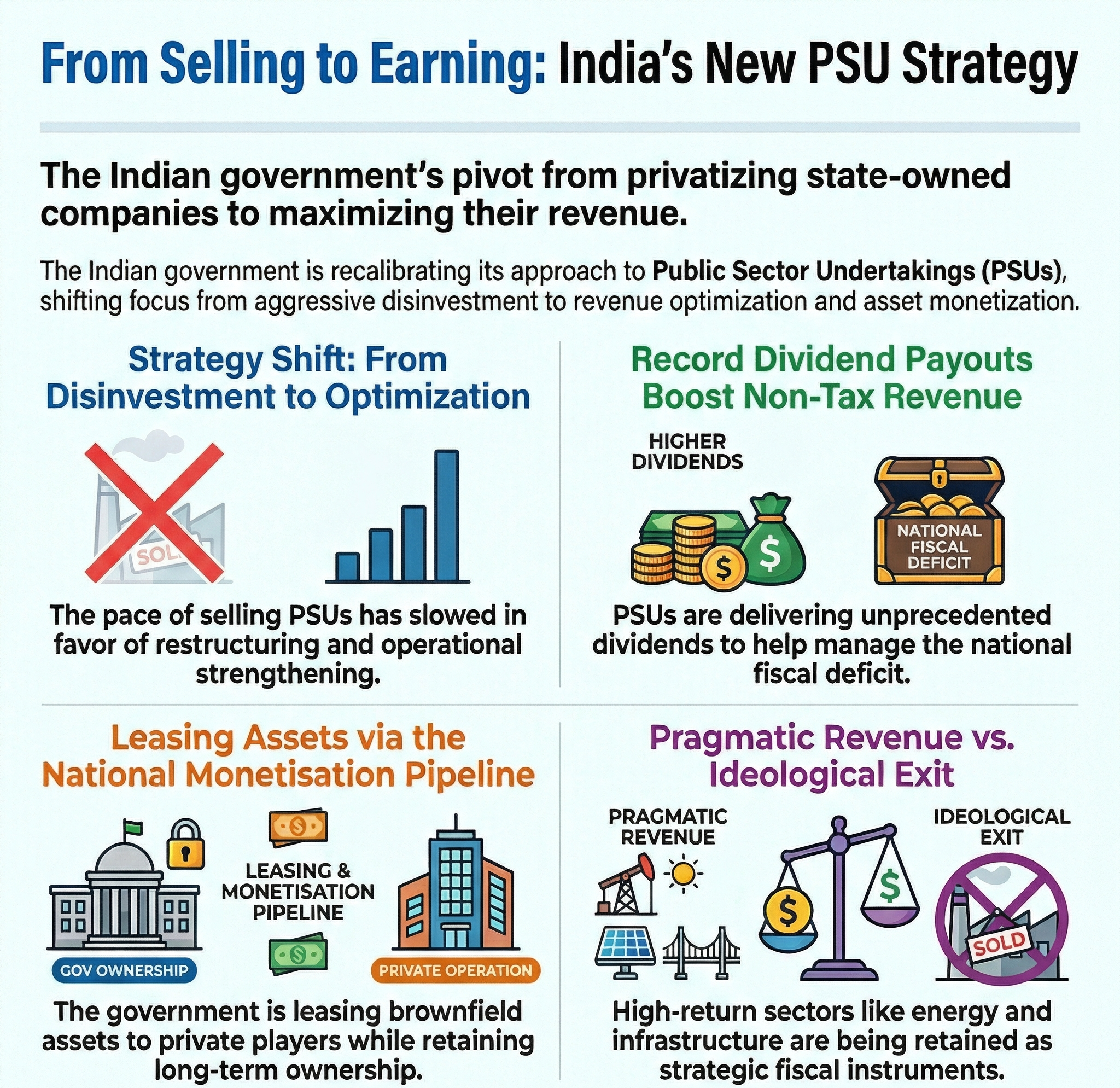
The article analyses a strategic shift in the Union government’s approach toward Public Sector Undertakings (PSUs). Instead of aggressive disinvestment and outright privatisation, the focus has moved toward asset monetisation, dividend extraction, operational restructuring, and improved profitability.
The central argument: the government is recalibrating from ownership exit to revenue optimisation and value unlocking.
Key Arguments Presented
1. Decline in Aggressive Disinvestment
The pace of strategic sales has slowed compared to earlier targets, partly due to market conditions and valuation concerns.
2. Emphasis on Dividend Income
PSUs have delivered record dividend payouts, contributing significantly to non-tax revenue.
3. Asset Monetisation Strategy
Through mechanisms such as the National Monetisation Pipeline (NMP), the government aims to lease brownfield assets rather than sell equity stakes.
4. Operational Strengthening
Improved profitability of select PSUs, particularly in energy and infrastructure sectors, has enhanced fiscal support.
5. Fiscal Consolidation Motive
Higher dividends and monetisation receipts help manage fiscal deficit without politically sensitive privatisation.
Author’s Stance
The tone is analytical and cautiously supportive.
• Recognises strategic recalibration
• Suggests realism in fiscal planning
• Avoids ideological framing of privatisation
The article treats the shift as pragmatic rather than ideological reversal.
Possible Biases and Framing
Fiscal Pragmatism Bias
Frames dividend extraction positively without fully examining long-term capital expenditure implications for PSUs.
Understated Structural Reform Debate
Does not deeply engage with efficiency arguments for full privatisation.
Revenue-Centric Framing
Emphasises short-term fiscal gains over long-term productivity reforms.
Strengths of the Article
• Connects PSU policy with fiscal consolidation
• Highlights asset monetisation as alternative to privatisation
• Provides data-driven context
• Recognises changing macroeconomic conditions
Limitations
• Limited analysis of governance reform within PSUs
• Insufficient discussion on crowding-out effects
• Does not assess impact on capital investment by PSUs
• Minimal evaluation of long-term competitiveness
Policy Implications
1. Redefining Role of PSUs
Shift from ownership dilution to performance-driven governance.
2. Asset Monetisation vs Privatisation
Leasing infrastructure assets while retaining ownership could balance revenue needs and strategic control.
3. Fiscal Stability
Dividend flows improve non-tax revenue and reduce borrowing pressure.
4. Governance Reform
Need for professional management and board autonomy to sustain profitability.
Real-World Impact
Short Term
• Boost in government revenues
• Reduced fiscal pressure
• Political acceptability
Medium Term
• Increased pressure on PSUs to maintain profitability
• Possible underinvestment if dividend payouts are excessive
Long Term
• Strategic sectors may remain state-controlled
• Sustainability depends on operational efficiency improvements
UPSC GS Alignment
GS Paper III – Economy
• Disinvestment policy
• Asset monetisation
• Fiscal deficit management
• Public sector reforms
GS Paper II
• Public administration reforms
• Governance of state-owned enterprises
Essay Relevance
• “Privatisation vs public ownership”
• “State as regulator or entrepreneur?”
Balanced Editorial Assessment
The shift reflects fiscal pragmatism in a volatile global environment. Retaining ownership while extracting higher returns may be politically and strategically convenient.
However, dividend-heavy strategies risk weakening PSUs’ reinvestment capacity. Sustainable reform requires improving efficiency, innovation, and accountability—not merely revenue extraction.
Future Perspective
India’s PSU policy may evolve toward:
• Strategic retention in critical sectors
• Selective privatisation
• Performance-linked governance reforms
• Greater transparency in asset monetisation
The long-term test will be whether PSUs become globally competitive entities or remain fiscal instruments.
Final Editorial Judgment:
The recalibration from selling PSUs to earning from them reflects tactical fiscal realism. Yet, without deeper structural reform, revenue optimisation alone cannot substitute long-term productivity transformation.
