

Chamoli, Wayanad disasters were avoidable: NDMA report
Hindustan Times
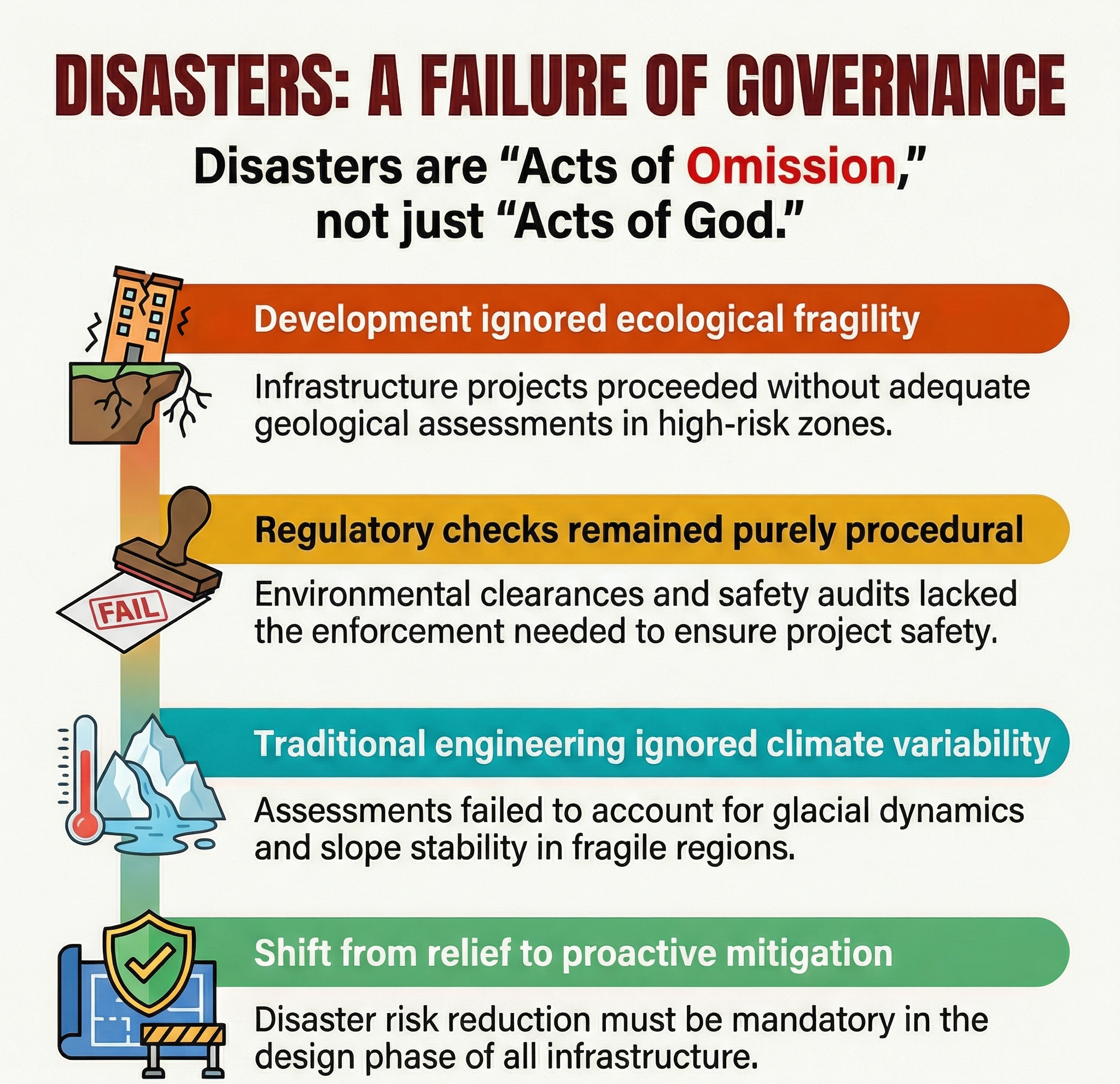
Core Premise of the Article
The article reports findings of the National Disaster Management Authority (NDMA) suggesting that recent disasters — including the Chamoli avalanche (2021), Wayanad landslide (2024), Silkyara tunnel collapse (2023), and Draupadi Ka Danda Avalanche (2022) — were not purely “natural” but significantly shaped by governance failures, risk mismanagement, regulatory gaps, and ecological neglect.
The central assertion: many of these disasters were preventable with better planning, regulation, and environmental assessment.
Key Arguments Presented
1. Disasters are “compound” and anthropogenic
The report challenges the simplistic natural disaster narrative. It emphasizes that infrastructure expansion, ecological fragility, and administrative oversight failures amplified risks.
2. Development projects ignored environmental vulnerability
Especially in Himalayan and Western Ghats regions, projects proceeded without adequate geological assessment, environmental safeguards, and disaster preparedness.
3. Risk assessment mechanisms were inadequate
Traditional engineering approaches did not integrate climate variability, glacial dynamics, or fragile slope stability considerations.
4. Regulatory institutions lacked enforcement strength
Environmental clearances and safety audits were often procedural rather than substantive.
5. Lessons for future planning
The report urges:
- Stronger environmental impact assessments
- Integration of disaster risk reduction in infrastructure planning
- Inter-agency coordination
- Improved early warning systems
Author’s Stance
The tone is institutionally corrective but not sensationalist.
The article:
- Supports NDMA’s critical evaluation
- Signals governance accountability
- Encourages reform without overt political targeting
It reflects a reform-oriented, governance-improvement perspective rather than blame politics.
Implied Biases and Framing
Development-risk framing bias
The article leans toward portraying infrastructure expansion as structurally problematic in fragile zones.
Institutional trust bias
The NDMA findings are presented as authoritative; limited counter-views from project authorities are visible.
Environmentalist tilt
The narrative strongly favours ecological caution, potentially underplaying economic compulsions of connectivity and growth.
However, these are normative, not ideological biases.
Strengths of the Article
• Recognises climate change as a multiplier of disaster risk
• Connects governance lapses to human casualties
• Moves debate from “acts of God” to “acts of omission”
• Emphasises systemic reform rather than episodic blame
Weaknesses / Gaps
• Limited quantification of regulatory failure
• Does not deeply assess trade-offs between development and safety
• Minimal discussion of federal-state responsibility distribution
• Underexplores financial constraints of compliance
Policy Implications
1. Environmental Governance Reform
Strengthening Environmental Impact Assessment (EIA) frameworks and ensuring scientific integrity.
2. Climate-Resilient Infrastructure
Mandatory integration of disaster risk reduction in project design.
3. Federal Coordination
Improved Centre–State collaboration in monitoring fragile ecological zones.
4. Institutional Accountability
Clear liability frameworks for regulatory lapses.
5. Early Warning & Community Preparedness
Shift from reactive relief to proactive risk mitigation.
Real-World Impact
Short Term
• Heightened scrutiny of infrastructure in ecologically sensitive areas
• Temporary slowdown of approvals in high-risk zones
Medium Term
• More stringent compliance norms
• Increased project costs due to safety requirements
Long Term
• Potential reduction in disaster-linked casualties
• Institutional strengthening of risk governance
UPSC GS Alignment
GS Paper I
• Physical geography of Himalayas and Western Ghats
• Disaster-prone regions of India
• Human-environment interaction
GS Paper II
• Role of NDMA
• Governance and regulatory mechanisms
• Centre-State relations in disaster management
GS Paper III
• Disaster management
• Environmental impact assessment
• Climate change adaptation
• Infrastructure development vs sustainability
Essay Relevance
• “Development without sustainability is self-defeating”
• “Disasters are failures of development planning”
Balanced Editorial Evaluation
The article appropriately reframes disasters as governance challenges rather than fatalistic inevitabilities. It underscores a shift from reactive relief culture to preventive risk governance.
However, reforms require balancing ecological caution with developmental imperatives — especially in border regions where infrastructure also serves strategic and socio-economic functions.
Future Perspective
India must move toward:
• Integrated ecological zoning before project approval
• Climate-proof engineering norms
• Real-time monitoring of fragile regions
• Transparent audit of disaster accountability
The long-term question is not whether disasters can be eliminated — but whether avoidable vulnerability can be systematically reduced.
Final Editorial Judgment:
The article correctly situates disaster management within governance reform. Its central insight is crucial — development policy and disaster policy are inseparable.
