

Citizenship Verification, Electoral Rolls and Documentary Identity
Citizenship Verification, Electoral Rolls and Documentary Identity
Source: The Tribune (11-07-2026)
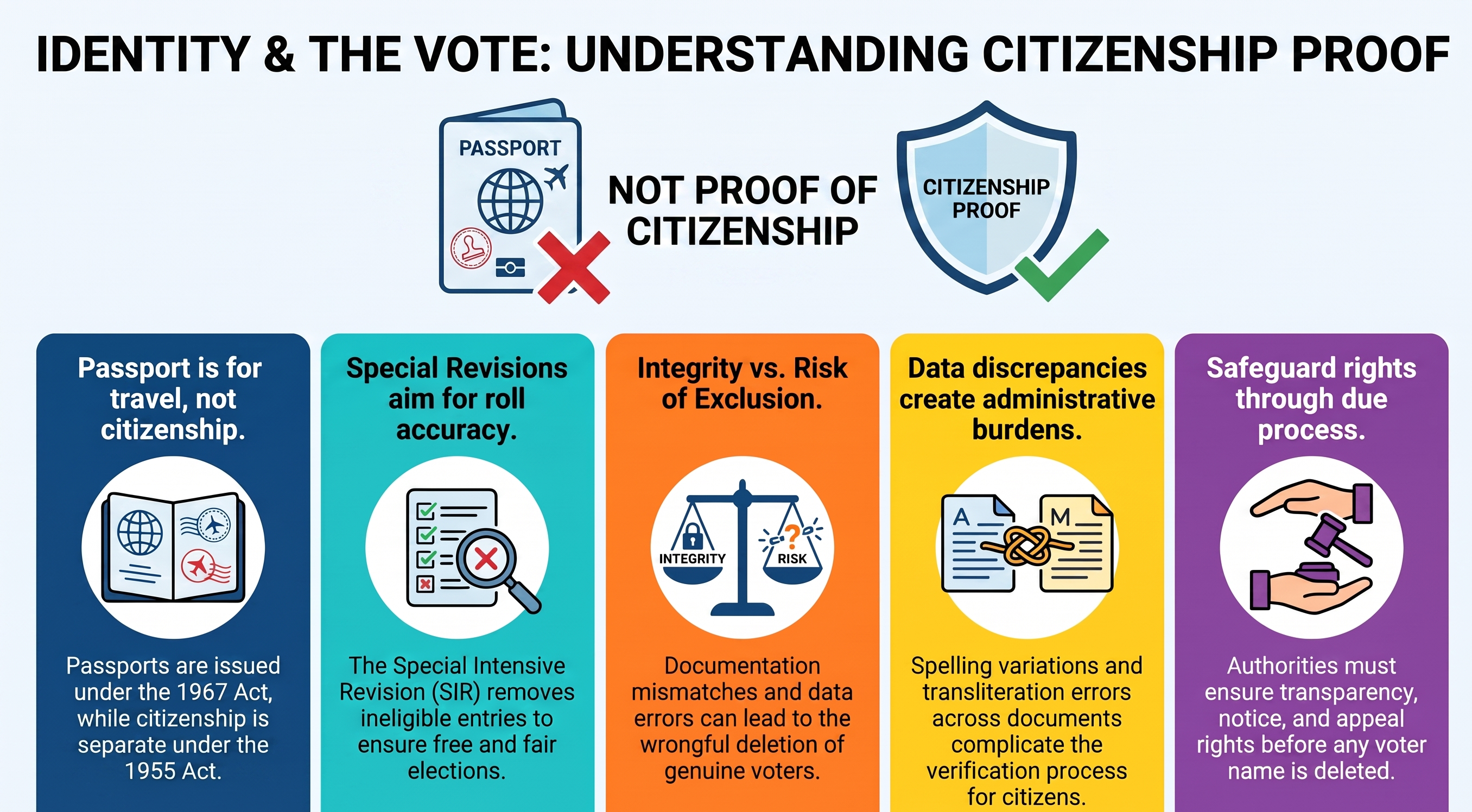
Why in News?
A public debate has emerged following the Ministry of External Affairs' clarification that an Indian passport is a travel document and not, by itself, proof of citizenship, alongside concerns over the Special Intensive Revision (SIR) of electoral rolls and its possible implications for citizens.
Background
- On Passport Seva Divas (24 June), the Ministry of External Affairs clarified that:
- A passport is issued under the Passports Act, 1967.
- Citizenship is governed separately under the Citizenship Act, 1955.
- Therefore, a passport facilitates international travel but is not the legal proof of citizenship.
- The clarification has triggered wider discussions on documentary identity and citizenship verification.
Why the Issue Matters
- For many Indians, particularly in migration-intensive States such as Punjab, a passport is widely regarded as the most authoritative government-issued identity document.
- Concerns have grown that ambiguity regarding proof of citizenship may create uncertainty during administrative verification processes.
Special Intensive Revision (SIR) of Electoral Rolls
Purpose
- To improve the accuracy of electoral rolls by removing ineligible entries and updating voter records.
Concerns
- Deletion of names due to documentation mismatches or data inconsistencies.
- Errors arising from spelling variations, transliteration and administrative discrepancies.
- Burden on genuine citizens to establish identity or eligibility.
- Possible implications where electoral records are relied upon during verification for other government services.
Constitutional and Legal Framework
Constitutional Provisions
- Article 14 – Equality before law and equal protection of laws.
- Article 21 – Protection of life and personal liberty.
- Articles 5–11 – Citizenship provisions.
- Article 326 – Adult suffrage.
Relevant Laws
- Citizenship Act, 1955
- Passports Act, 1967
- Representation of the People Act, 1950
- Representation of the People Act, 1951
Key Issues
- Balancing electoral integrity with protection of genuine voters.
- Administrative and documentation errors affecting eligible citizens.
- Burden of proving citizenship during verification exercises.
- Need for transparency and procedural safeguards.
- Maintaining public confidence in government-issued identity documents.
Significance
- Accurate electoral rolls are fundamental to free and fair elections.
- Citizenship documentation influences access to constitutional and legal rights.
- Reliable government databases strengthen governance and service delivery.
- Transparent verification mechanisms enhance trust in public institutions.
Challenges
- Data-entry and transliteration errors.
- Multiple spellings of names across official documents.
- Variations in documentary evidence.
- Administrative capacity constraints during large-scale verification exercises.
- Preventing wrongful exclusion while identifying ineligible entries.
Way Forward
- Strengthen transparency in electoral roll revision.
- Ensure adequate notice, hearing and appeal before deletion of names.
- Improve interoperability and accuracy of government databases.
- Use technology-assisted verification with safeguards against exclusion.
- Balance electoral integrity with protection of constitutional rights through due process.
Conclusion
The debate highlights the need for citizenship verification and electoral roll revision processes that are accurate, transparent and legally robust. Electoral integrity and the protection of genuine citizens' rights must be pursued together through fair procedures, reliable docum entation and institutional accountability.
Final Takeaway
A strong democracy depends on both accurate electoral rolls and effective procedural safeguards. Transparent verification systems, robust documentation and due process are essential to protect citizens' rights while ensuring the integrity of the electoral process.
