

Cleaner Water: India's Groundwater Contamination Crisis

Cleaner Water: India's Groundwater Contamination Crisis
Relevance: GS Paper III (Environment, Water Resources, Public Health) | GS Paper II (Health, Governance)
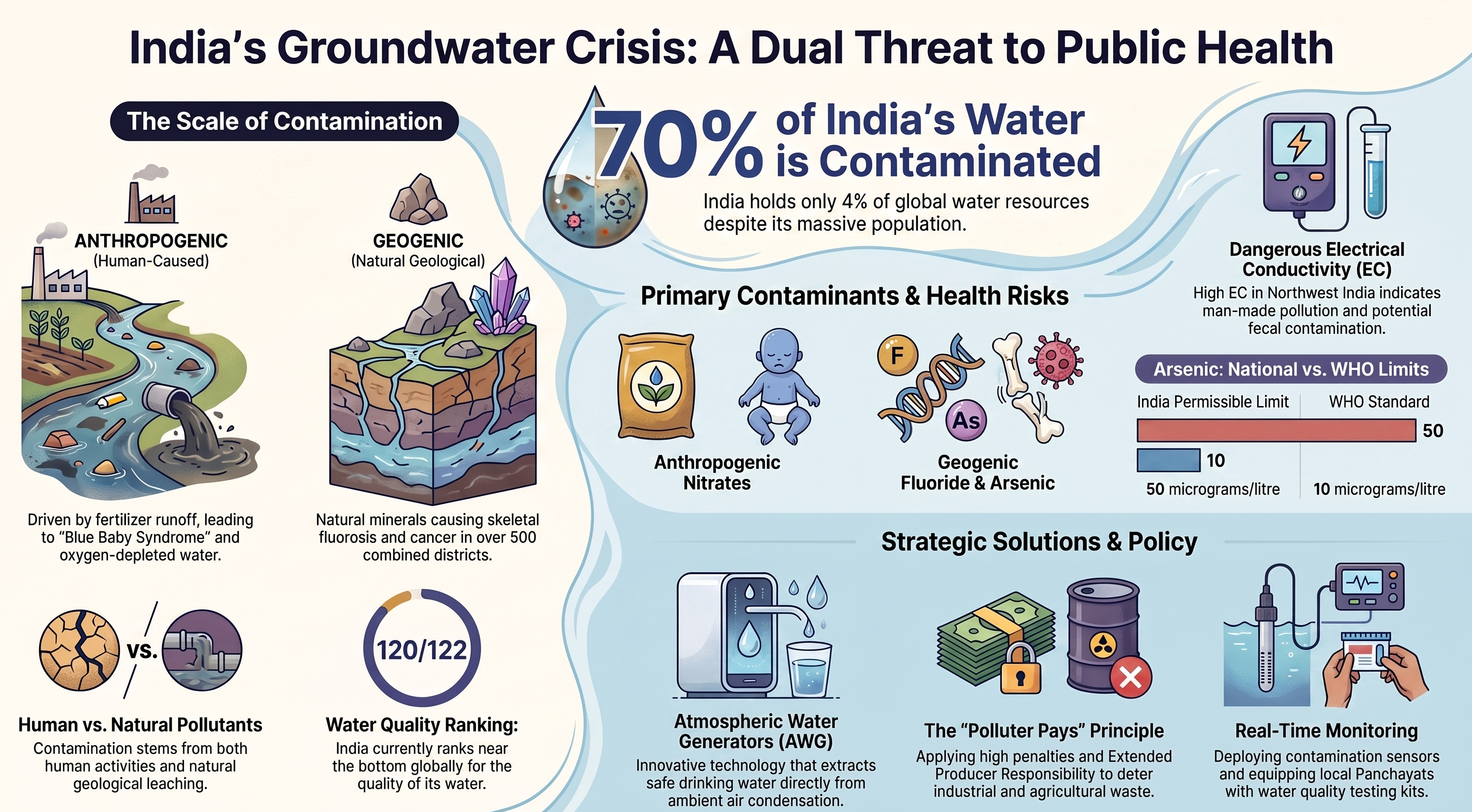
The Scale of the Problem
- India has just 4% of the world's water resources, and its water quality ranks 120 out of 122 countries.
- About 70% of water in India is contaminated.
- Groundwater usage: about 64% in irrigation (likely intended as ~64%, figure noted as unclear in source), about 85% in rural water supply, and about 50% in urban water consumption.
- Groundwater is replenished annually, but its availability is uneven across locations and states.
- India's total utilisable water is estimated at 1,123 billion cubic metres (bcm) — comprising 690 bcm surface water and 433 bcm groundwater.
Global and Policy Context
- UN Sustainable Development Goal 6 mandates universal and equitable access to safe, affordable drinking water for all by 2030.
- Per the Falkenmark Water Stress Indicator, India is among 31 countries facing water stress, projected to worsen by 2050.
Why Water Quality Is Deteriorating?
- Deteriorating surface and groundwater quality impairs the life of living beings, the economy, livelihoods, and ecosystem health.
- Key drivers: over-extraction of groundwater, poor sanitation practices, industrial effluent disposal, changing land use, and poor waste disposal.
- Nitrates and pesticides entering aquifers, lakes, and rivers also affect marine food chains.
- Coastal soil salinisation is rising due to saline water ingress into coastal aquifers from over-pumping.
- Poor medical waste disposal and indiscriminate antibiotic use create harmful micro-environments in aquifers, sewage, and surface water bodies.
- Over 350 districts in India have fluoride-affected pockets, and 150 districts have high arsenic-affected areas.
Two Types of Groundwater Contaminants
- Anthropogenic (human-caused): from agricultural practices (e.g., nitrogen compounds), industrial waste (e.g., lead, chromium), urbanisation (pathogens/toxins), and over-extraction (causing saltwater intrusion).
- Geogenic (natural): arising from geological formations naturally dissolving contaminants like arsenic, fluoride, uranium, and iron into groundwater.
Major Contaminants and Their Impacts
Nitrate (Anthropogenic)
- Nitrate (NO₃⁻) enters the environment mainly due to human activities and is known as anthropogenic nitrate.
- The major source is the excessive use of nitrogen-based chemical fertilizers in agriculture.
- Other important sources include livestock manure, domestic sewage, septic tanks, and industrial effluents.
- Nitrogen oxides (NOₓ) released from vehicles and industries also form nitrate through atmospheric deposition.
- It contaminates groundwater and surface water, reducing water quality.
- High nitrate levels cause eutrophication, leading to algal blooms and depletion of dissolved oxygen in water bodies.
- Excess nitrate poses health risks, including methemoglobinemia ("blue baby syndrome"), and harms aquatic ecosystems.
Fluoride (Predominantly Geogenic)
o Fluoride (F⁻) occurs predominantly from natural (geogenic) sources through the weathering and dissolution of fluoride-bearing minerals in rocks.
o Common fluoride-containing minerals include fluorite, apatite, and mica.
o Groundwater flowing through fluoride-rich geological formations dissolves these minerals, increasing fluoride concentration.
o High fluoride levels are commonly found in arid and semi-arid regions where groundwater remains in contact with rocks for long periods.
o Excess fluoride in drinking water can cause dental fluorosis and skeletal fluorosis.
o Small amounts of fluoride (about 0.7–1.0 mg/L) are beneficial for preventing dental caries, but concentrations above the recommended limit are harmful.
o Control measures include using alternative safe water sources, blending water, rainwater harvesting, and defluoridation techniques.
Electrical Conductivity (EC) — Indicator of Geogenic/Anthropogenic Contamination
- EC is acute in arid/semi-arid Northwest India — Rajasthan, Delhi, Haryana, Gujarat.
- EC directly correlates with dissolved inorganic ions, salts, and heavy metals (pure water has zero conductivity).
- Spikes in EC typically indicate man-made pollution — agricultural runoff (nitrate/phosphate) or industrial discharge.
- In Gujarat, rising EC often signals saltwater intrusion into fresh coastal aquifers.
- High EC can also indicate faecal contamination from pit latrines or urban waste, potentially causing gastrointestinal illnesses including cholera.
Arsenic (Geogenic)
- A major concern, especially in the Ganga and Brahmaputra river basins.
- Affected states: West Bengal (first detected in 1983), Bihar, and Uttar Pradesh.
- Health impacts: cancer of the liver, kidney, etc., and endocrine disruption.
- India's permissible limit is under 50 micrograms/litre — notably higher (less strict) than the WHO standard of 10 micrograms/litre.
Other Geogenic Contaminants
- Uranium, manganese, and copper are also significant geogenic concerns requiring targeted treatment.
Remediation Strategies by Contaminant
- Fluoride: source selection, blending high/low fluoride water sources, community-based treatment plants, public awareness.
- Nitrate: efficient freshwater management, soil testing, appropriate fertiliser timing, greater use of organic fertilisers.
- Arsenic: short-term — household/community treatment units, prohibition of contaminated wells, alternate use of surface/groundwater; long-term — developing alternate safe aquifers, rainwater harvesting, and deep well construction using scaling techniques.
- Uranium: multiple technologies available — absorption, coagulation, extraction, reverse osmosis (RO), evaporation — chosen based on cost, efficiency, and local conditions.
- Iron/Manganese: filtration, dedicated removal plants, chemical oxidation.
- Lead: strict regulation of industrial effluents and lab testing in public buildings.
Institutional and Policy Measures
Current Steps
- The Central Ground Water Board (CGWB) issues fortnightly groundwater quality alerts to states — a welcome step toward a real-time early warning system, supporting regular sampling, advisories, and mitigation measures.
Recommended Reforms
- Place this contamination information framework in the public domain, including health impact analyses for affected stakeholders, policymakers, communities, Gram Panchayats, and Nagar Palikas.
- Establish dedicated water quality divisions at both Union and State government levels, staffed by relevant professionals.
- Deploy real-time contamination detection sensors.
- Make water quality a core component of capacity-building programmes on water resources.
- Equip Panchayati Raj Institutions with water quality testing kits and monitoring/surveillance responsibilities.
- Follow the National Environment Policy 2006 approach: environmental remediation, voluntary compliance, and civil/criminal penalties.
- Apply the "Polluter Pays Principle" with sufficiently high penalties to deter violations, as part of Extended Producer Responsibility (EPR); repeated violations should invite strong corrective measures.
An Innovative Technology Solution: Atmospheric Water Generators (AWG)
- In areas where groundwater is contaminated and piped water supply is absent, AWG technology offers a potential solution — extracting potable water from ambient air through condensation.
- Greater public awareness of AWG adoption is recommended.
