

Climate Equity: India’s Position Ahead of COP31

Source:The Hindu
Unequal Carbon Responsibility
- At an international conference on “The Future of Environment and Climate Dynamics”, the Indian PM highlighted disparities in global carbon responsibility.
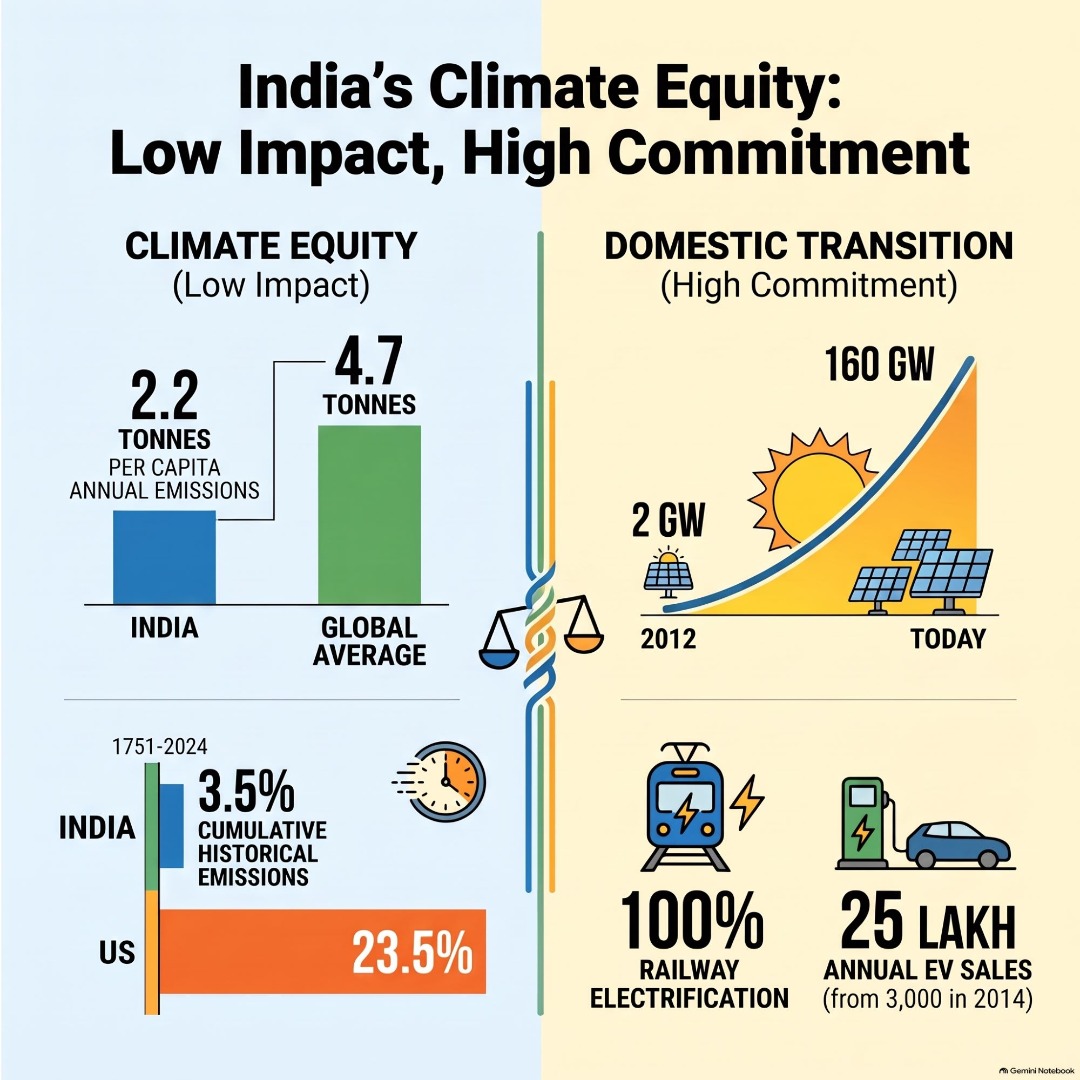
- India’s per capita carbon emissions: about 2.2 tonnes annually, against the global average of 4.7 tonnes.
- Per capita emissions are significantly higher in developed economies:
- US: 14.2 tonnes
- Russia: 14 tonnes
- Cumulative carbon emissions, 1751–2024:
- US: 23.5%
- China: 15.4%
- Russia: 6.6%
- Germany: 5.1%
- UK: 4.3%
- India: 3.5%
- India argues that historical emissions from industrialised countries must be considered while allocating present and future climate responsibilities.
- This approach is rooted in the principle of Common but Differentiated Responsibilities and Respective Capabilities (CBDR-RC).
India’s Climate Action
- India maintains that climate equity does not imply avoidance of climate responsibility and points to its implementation of Paris Agreement commitments.
- Major initiatives and outcomes:
- Solar capacity increased from around 2 GW in 2012 to about 160 GW.
- PM-KUSUM has provided solar pumps to around 30 lakh farmers.
- One Nation One Grid has helped avoid an estimated 200 million tonnes of carbon emissions.
- Expansion of wind and hydropower and decentralised/rooftop solar.
- Annual EV sales rose from around 3,000 in 2014 to about 25 lakh in the previous year.
- Metro rail expanded from less than 250 km in five cities to over 1,000 km across 20 cities.
- 100% railway electrification has been achieved.
- Inland waterways and around 3,000 km of Dedicated Freight Corridors support lower fuel consumption.
- India has also promoted global cooperation through the International Solar Alliance, Global Biofuel Alliance and International Big Cat Alliance.
Development and Environmental Protection
- The conference highlighted the need to move beyond the binary of “development versus environment” towards sustainable development.
- The judicial approach to environmental protection is increasingly concerned with harmonising development and conservation.
- Climate-related rights are gaining importance alongside conventional environmental rights, reflecting the link between a healthy environment and human well-being.
- India’s conservation agenda includes protection of tigers, elephants, lions, the Great Indian Bustard and vultures.
- The underlying policy challenge is to pursue economic growth while reducing emissions, protecting ecosystems and ensuring livelihood security.
India’s Climate Diplomacy and COP31 Priorities
- Ahead of COP31 in Antalya, Türkiye, India is expected to emphasise:
- Climate equity and climate justice.
- Recognition of historical responsibility.
- Implementation of existing climate commitments.
- Greater support for vulnerable developing countries.
- Alignment of climate action with developmental needs.
- Loss and Damage Fund (LDF): Increasingly important for vulnerable countries facing climate-induced disasters, particularly where adaptation capacity is limited.
- India’s position seeks to balance three dimensions:
- Historical emissions and present-day per capita disparities.
- Developmental aspirations of poorer countries.
- Collective responsibility for accelerating global climate action.
Significance for Global Climate Governance
- Climate equity raises the question of how mitigation burdens, finance and technological responsibilities should be distributed among countries.
- India’s argument combines historical responsibility + per capita equity + differentiated capabilities + developmental needs.
- At the same time, India's expansion of renewable energy, electric mobility, railway electrification and conservation demonstrates its emphasis on combining development with environmental sustainability.
- The broader challenge for COP31 is to ensure that climate ambition is accompanied by finance, technology transfer, capacity-building and equitable implementation, particularly for developing and climate-vulnerable countries.
