

Defining modern economics
The Statesman
1. Key Arguments
A. Limitations of Classical Economics
Traditional models focus excessively on markets and efficiency.
They often ignore distributional justice, environmental costs, and social outcomes.
B. Need for Interdisciplinary Approach
Economics must integrate insights from sociology, politics, and ecology.
Complex global challenges require holistic frameworks.
C. Centrality of Inequality
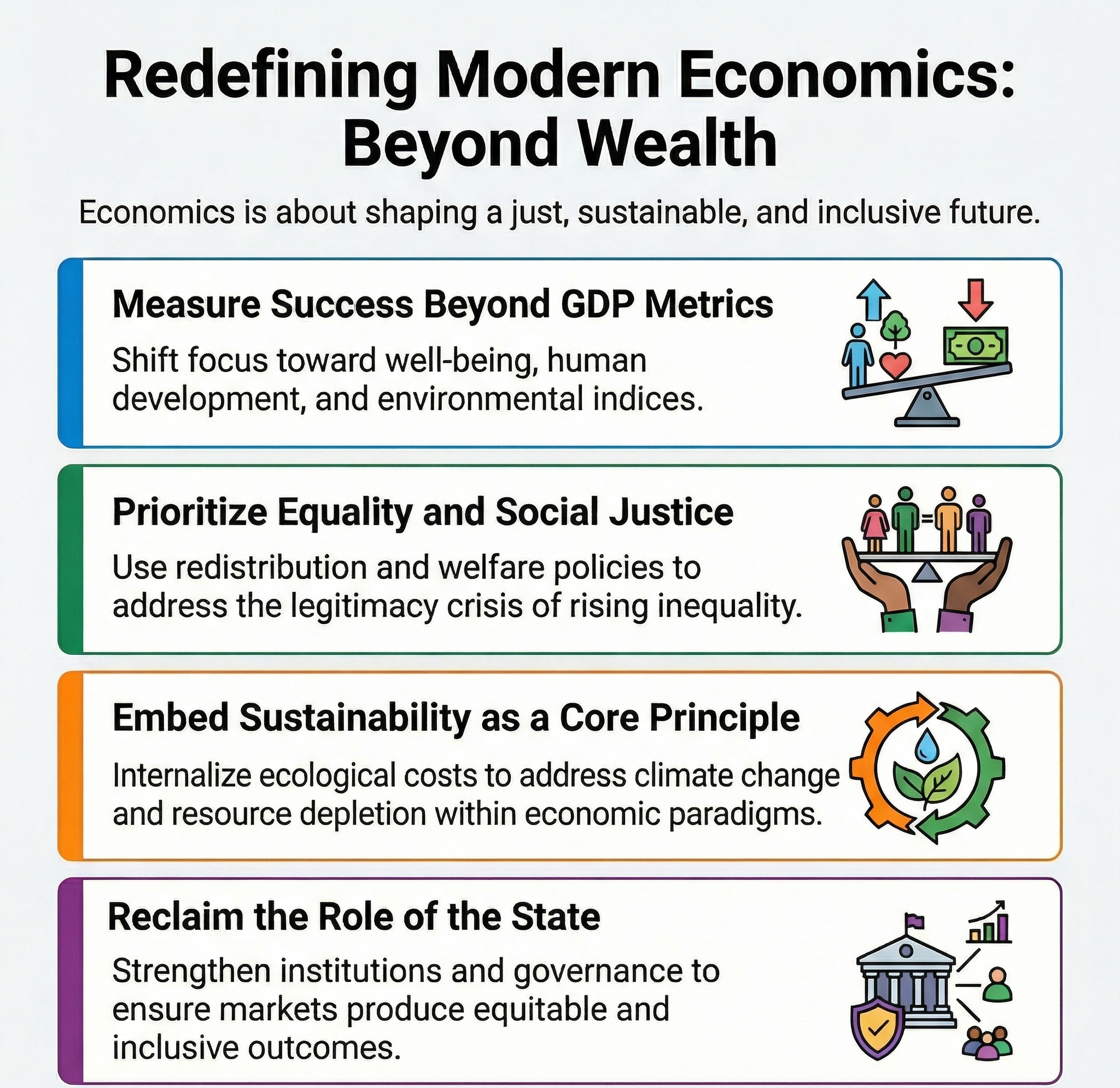
Rising inequality challenges the legitimacy of growth models.
Economic success must be evaluated beyond GDP metrics.
D. Role of the State and Institutions
Markets alone cannot ensure equitable outcomes.
Strong institutions and governance are essential for inclusive growth.
E. Sustainability as a Core Principle
Environmental constraints must be embedded in economic thinking.
Climate change and resource depletion demand new economic paradigms.
F. Evolving Nature of Global Economy
Technological change and globalisation require adaptive frameworks.
Digital economy, AI, and financialisation reshape economic realities.
2. Author’s Stance
Reformist and critical
Challenges orthodox economic thinking
Advocates a broader, more inclusive definition of economics.
Supports state intervention and ethical considerations
Emphasises balance between markets and governance.
3. Biases and Limitations
Critical bias against classical models
May understate their continued relevance.
Normative orientation
Focuses more on what economics should be rather than empirical validation.
Limited policy specificity
Broad recommendations without detailed frameworks.
4. Strengths (Pros)
Holistic perspective
Addresses economic, social, and environmental dimensions.
Relevance to contemporary challenges
Aligns with global debates on inclusive and sustainable growth.
Intellectual depth
Engages with theoretical evolution of economics.
5. Weaknesses (Cons)
Abstract nature
Lacks concrete examples and case studies.
Limited operational clarity
Does not clearly outline how to implement new frameworks.
Potential overgeneralisation
May oversimplify complexities of economic systems.
6. Policy Implications
A. Redefining Economic Metrics
Beyond GDP to include well-being and sustainability indicators
Human development and environmental indices.
B. Strengthening Welfare Policies
Addressing inequality through redistribution and social protection
Inclusive growth strategies.
C. Integrating Environmental Economics
Internalising ecological costs
Carbon pricing and green policies.
D. Institutional Reforms
Enhancing governance and regulatory frameworks
Ensuring accountability and efficiency.
E. Promoting Inclusive Innovation
Leveraging technology for equitable development
Bridging digital divides.
7. Real-World Impact
Economic Policy
Shift towards inclusive and sustainable development models
Balanced growth strategies.
Social Impact
Reduction in inequality and improved welfare
Better quality of life.
Environmental Impact
Integration of sustainability into economic decisions
Long-term ecological balance.
Challenges
Trade-offs between growth and redistribution
Policy complexity increases.
8. UPSC GS Paper Linkages
GS Paper III (Economy)
- Inclusive growth
- Sustainable development
- Economic reforms
GS Paper II (Governance)
- Role of state
- Public policy
GS Paper I (Society)
- Inequality and social justice
GS Paper IV (Ethics)
- Economic justice
- Responsibility in policymaking
9. Balanced Conclusion
Modern economics must evolve to remain relevant in a complex and interconnected world.
While traditional models provide foundational insights, they need to be complemented by broader, interdisciplinary approaches.
10. Future Perspective
Towards inclusive economic frameworks
Balancing efficiency with equity.
Embedding sustainability in economic policy
Addressing climate and resource challenges.
Strengthening institutions
Ensuring effective governance.
Adapting to technological change
Preparing for future economic transformations.
Final Insight
Economics is no longer just about wealth creation—it is about shaping a just, sustainable, and inclusive future.
