

Desmond Morris: The Controversial Zoologist
The Hindu
1. Core Issue and Context
The article is a tribute and critical reflection on the life and intellectual legacy of Desmond Morris, the British zoologist, anthropologist, broadcaster, and author of The Naked Ape.
The piece revisits Morris’s central argument:
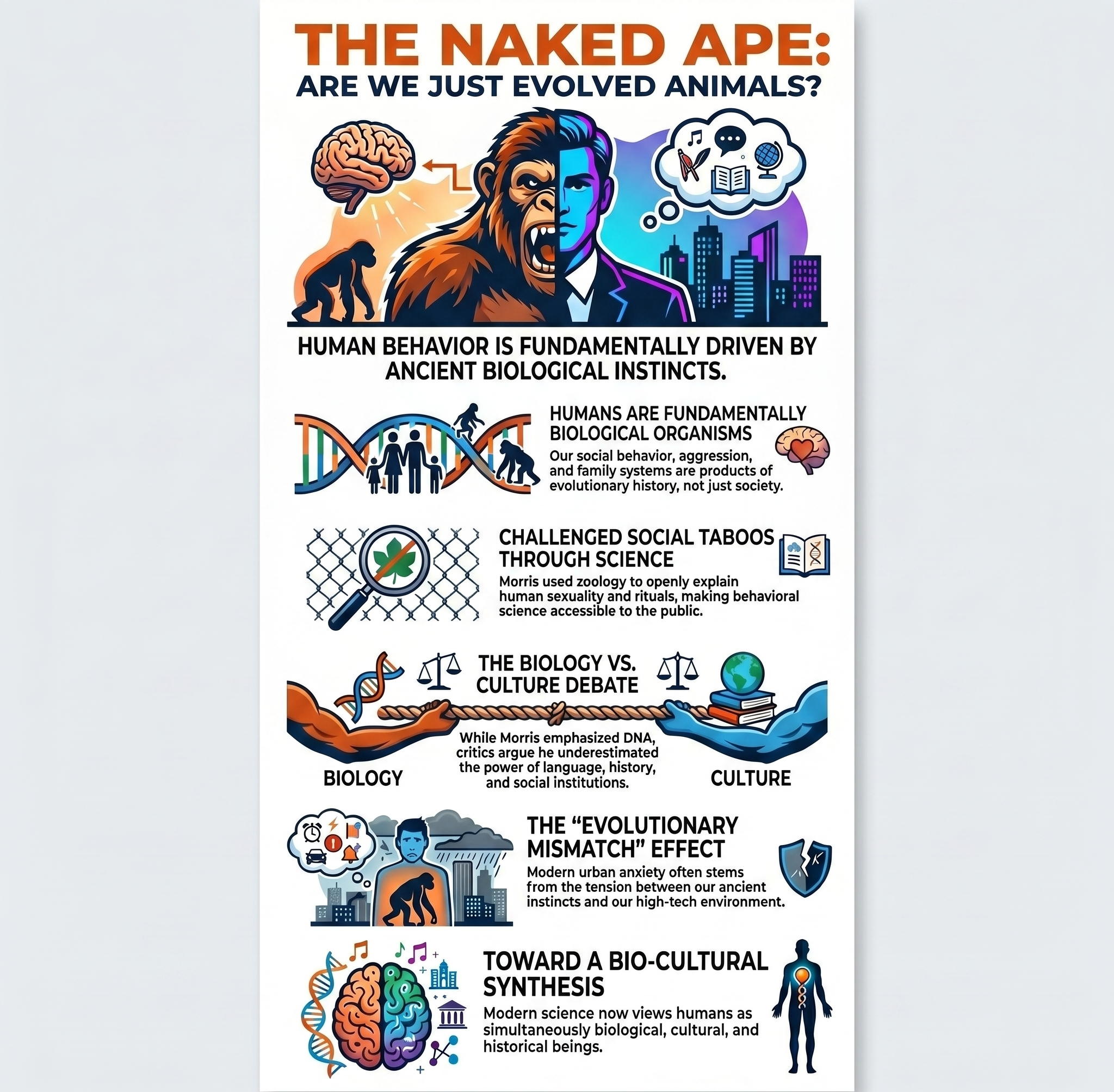
Human beings should be understood as evolved animals whose behaviour is deeply shaped by biology, instinct, and evolutionary history.
The article highlights how Morris became globally influential by applying zoological and evolutionary frameworks to understand:
- Human sexuality
- Social behaviour
- Aggression
- Family systems
- Communication
- Modern civilisation
At the same time, the article acknowledges that Morris remained deeply controversial because many critics accused him of:
- Biological reductionism
- Gender stereotyping
- Oversimplification of human culture
- Misogyny
The larger intellectual debate concerns:
How far human behaviour can be explained biologically versus socially and culturally.
2. Key Arguments in the Article
Morris treated humans as evolved animals
The article explains that Morris argued:
- Humans are fundamentally biological organisms shaped by evolutionary instincts.
He viewed:
- Modern social behaviour
through - Evolutionary and zoological frameworks.
The Naked Ape revolutionised public understanding of human behaviour
The article highlights:
- Morris popularised behavioural science for ordinary readers.
He connected:
- Human courtship
- Territoriality
- Aggression
- Sexual behaviour
to patterns seen in animals.
His ideas challenged social taboos
Morris openly discussed:
- Sexuality
- Reproductive behaviour
- Social rituals
which made him:
- Both influential and controversial.
Human civilisation has not erased evolutionary instincts
A recurring theme is:
- Modern humans remain influenced by ancient biological drives despite technological progress.
3. Author’s Stance
Respectful but critically balanced
The article clearly admires Morris’s:
- Intellectual originality
- Popular influence
- Ability to provoke debate
However, it also acknowledges:
- Criticism of his ideas
- Charges of reductionism and sexism
The tone is:
- Reflective
- Appreciative
- Historically analytical
rather than blindly celebratory.
4. Underlying Biases
Evolutionary psychology bias
The article gives substantial weight to:
- Biological explanations of behaviour
Admiration for intellectual iconoclasm
The article values:
- Thinkers who challenge conventional morality and social assumptions.
Scientific-humanist perspective
The discussion reflects belief in:
- Scientific inquiry into human nature
even when socially uncomfortable.
5. Anthropological and Intellectual Dimensions
Biological versus cultural explanations
Morris’s work reflects a major debate within anthropology:
- Are humans primarily shaped by biology?
or - By culture and social conditioning?
Popularisation of behavioural science
Morris helped bring:
- Ethology
- Evolutionary thinking
- Human behavioural studies
into mainstream public discourse.
Human-animal continuity
His work challenged the idea that:
- Humans are fundamentally separate from animals.
Instead, he argued:
- Human behaviour evolved through natural selection.
Critique of modern civilisation
Morris believed:
- Many modern anxieties result from mismatch between:
- Ancient instincts
- Modern urban civilisation
6. Pros (Positive Dimensions of Morris’s Contribution)
Made science accessible to the public
Morris transformed complex behavioural theories into:
- Readable
- Popular
- Engaging discussions
Encouraged interdisciplinary thinking
His work bridged:
- Zoology
- Anthropology
- Psychology
- Sociology
Opened debate on human behaviour
Morris challenged:
- Social taboos
- Anthropocentric assumptions
- Moral rigidity
Highlighted evolutionary continuity
His work encouraged understanding of:
- Human beings as products of evolutionary processes.
7. Cons and Criticisms
Biological reductionism
Critics argue Morris:
- Overemphasised biology
while underestimating: - Culture
- History
- Social structures
Accusations of misogyny and stereotyping
Some interpretations of gender and sexuality were criticised for:
- Reinforcing patriarchal assumptions
- Simplifying female behaviour
Limited cultural diversity perspective
His frameworks often reflected:
- Western social norms
- Universalist assumptions
without sufficient cross-cultural variation.
Oversimplification of human complexity
Human behaviour is shaped not only by evolution but also:
- Language
- Institutions
- Ideology
- Economics
- Historical experience
8. Policy and Intellectual Implications
Importance of interdisciplinary human studies
The article highlights the value of integrating:
- Biology
- Anthropology
- Psychology
- Sociology
for understanding human behaviour.
Need for ethical application of behavioural science
Biological explanations must avoid:
- Determinism
- Justification of inequality
- Gender bias
Behavioural science in policymaking
Insights into human behaviour increasingly influence:
- Public health
- Consumer behaviour
- Governance
- Conflict studies
Balancing biology and culture
Modern anthropology increasingly adopts:
- Bio-cultural approaches
rather than purely biological or purely cultural explanations.
9. Real-World Impact
Influence on public discourse
Morris shaped popular understanding of:
- Human sexuality
- Social behaviour
- Evolutionary psychology
Influence on media and academia
His work influenced:
- Television science communication
- Behavioural research
- Popular anthropology
Controversies in gender and social debates
His interpretations continue influencing discussions regarding:
- Gender roles
- Evolutionary behaviour
- Human instincts
Impact on modern behavioural sciences
Contemporary fields like:
- Evolutionary psychology
- Behavioural ecology
owe intellectual debt to thinkers like Morris.
10. UPSC GS Paper Linkages
GS Paper I (Society & Culture)
Relevant themes:
- Human behaviour
- Social institutions
- Gender debates
- Culture versus biology
Anthropology Optional
Highly relevant for:
- Biological anthropology
- Evolutionary theory
- Human behaviour studies
- Ethology and socio-biology
GS Paper IV (Ethics)
Relevant themes:
- Human nature
- Behavioural ethics
- Moral conditioning
Essay Relevance
Important themes:
- “Nature versus nurture”
- “Science and society”
- “Human behaviour and civilisation”
11. Critical Examination from UPSC Perspective
Morris challenged anthropocentrism
The article reflects how Morris questioned:
- Human exceptionalism
by placing humans within:
- Evolutionary continuity with animals.
Anthropology today favours bio-cultural synthesis
Modern anthropology recognises:
- Human beings are simultaneously:
- Biological
- Cultural
- Social
- Historical beings
Thus, Morris’s biological emphasis is important but incomplete.
Scientific inquiry can clash with social sensitivities
Morris’s career demonstrates:
- Public intellectuals often face backlash when challenging dominant moral or cultural assumptions.
Need for nuanced interpretation of behavioural science
Biology influences behaviour, but:
- Culture, institutions, and historical context remain equally important.
12. Balanced Conclusion
Desmond Morris remains one of the most influential and controversial interpreters of human behaviour in the modern era. Through works like The Naked Ape, he popularised the idea that human beings cannot be fully understood outside their evolutionary and biological context.
The article rightly recognises both:
- His intellectual contributions
and - The criticisms directed at his reductionist tendencies.
Morris expanded public conversation on:
- Human instincts
- Sexuality
- Social behaviour
- Evolutionary continuity
but his ideas also revealed the dangers of oversimplifying the complex relationship between biology, culture, and society.
13. Future Perspective
Future human behavioural studies will increasingly move toward:
- Interdisciplinary bio-cultural frameworks
- Neuroscience and behavioural anthropology
- Evolutionary psychology with cultural sensitivity
- Ethical behavioural science
Ultimately, Morris’s legacy lies not merely in the answers he offered, but in the uncomfortable and enduring questions he forced humanity to ask about its own nature.
