

Development in West Bengal leaves much to be desired
The Hindu
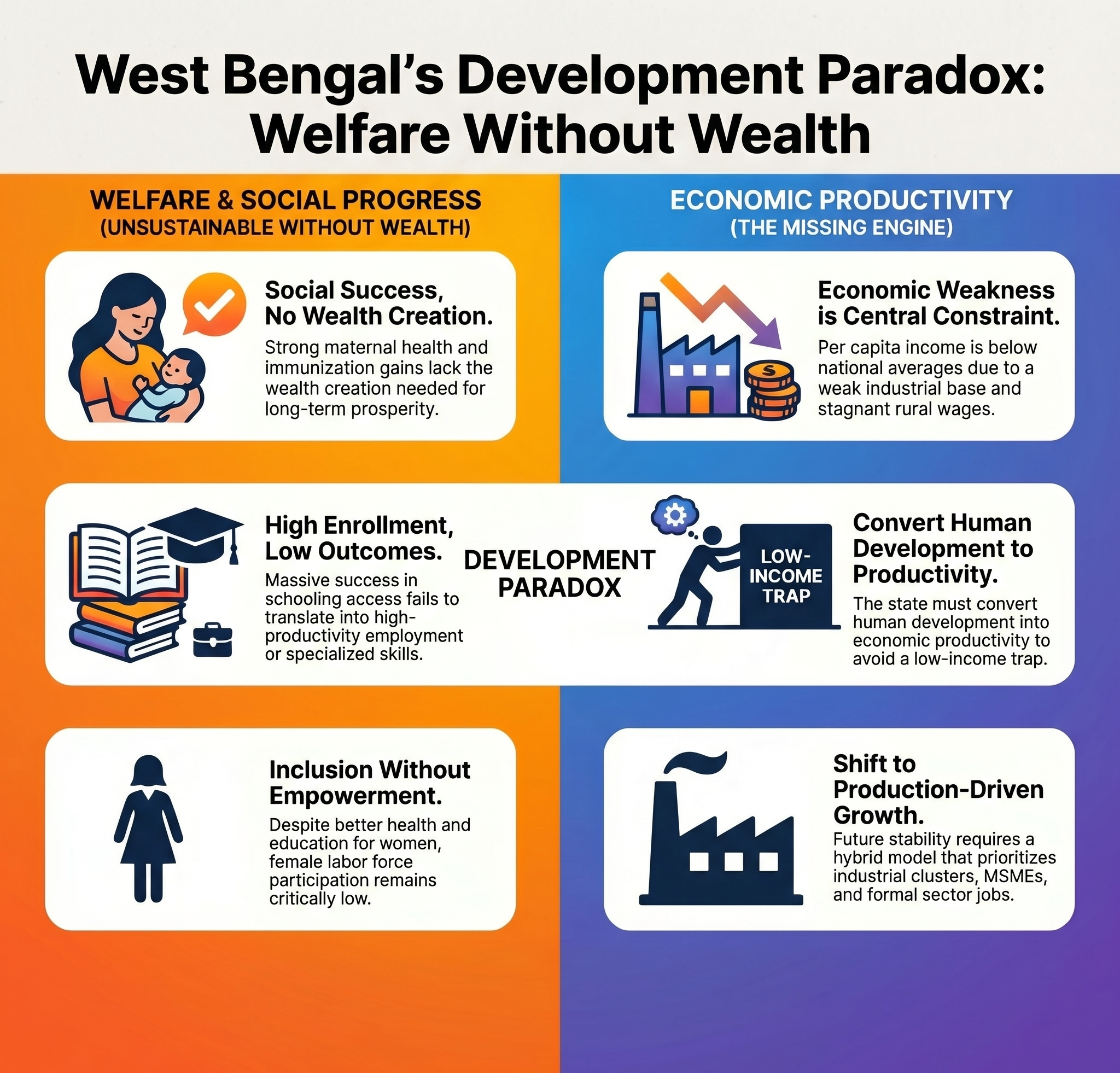
1. Core Thesis of the Article
The article presents a development paradox in West Bengal —
while the state has achieved notable progress in social indicators (especially health and basic services), its economic performance remains weak, leading to incomplete and unbalanced development.
The underlying argument is that human development without economic dynamism cannot sustain long-term growth.
2. Detailed Breakdown of Key Arguments
(1) Economic Weakness as the Central Constraint
The article clearly positions economic underperformance as the core structural issue.
West Bengal’s per capita income remains below the national average, and more importantly, rural wages are stagnating, which directly affects consumption demand and poverty reduction. Unlike states such as Tamil Nadu or Gujarat, which leveraged industrialisation, West Bengal has struggled to create high-productivity employment opportunities.
This reflects:
- Weak industrial base post-1990s
- Limited private investment
- Structural shift towards informal economy
Thus, despite social spending, income generation capacity remains limited, constraining overall development.
(2) Social Sector Success — But With Limits
The article acknowledges strong performance in health indicators, such as:
- Better maternal and child health outcomes
- Higher immunisation coverage
- Improved institutional delivery rates
This indicates effective public welfare delivery mechanisms, possibly through schemes and grassroots health infrastructure.
However, the editorial subtly argues that:
- These gains are necessary but not sufficient
- Without economic backing, they may not translate into long-term prosperity
This is a classic case of:
“Welfare without wealth creation”
(3) Education: Access vs Outcomes Divide
The state has achieved high enrolment and schooling coverage, which reflects success in expanding access.
But the deeper issue lies in:
- Low learning outcomes
- Weak transition to higher education and employment
- Skill mismatch
This highlights a critical shift in development discourse:
From “schooling” → “human capital productivity”
Thus, the article implicitly critiques the state for failing to convert educational access into economic value.
(4) Gender Development — Partial Progress
West Bengal shows moderate improvements in gender indicators, especially in:
- Female health outcomes
- Education participation
However, the critical gap lies in:
- Low female labour force participation
- Limited economic empowerment
This indicates that social inclusion has not translated into economic inclusion, a key concern in development economics.
(5) Infrastructure Deficit and Rural-Urban Divide
The article flags issues such as:
- Poor sanitation in pockets
- Inadequate drinking water access
- Weak rural infrastructure
This reflects:
- Uneven development across districts
- Persistent rural deprivation despite state-level averages
Thus, development is not spatially inclusive, leading to regional imbalance.
(6) Structural Issue: Lack of Industrialisation
This is the unstated but most important argument.
West Bengal’s historical industrial decline (post-1960s labour unrest, policy stagnation) has:
- Reduced manufacturing base
- Limited job creation
- Increased dependence on informal sector
Compared to:
- Gujarat → Manufacturing-led growth
- Tamil Nadu → Industrial clusters
- Karnataka → Service-led growth
West Bengal lacks a clear growth engine.
3. Author’s Stance
The article adopts a data-driven but critical stance.
It does not outright dismiss the state’s achievements, but clearly argues that:
“Social progress without economic transformation creates a fragile development model.”
The tone is:
- Analytical
- Evidence-based
- Implicitly reform-oriented
4. Hidden Biases and Framing
(1) Economic Determinism Bias
The article prioritises income and economic indicators over social indicators.
However, development theory (Amartya Sen) suggests:
- Health and education are ends in themselves, not just means
Thus, the critique may undervalue social achievements.
(2) Comparative Bias
Benchmarking West Bengal against top-performing states may:
- Ignore historical constraints
- Overlook demographic and political context
(3) Policy Neutrality Bias
The article avoids explicitly discussing:
- Political economy
- Governance model
- Role of state policies
This makes it analytically safe but less explanatory.
5. Policy Implications (Deep Analysis)
(1) Need for Economic Rebalancing
West Bengal must move from:
- Welfare-driven model → Production-driven model
Focus areas:
- MSMEs and labour-intensive industries
- Agro-processing
- Logistics and port-based economy
(2) Employment-Centric Growth
The key challenge is not GDP growth but:
- Jobless growth avoidance
Policy shift required:
- Skill alignment with industry
- Formal sector expansion
(3) Education Reform
Shift from:
- Enrolment → Learning outcomes + employability
Focus:
- Vocational education
- Industry linkages
(4) Gender Economic Inclusion
Policies needed for:
- Women workforce participation
- Entrepreneurship support
(5) Regional Planning
Targeted intervention in:
- Backward districts
- Rural infrastructure
6. Real-World Implications
Short Term
- Continued welfare support but limited income rise
Medium Term
- Migration of youth to other states
- Informalisation of labour
Long Term
- Risk of “low-income equilibrium trap”
- Social gains stagnating without economic backing
7. UPSC Linkage (Deep Integration)
GS Paper III (Most Important)
- Inclusive growth vs growth quality
- Employment crisis
- Regional inequality
GS Paper II
- State capacity and governance
- Welfare delivery mechanisms
GS Paper I
- Regional disparities
- Rural-urban divide
Essay Themes
- “Development vs Growth”
- “Can welfare substitute economic growth?”
8. Balanced Conclusion
The article correctly identifies that West Bengal’s development challenge is not absence of progress, but imbalance in progress.
While the state has:
- Built strong social foundations
It has failed to:
- Generate sustainable economic momentum
Thus, the real issue is:
“Conversion problem — turning human development into economic productivity.”
9. Future Perspective (Advanced Insight)
West Bengal’s path forward lies in:
- Hybrid model: Welfare + industrial growth
- Leveraging human capital for economic expansion
- Reviving manufacturing + services synergy
Final Editorial Insight
West Bengal today represents a broader Indian dilemma:
“Development cannot remain consumption-driven; it must become production-driven.”
Unless economic dynamism complements social progress,
development remains incomplete, fragile, and unsustainable.
