

Differentiating Welfare and Development
The Hindu
1. Core Thesis of the Article
The article argues that welfare and development are conceptually distinct but increasingly conflated in democratic policymaking, leading to suboptimal outcomes.
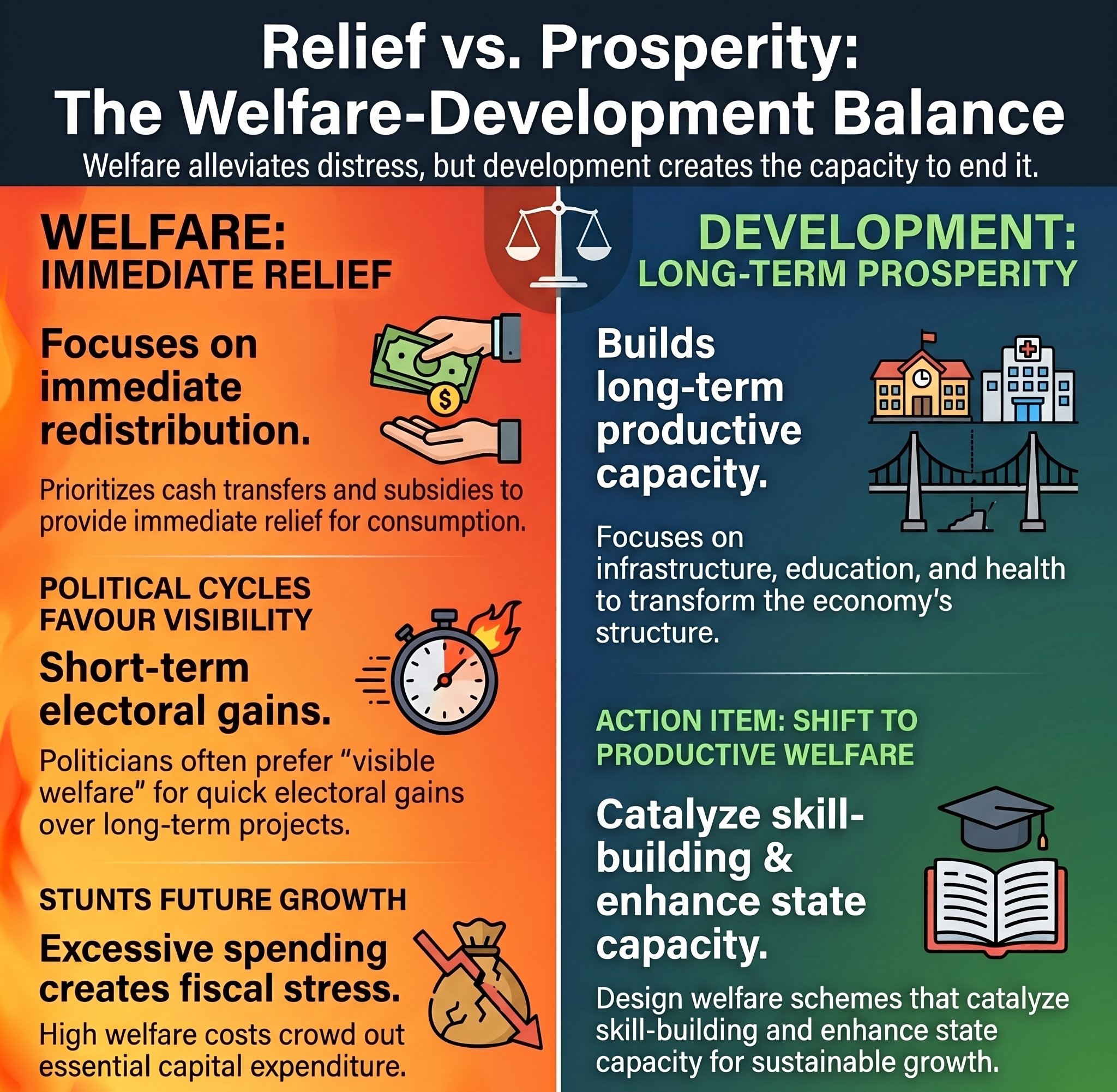
Welfare addresses immediate needs and redistribution, whereas development focuses on long-term structural transformation. Effective governance requires balancing both rather than substituting one for the other.
2. Detailed Breakdown of Key Arguments
(1) Rise of “Visible Welfare” in Democratic Politics
- Governments increasingly emphasise:
- Cash transfers
- Subsidies
- Freebies
- Reason:
- Immediate political returns
- Electoral incentives
Implication:
Short-term visibility is prioritised over long-term structural change.
(2) Conceptual Difference: Welfare vs Development
Welfare:
- Redistributive
- Consumption-oriented
- Immediate relief (food, cash, subsidies)
Development:
- Production-oriented
- Long-term
- Focus on:
- Infrastructure
- Education
- Health
- Productivity
Critical Insight:
The confusion arises when welfare is presented as development.
(3) Time Horizon Difference
- Welfare:
- Short-term gains
- Immediate consumption
- Development:
- Long-term transformation
- Delayed but sustainable outcomes
Key argument:
Democratic systems often favour short-term welfare over long-term development due to electoral cycles.
(4) Welfare Cannot Substitute Development
- Excessive reliance on welfare:
- Does not create productive capacity
- Does not generate jobs sustainably
- Development:
- Builds economic base
- Enhances state capacity
Conclusion:
Welfare without development → stagnation risk.
(5) Need for Complementarity, Not Competition
- Welfare is necessary for:
- Reducing inequality
- Supporting vulnerable groups
- Development is necessary for:
- Growth
- Productivity
- Fiscal sustainability
Balanced approach:
Welfare + Development = Inclusive growth
(6) Risks of Welfare Populism
- Fiscal stress
- Dependency culture
- Reduced incentive for productivity
- Political risk:
- Competitive populism among states
(7) Development Requires Institutional Capacity
- Long-term investments need:
- Governance efficiency
- Policy continuity
- Administrative capability
Observation:
Weak institutions → welfare dominance over development.
(8) Structural Transformation is the Goal
Development entails:
- Shift from agriculture → industry → services
- Skill development
- Human capital formation
Argument:
This cannot be achieved through welfare schemes alone.
(9) Importance of Public Goods
- Development depends on:
- Education
- Healthcare
- Infrastructure
These are:
- Non-excludable
- Long-term investments
(10) Political Economy Constraint
- Politicians prefer:
- Quick, visible gains
- Development projects:
- Take time
- Have uncertain political returns
Insight:
This structural bias explains policy distortion.
(11) Fiscal Sustainability Concern
- High welfare spending:
- Reduces fiscal space
- Crowds out capital expenditure
Impact:
Lower long-term growth potential.
(12) Mislabeling Welfare as Development
- Governments brand:
- Subsidies as “empowerment”
- Transfers as “development”
Result:
Public discourse becomes blurred.
3. Author’s Stance
- Clearly analytical and cautionary
- Advocates:
- Conceptual clarity
- Balanced policy mix
- Critiques:
- Welfare populism
- Political short-termism
Tone:
- Academic, policy-driven, reform-oriented
4. Biases in the Article
(1) Pro-Development Bias
- Strong emphasis on:
- Structural reforms
- Long-term investments
(2) Slight Anti-Populist Tone
- Welfare schemes viewed skeptically
- May underplay:
- Welfare’s role in poverty alleviation
(3) Technocratic Perspective
- Focus on:
- Efficiency
- Fiscal prudence
Less focus on:
- Political compulsions
- Ground-level distress
5. Pros and Cons of the Argument
Pros
Conceptual clarity
- Clearly differentiates welfare vs development
Policy relevance
- Addresses real governance dilemma
Balanced recommendation
- Advocates complementarity
Cons
Underestimates welfare necessity
- Welfare is essential in:
- High-poverty contexts
Limited political realism
- Electoral compulsions not deeply explored
6. Policy Implications
(1) Rationalise Welfare Spending
- Targeted subsidies
- Avoid universal freebies
(2) Increase Capital Expenditure
- Focus on:
- Infrastructure
- Human capital
(3) Integrate Welfare with Development
- Example:
- Skill-linked cash transfers
- Conditional welfare
(4) Strengthen Institutions
- Improve:
- Governance capacity
- Implementation efficiency
(5) Fiscal Discipline
- Maintain balance:
- Revenue vs expenditure
7. Real-World Impact
Short-Term
- Welfare:
- Reduces poverty
- Provides safety net
Medium-Term
- Excess welfare:
- Fiscal stress
- Reduced investment
Long-Term
Two outcomes:
Balanced approach:
- Sustainable inclusive growth
Welfare-heavy model:
- Low productivity trap
8. UPSC GS Linkages
GS Paper II
- Welfare schemes
- Governance
- Policy design
GS Paper III
- Inclusive growth
- Fiscal policy
- Development vs redistribution
GS Paper I
- Poverty
- Social inequality
Essay Topics
- “Welfare vs Development: False Dichotomy?”
- “Freebies vs Fiscal Responsibility”
9. Critical Analytical Insight
The real challenge is not choosing between welfare and development, but designing welfare in a way that catalyses development rather than replacing it.
10. Balanced Conclusion
The article correctly highlights that:
- Welfare and development serve different purposes
- Conflating them weakens policy effectiveness
However:
- Welfare remains indispensable in a country with:
- High inequality
- Vulnerable populations
11. Way Forward
- Shift from:
- “Populist welfare” → “Productive welfare”
- Ensure:
- Welfare supports capability building
- Development ensures long-term growth
Final Editorial Takeaway
Welfare may alleviate distress, but development creates prosperity. Sustainable governance lies in harmonising both—providing immediate relief while building future capacity.
