

E20 Ethanol Blending: Costs and Benefits

E20 Ethanol Blending: Costs and Benefits
Why in News?
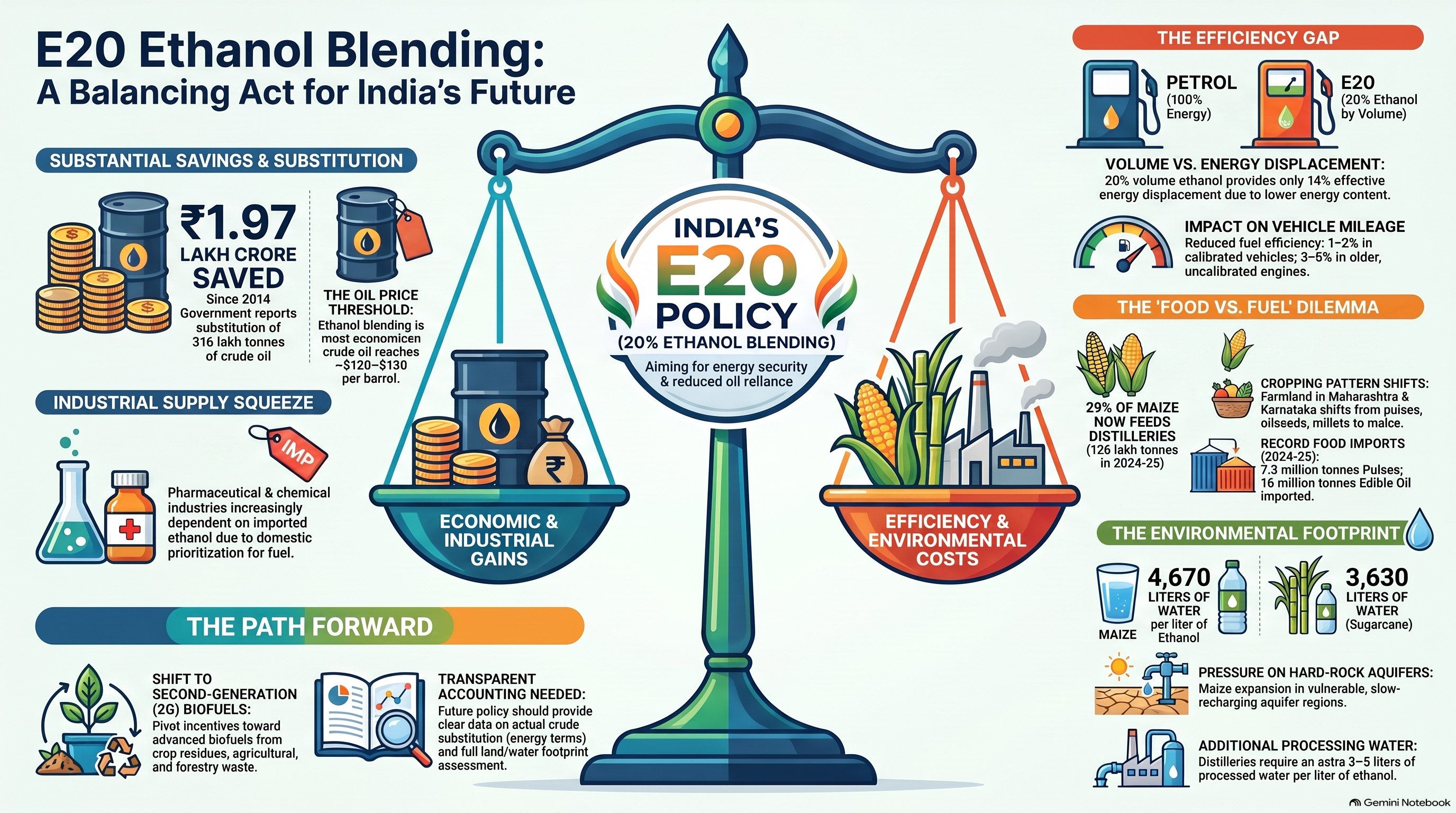
- India has achieved around 20% ethanol blending in petrol, but concerns are emerging over whether the benefits from reduced crude oil consumption justify the economic, agricultural and environmental costs.
- The debate centres on ethanol's lower energy content, diversion of farmland towards feedstock crops, rising imports of pulses and edible oils, and pressure on groundwater resources.
E20 and Petroleum Savings
- E20 contains approximately 20% ethanol and 80% petrol.
- Ethanol has only about two-thirds the energy content of petrol by volume.
- Therefore, a 20% ethanol blend does not displace 20% of petrol consumption on an energy-equivalent basis.
- The effective displacement is estimated at around 14%.
- The Petroleum Ministry states that E20 can reduce mileage by around 1–2% in calibrated vehicles and 3–6% in older vehicles.
- The government has reported savings of around ₹1.97 lakh crore and substitution of about 316 lakh tonnes of crude oil since 2014-15 through ethanol blending.
- However, crude oil import dependence has continued to remain high despite the expansion of ethanol blending.
Impact on Ethanol and Industrial Use
- In 2019, India moved ethanol imports from the free list to the restricted category for fuel blending.
- Domestic distillers increasingly shifted ethanol towards fuel blending because oil marketing companies offered assured offtake and administered prices.
- Industrial ethanol production declined, increasing dependence of pharmaceutical and chemical industries on imported ethanol.
- At one point, imported ethanol accounted for more than half of ethanol consumed by these industries.
- Ethanol becomes relatively economical compared with petrol when crude oil prices are substantially higher, with the article citing around $120–130 per barrel as the level at which the economics become more favourable.
Impact on Agriculture and Food Security
- Growing demand for ethanol feedstock has increased maize cultivation.
- Between 2021-22 and 2024-25:
- Maize production grew by around 8.8% annually.
- Area under maize increased by around 6.7% annually.
- In 2024-25, around 126 lakh tonnes of maize, or approximately 29% of total production, went to distilleries.
- In states such as Maharashtra and Karnataka, farmland has reportedly shifted from pulses, soybean, millets and cotton towards maize.
- This raises concerns over food security and competition between fuel and food uses.
Import and Water Concerns
- India imported around 16 million tonnes of edible oil in 2024-25.
- Pulses imports reached a record 7.3 million tonnes.
- India also became a net importer of maize in 2024.
- The increased use of maize for ethanol can intensify pressure on water resources.
- The article cites an estimate that producing 1 litre of ethanol requires around 4,670 litres of water from maize and around 3,630 litres from sugarcane.
- Distilleries additionally use around 3–5 litres of processed water per litre of ethanol.
- This is particularly concerning because expansion of maize cultivation is occurring in regions dependent on hard-rock aquifers.
Policy Concerns and Way Forward
- The article argues that the government's primary objective of ethanol blending should remain reducing petroleum import dependence rather than simply supporting the expansion of the distillery sector.
- The government should provide a clear accounting of crude oil actually substituted by ethanol in both energy and volume terms.
- The land and water footprint of ethanol production should also be assessed, including additional acreage brought under feedstock crops.
- Excessive dependence on first-generation feedstocks such as maize and sugarcane can create competition with food crops and increase pressure on water resources.
- Policy incentives should progressively shift towards second-generation biofuels derived from crop residues, agricultural waste and forestry waste.
- The 2018 National Policy on Biofuels had envisaged greater use of such advanced feedstocks, but their expansion remains limited.
- A comprehensive assessment should therefore consider not only crude oil savings but also food security, land use, water consumption, foreign exchange expenditure and environmental sustainability.
