

Economic Liberalisation in India: 1991 Reforms and Reform Consensus

Why in News?
The article highlights how the economic reforms initiated in 1991 have continued across successive governments despite changes in political leadership and ideology.
Over three decades, governments of different political parties broadly accepted liberalisation, privatisation, FDI and dismantling of the Licence-Permit Raj as important components of India's economic policy.
Background and 1991 Economic Reforms
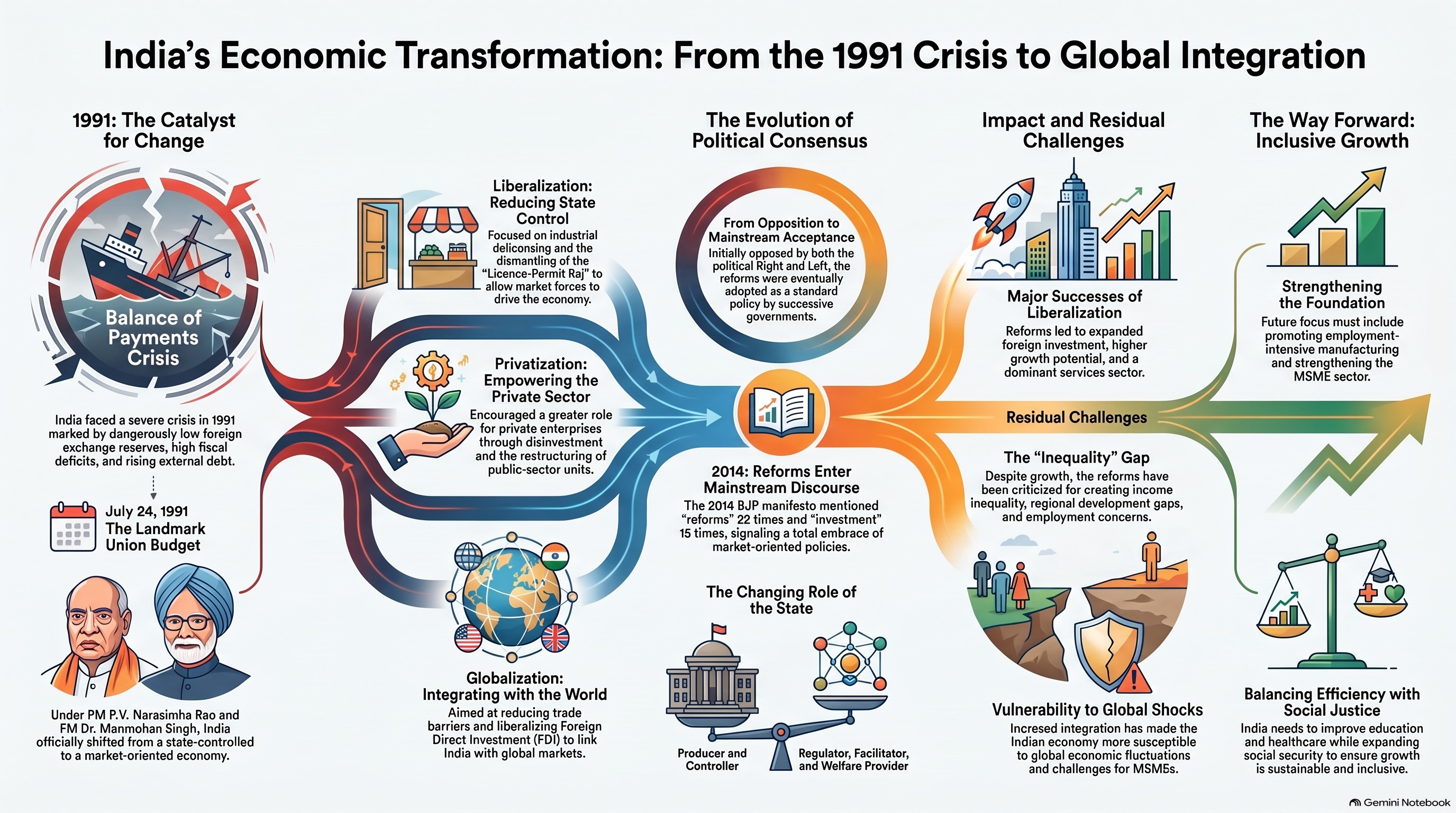
India faced a severe Balance of Payments crisis in 1991, marked by low foreign exchange reserves, high fiscal and current account deficits, rising external debt and inflation.
Under Prime Minister P. V. Narasimha Rao, Finance Minister Dr. Manmohan Singh presented the landmark Union Budget on 24 July 1991, initiating a major shift from a state-controlled economy towards a market-oriented economy.
Key reforms included:
- Industrial delicensing and reduction of government controls
- Greater role for the private sector
- Liberalisation of Foreign Direct Investment
- Reduction of import restrictions and trade barriers
- Disinvestment and restructuring of public-sector enterprises
- Greater emphasis on competition and market forces
Thus, the reforms broadly rested on:
Liberalisation → Reduction of government controls
Privatisation → Greater role for private enterprises
Globalisation → Integration with the global economy
Reform Consensus Across Governments
Initially, the reforms faced opposition from both the political Right and Left. However, successive governments gradually continued the broad reform trajectory.
Despite changes in governments and political parties, policies promoting:
- Private investment
- FDI
- Competition
- Deregulation
- Global economic integration
largely continued.
This reflects the emergence of a broad political consensus on economic liberalisation.
The article also highlights that by the 2014 Lok Sabha elections, economic reforms had become an important part of mainstream political discourse. The BJP manifesto mentioned “reforms” 22 times and “investment” 15 times, reflecting the increasing political acceptance of market-oriented economic policies.
Significance and Challenges
The 1991 reforms significantly altered the role of the Indian state.
Earlier:
State → Producer + Controller + Regulator
Increasingly:
State → Regulator + Facilitator + Welfare Provider
Major outcomes include:
- Greater private-sector participation
- Increased competition
- Expansion of foreign investment
- Greater integration with global markets
- Higher economic growth potential
- Expansion of India's services and private sectors
However, liberalisation has also faced criticism due to:
- Income and wealth inequality
- Uneven regional development
- Employment concerns
- Vulnerability to global economic shocks
- Challenges faced by MSMEs and informal workers
- Market concentration
Therefore, economic growth has not automatically translated into equally distributed development.
Way Forward
India needs to move towards inclusive, employment-oriented and sustainable reforms.
Focus areas should include:
- Strengthening MSMEs
- Promoting employment-intensive manufacturing
- Improving education and healthcare
- Expanding social security
- Attracting FDI while protecting strategic interests
- Ensuring competitive markets
- Integrating Indian firms into global value chains
- Balancing market efficiency with social justice
