

Election Commission of India: Independence and Appointment of Election Commissioners

Election Commission of India: Independence and Appointment of Election Commissioners
Source: The Hindu
Why in News?
The debate over the appointment of Election Commissioners has revived concerns that were already raised in the Constituent Assembly regarding executive influence over the electoral machinery. The issue is significant because the Election Commission of India (ECI) is responsible for conducting elections and ensuring the integrity of the electoral process.
Constitutional Framework of the ECI
- The ECI is a constitutional body established under Article 324, which vests it with the “superintendence, direction and control” of elections.
- It conducts elections to:
- Parliament
- State Legislatures
- President
- Vice-President
- The Commission currently consists of the Chief Election Commissioner (CEC) and two Election Commissioners (ECs).
- The ECI was initially a single-member body; it became a permanent multi-member body in 1993.
- Its functions include:
- Preparation and revision of electoral rolls.
- Conduct and scheduling of elections.
- Implementation of the Model Code of Conduct.
- Advising the President/Governors on disqualification of legislators under Articles 103 and 192.
- Recognition of political parties and allotment of election symbols.
Constituent Assembly’s Concern
- The independence of the electoral machinery was debated extensively during constitution-making.
- Shibban Lal Saxena argued that appointments should require approval by a two-thirds majority of Parliament so that a single political party could not dominate the process.
- H.N. Kunzru warned that if electoral machinery lacked integrity, “democracy will be poisoned at the source.”
- Dr. B.R. Ambedkar acknowledged the difficulty of designing an appointment mechanism and described it as one of the Drafting Committee's “greatest headaches.”
- The American model of legislative confirmation was considered but Ambedkar expressed concern that it could introduce political considerations into appointments.
- Ultimately, Article 324 provided for appointment by the President, with Parliament empowered to regulate the process through law.
Judicial Intervention and 2023 Act
- For several decades, Parliament did not enact a law specifically prescribing the appointment procedure.
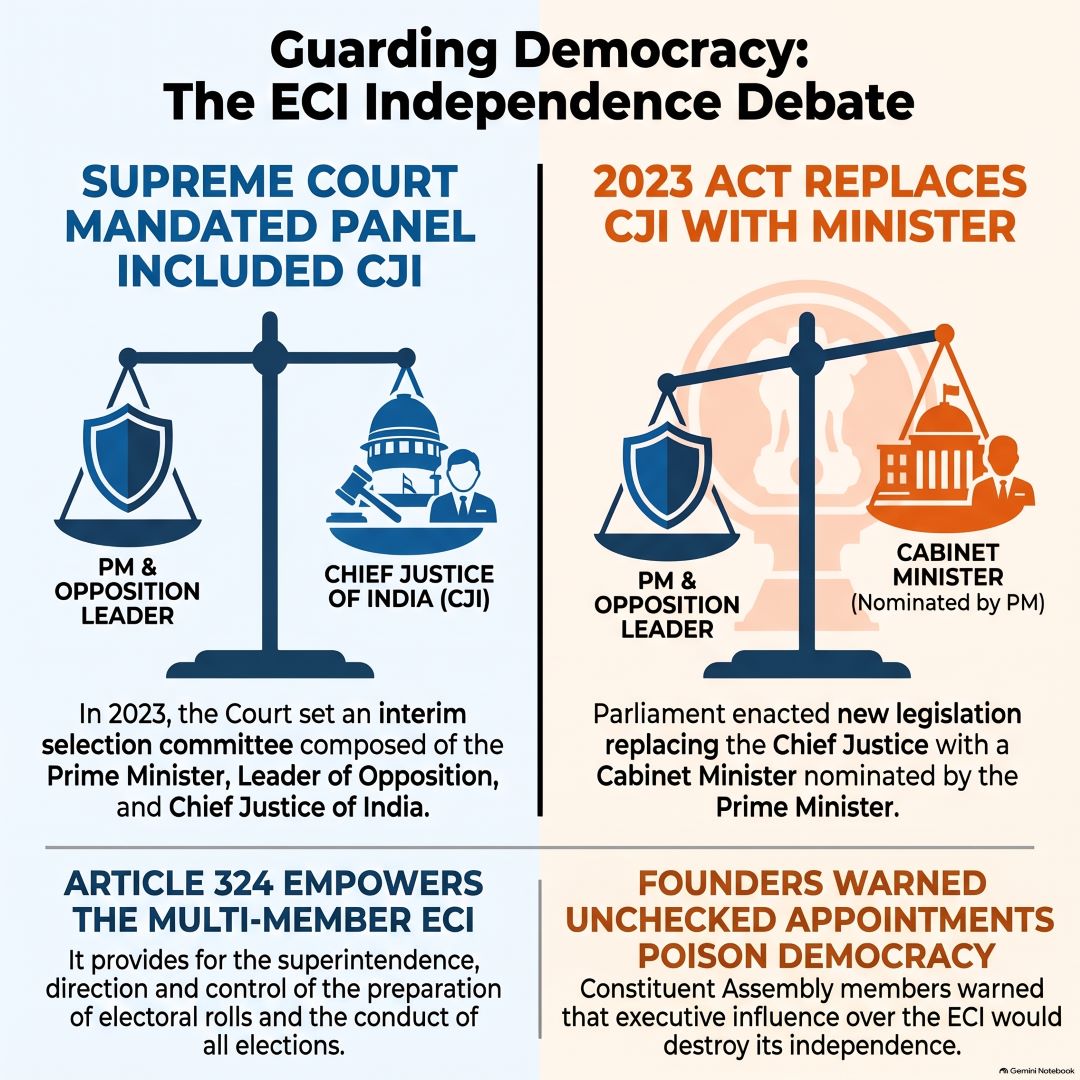
- In Anoop Baranwal v. Union of India (2023), the Supreme Court addressed this legislative vacuum and prescribed an interim selection mechanism consisting of:
- Prime Minister
- Leader of Opposition in Lok Sabha
- Chief Justice of India
- This mechanism was to operate until Parliament made a law governing appointments/
- Parliament subsequently enacted the Chief Election Commissioner and Other Election Commissioners (Appointment, Conditions of Service and Term of Office) Act, 2023.
- Under the Act:
- A Search Committee headed by the Law Minister prepares a panel of candidates.
- The Selection Committee consists of the Prime Minister, Leader of Opposition in Lok Sabha and a Union Cabinet Minister nominated by the Prime Minister.
- Thus, the CJI was replaced by a Union Cabinet Minister in the statutory selection mechanism.
- The change has generated debate over the appropriate balance between executive participation and institutional independence. The Supreme Court has recorded challenges specifically concerning the replacement of the CJI and the transparency of the selection process. Sci API
Independence of the ECI: Key Issues
- The core constitutional concern is that the body conducting elections should be institutionally capable of exercising its functions without undue influence from the government of the day.
- The debate involves two competing considerations:
- Executive accountability: The elected government participates in appointments to a constitutional body.
- Institutional independence: The selection process should inspire confidence among all political stakeholders and voters.
- The CEC enjoys stronger removal protection: removal is broadly on the same basis and manner as a Supreme Court judge, while the Election Commissioners have a different statutory/constitutional protection framework.
- The issue therefore goes beyond the identity of individual office-holders and concerns the design of institutions responsible for free and fair elections.
Way Forward
- A transparent, merit-based and clearly defined selection process can strengthen public confidence.
- Selection should ensure meaningful participation of both the government and opposition.
- Objective eligibility criteria, transparent shortlisting and adequate disclosure can reduce perceptions of partisan selection.
- Parliamentary scrutiny or a broader bipartisan consultation mechanism could be considered while preserving administrative efficiency.
- The larger constitutional principle should remain the independence, neutrality and credibility of the electoral machinery.
|
UPSC Mains Practice “Independence of the electoral machinery is essential for the credibility of a constitutional democracy.” Discuss in the context of the appointment process of the Election Commission of India. |
