

FCRA Bill and the Joint Parliamentary Committee (JPC)

FCRA Bill and the Joint Parliamentary Committee (JPC)
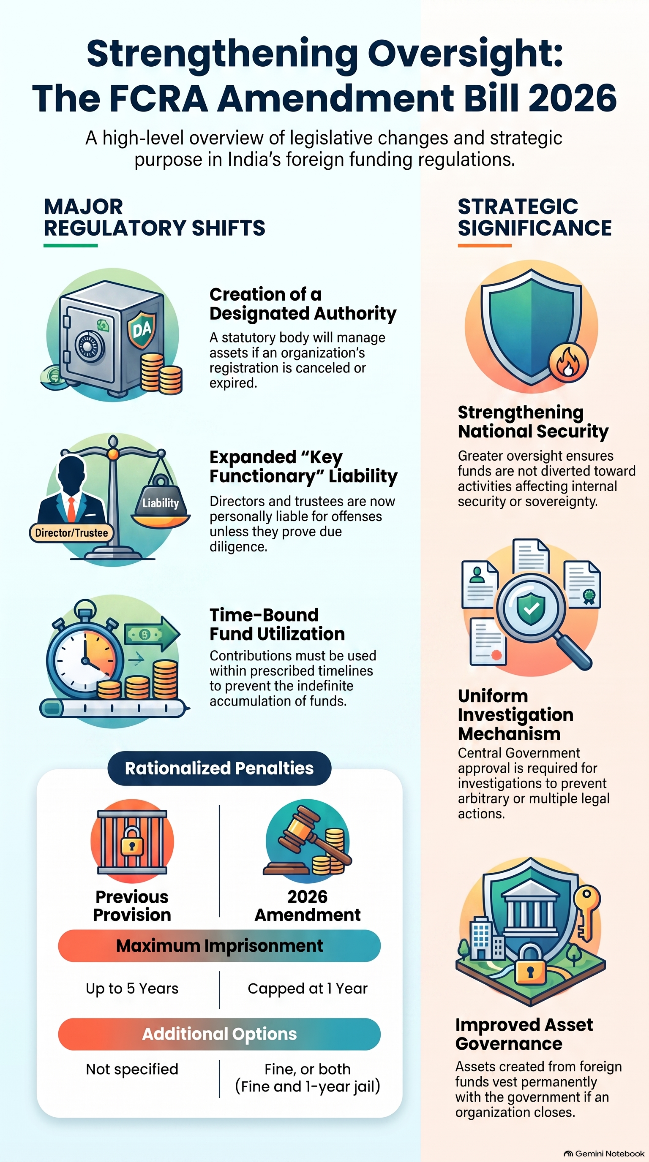 Why in News?
The Lok Sabha referred the Foreign Contribution (Regulation) Amendment Bill, 2026 to a Joint Parliamentary Committee (JPC), amid objections over provisions like the retrospective vesting of foreign-funded assets in a government-designated authority — reviving debate on how effective parliamentary committees really are when the ruling party holds a majority within them.
Purpose of Parliamentary Committees
Address Parliament's limited time to examine complex legislation. Smaller committees can spend more time on a Bill, question officials, hear experts/stakeholders, and scrutinise provisions clause by clause. As per Rajya Sabha's literature, their philosophy is: influence, not control; advise, not command; criticism, not obstruction; scrutiny, not initiative; accountability, not prior approval.
Types of Parliamentary Committees
- Department-related Standing Committees — ongoing scrutiny of ministries
- Financial Committees — scrutinise government expenditure
- Select Committees — formed by one House for a specific Bill
- JPC — members from both Houses, formed for a specific Bill/issue
Committees can call for persons, papers, and records, and take evidence — but recommendations are not binding on government.
The Central Limitation: Ruling Party Majority
JPC membership reflects party strength in Parliament, so the ruling party/alliance usually holds a majority and the chairperson comes from government benches, with a casting vote in case of a tie. Yet Opposition isn't powerless — it can demand witnesses, question officials, put evidence on record, propose changes, and file dissent notes. The real test is whether Opposition input actually changes the law.
Have JPCs Actually Changed Laws? — Yes, by Modification
- Stock Market Scam JPC (2001-02): Recommendations on SEBI–exchange coordination; government acted on 236 recommendations
- Pesticide Residues JPC (2004): Flagged unsafe pesticide levels in soft drinks, leading to stricter safety standards
- Multi-State Co-operative Societies (Amendment) Bill, 2022: Recommendations on Cooperative Election Authority largely incorporated
- Biological Diversity (Amendment) Bill, 2021: Core approach retained but with added safeguards/clarifications
- FRDI Bill, 2017: JPC scrutiny of "bail-in" provisions contributed to the Bill's eventual withdrawal
When Opposition Dissent Didn't Prevail
- Personal Data Protection Bill JPC: Government exemptions retained despite surveillance concerns; 2019 Bill withdrawn, replaced by a 2022 law that still kept broad exemptions
- Citizenship (Amendment) Bill, 2016: JPC retained the Bill's core objective despite Opposition concerns on religious criteria and Assam/secularism implications; 2019 Act followed the same approach
- 2G JPC: Broadly defended government's telecom allocation position; outcome shaped more by CAG findings and Supreme Court's licence cancellation than by the JPC itself
Takeaway: Partisan tilt in JPCs isn't unique to any one government — when an issue is politically central, the ruling side's majority tends to prevail.
Has the Committee System Weakened Over Time?
Share of Bills referred to committees (PRS Legislative Research):
- 14th Lok Sabha (2004-09): ~60%
- 15th Lok Sabha (2009-14): ~71%
- 16th Lok Sabha (2014-19): ~25%
- 17th Lok Sabha (2019-24): ~16%
Pattern: routine scrutiny has declined, even as JPCs are increasingly reserved for especially contentious Bills.
Conclusion
JPCs rarely overturn a government's core legislative intent, but they consistently force explanation, modification, and public scrutiny — a meaningful check even within majoritarian limits. Given the overall decline in committee referrals, the FCRA Bill's JPC referral is a notable, if modest, reaffirmation of deliberative process over numerical dominance.
