

Foreign Technology Dependence: Challenges to India’s Strategic Autonomy

Foreign Technology Dependence: Challenges to India’s Strategic Autonomy
Source: The Hindu, 22 October 2026
Why in News?
- Reports of restrictions on Ukraine’s access to the military-grade Starshield satellite network have renewed concerns about dependence on foreign-controlled technologies.
- The issue highlights India’s vulnerabilities in satellite communication, navigation, cloud computing, digital payments and defence equipment.
Key Areas of Foreign Dependence
- Satellite Communication: Starlink, Eutelsat OneWeb and Jio Satellite Communications have been licensed for satellite broadband. However, foreign entities retain significant influence over ownership or network management in some arrangements.
- Satellite Navigation: India’s NavIC system faces operational challenges due to an insufficient number of operational satellites, affecting independent positioning, navigation and timing (PNT) capabilities.
- Cloud Computing: AWS, Microsoft Azure and Google Cloud dominate much of the cloud ecosystem. India’s MeghRaj initiative promotes government cloud infrastructure, but dependence on foreign-controlled management systems persists in some deployments.
|
Key Areas of Strategic Vulnerability India's dependence on foreign technology creates "chokepoints" that can be weaponized during geopolitical friction:
2. Geopolitical Weaponization of Technology The 2025–2026 regional conflict in West Asia (involving the US, Israel, and Iran) highlighted how technology dependence forces difficult diplomatic choices:
India’s Multi-Pronged Response To mitigate these risks, the government has moved toward a long-term (20–25 year) strategic roadmap:
|
- Digital Payments: UPI has reduced India’s dependence on international card networks such as Visa and Mastercard. However, several popular consumer-facing payment applications are operated by foreign-linked companies.
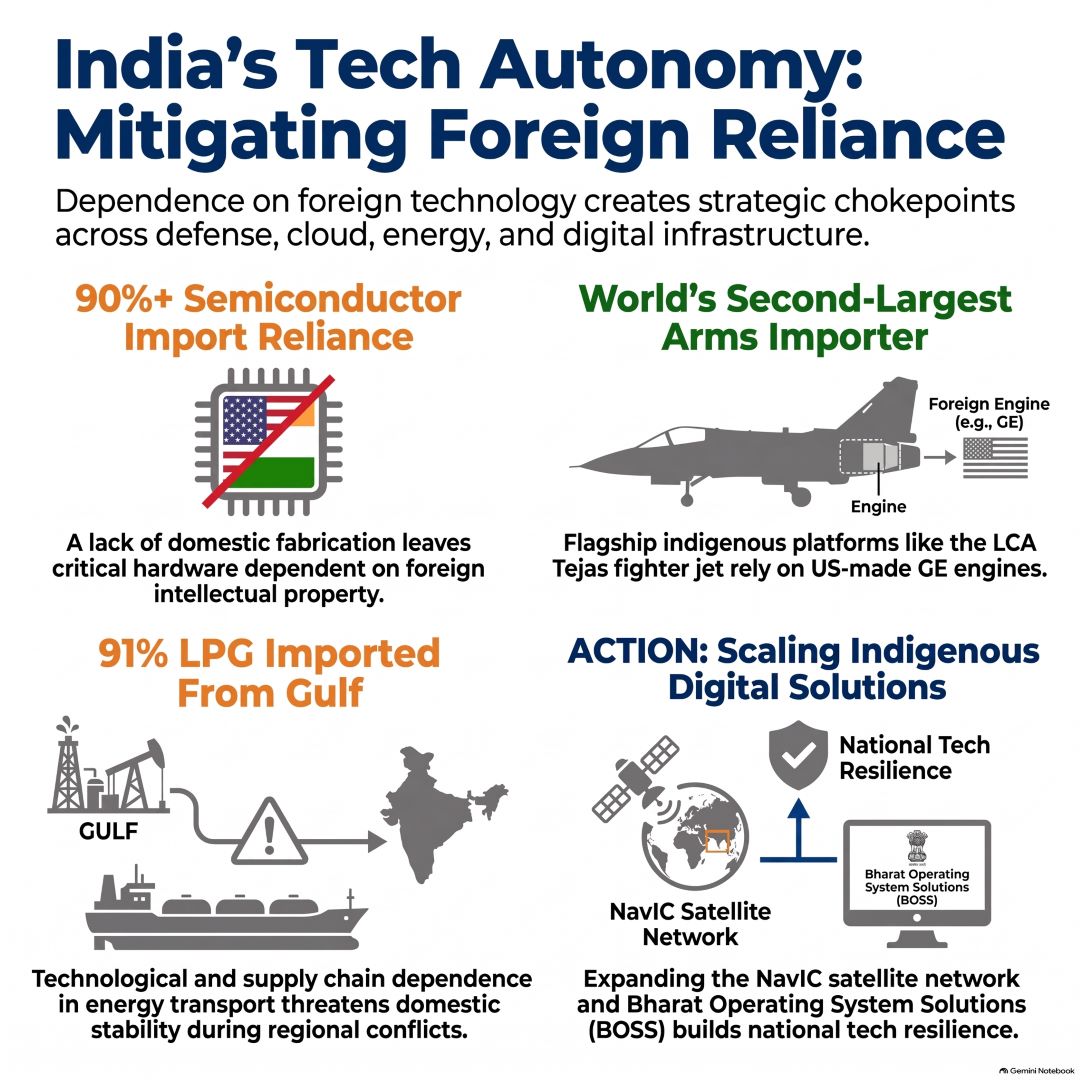
- Military Equipment: India remains dependent on imported defence equipment and critical components. The Tejas fighter programme’s reliance on US-made GE engines illustrates the challenges of achieving complete indigenous capability.
Major Risks
- Service denial: Foreign operators may restrict access to essential services due to geopolitical tensions or commercial decisions.
- External control: Foreign-controlled software, network management and updates may create vulnerabilities even when infrastructure is physically located in India.
- Supply-chain disruption: Sanctions, export restrictions and delayed deliveries can affect defence production and strategic projects.
- Economic disruption: Outages or restrictions affecting cloud services, banking networks and digital infrastructure can disrupt essential economic activities.
Measures to Strengthen Strategic Autonomy
- Complete and strengthen the NavIC satellite constellation to ensure reliable indigenous navigation capabilities.
- Accelerate defence indigenisation, including domestic development of engines, components and critical technologies.
- Promote indigenous cloud infrastructure, open-source software and secure domestic network-management systems.
- Diversify technology suppliers and establish contingency arrangements for essential services.
- Strengthen cybersecurity, data governance and regulatory oversight of foreign technology providers.
Conclusion
Strategic autonomy requires more than domestic ownership or physical infrastructure. India must also develop control over critical software, network operations, maintenance, updates and supply chains. Strengthening indigenous capabilities while diversifying international partnerships is essential to protect national security and technological sovereignty.