

Growth and Energy Security

Why in News?
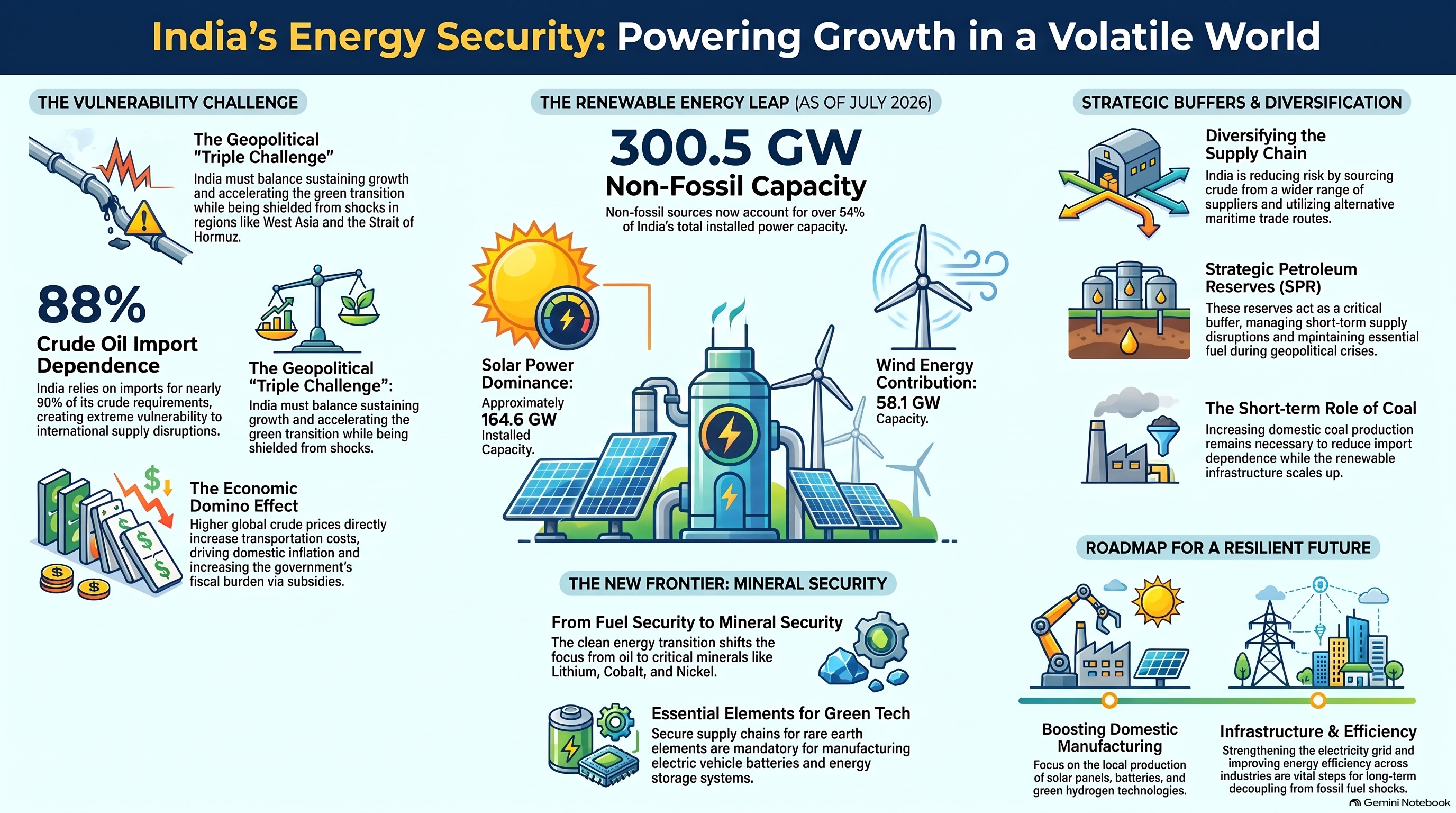
India's rapid economic growth has increased the importance of energy security as a prerequisite for sustained development. Rising geopolitical tensions and volatility in global crude oil prices have highlighted India's dependence on imported energy.
India therefore faces a triple challenge of sustaining high economic growth, protecting the economy from external energy shocks and accelerating the transition towards cleaner sources of energy.
Growth–Energy Nexus
Energy availability and economic growth are closely interconnected. Manufacturing, transport, agriculture, services and households all depend upon reliable and affordable energy.
India's high dependence on imported hydrocarbons creates vulnerability to international price and supply disruptions.
- India imports around 88% of its crude oil requirements.
- A significant share of natural gas is also imported.
- Geopolitical tensions in West Asia can disrupt supply and raise international energy prices.
- Disruptions around the Strait of Hormuz can particularly affect India's energy imports.
- Higher crude prices increase the cost of transportation and production, thereby contributing to domestic inflation.
- Higher energy prices can also increase the government's fiscal burden when subsidies are used to protect consumers.
Thus, energy security acts as a shock absorber for economic growth, reducing the transmission of global geopolitical and price shocks into the domestic economy.
India's Multi-Pronged Energy Security Strategy
India is increasingly moving from dependence on a limited number of conventional energy sources towards diversification, domestic production and clean-energy expansion.
Renewable Energy Expansion
India has rapidly expanded solar and wind power.
As of July 2026:
- Non-fossil installed capacity: about 300.5 GW
- Share of total installed capacity: over 54%
- Solar capacity: about 164.6 GW
- Wind capacity: about 58.1 GW
The expansion of renewables reduces dependence on imported fossil fuels and can improve long-term energy security.
Diversification of Energy Imports
India has sought to reduce excessive dependence on particular suppliers and transportation routes by:
- Diversifying crude oil suppliers
- Increasing imports through alternative maritime routes
- Maintaining flexibility in sourcing crude from different countries
- Strengthening domestic refining capacity
Import diversification reduces the vulnerability of the Indian economy to disruptions along any single trade route.
Critical Mineral Security
The energy transition is shifting the nature of energy security from fuel security to mineral security.
Minerals such as:
- Lithium
- Cobalt
- Nickel
- Rare earth elements
are important for electric vehicles, batteries, renewable-energy technologies and energy storage.
Therefore, India's clean-energy transition will require secure and diversified critical-mineral supply chains.
Strategic Petroleum Reserves
Strategic Petroleum Reserves provide a buffer against temporary disruptions in international oil supplies.
Expansion of India's SPR capacity can help:
- Manage supply disruptions
- Reduce short-term vulnerability to global price shocks
- Maintain essential fuel supplies during geopolitical crises
Domestic Coal Production
Coal continues to play an important role in India's electricity generation.
Increasing domestic coal production can reduce import dependence in the short term while India simultaneously expands renewable and other low-carbon energy sources.
Challenges and Way Forward
India's energy-security strategy faces several challenges:
- High dependence on imported crude oil
- Volatility in international energy prices
- Geopolitical risks in major energy-producing regions
- Intermittency of solar and wind power
- Need for large-scale battery and grid-storage capacity
- Dependence on imported critical minerals
- High investment requirements for the energy transition
- Balancing energy affordability with climate commitments
The way forward requires a combination of energy diversification, domestic production, renewable expansion, nuclear energy, energy efficiency and strategic reserves.
India also needs to strengthen:
- Domestic manufacturing of solar panels, batteries and other clean-energy technologies
- Electricity-grid infrastructure
- Energy-storage systems
- Critical-mineral supply chains
- International energy partnerships
- Energy efficiency across industries and transport
- Green hydrogen and other low-carbon technologies
India's long-term objective should be to decouple economic growth from vulnerability to global fossil-fuel shocks by building a diversified, resilient and increasingly low-carbon energy system.
