

GSDP share as criterion for central–State transfers
The Hindu
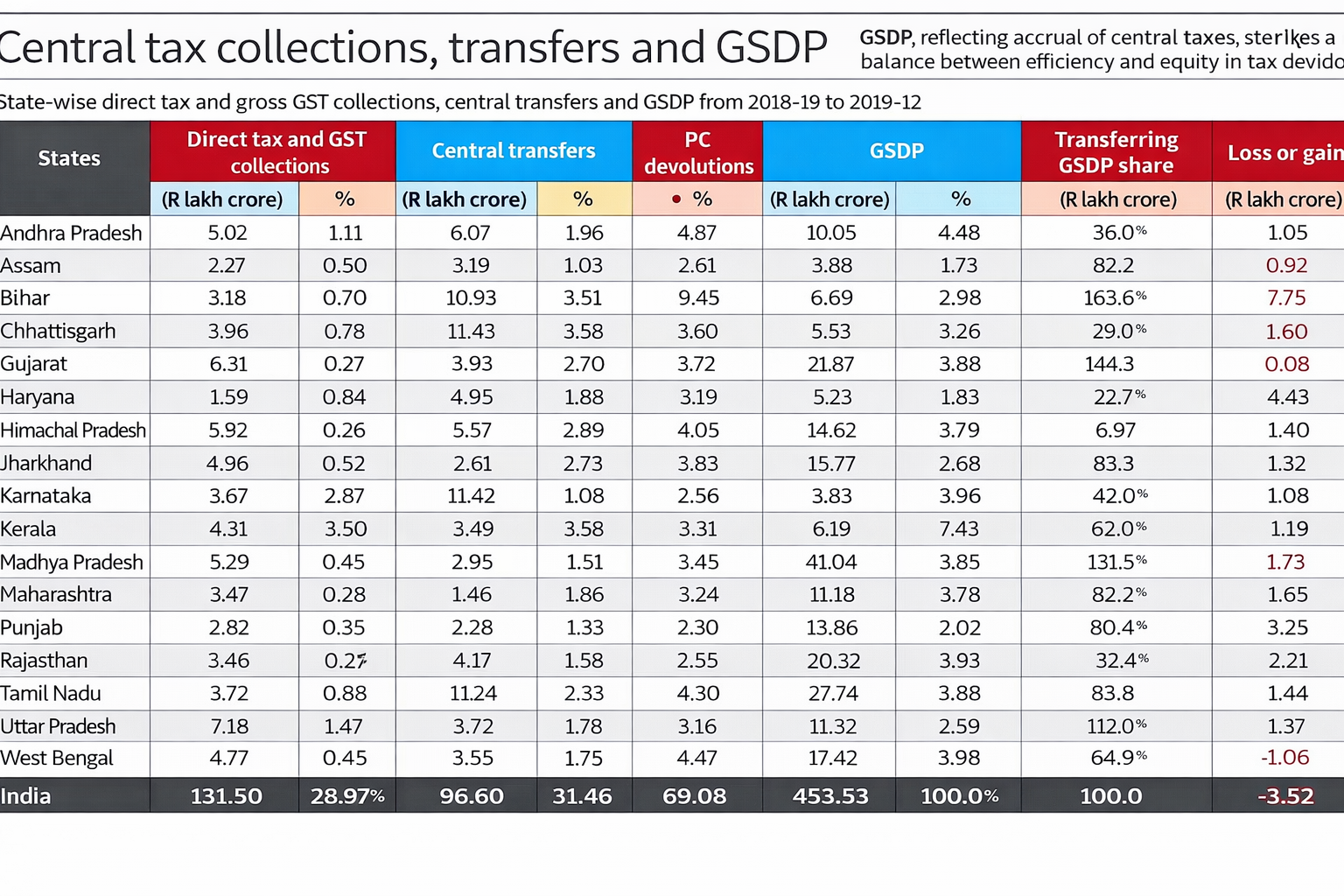
Core Theme and Context
The article examines the proposal to use Gross State Domestic Product (GSDP) share as a criterion for Centre–State fiscal transfers, situating it within India’s evolving framework of fiscal federalism after the abolition of the Planning Commission and the enhanced role of the Finance Commission.
The central question is whether GSDP-based allocation promotes fairness, efficiency, and cooperative federalism, or whether it risks reinforcing regional inequalities and distorting incentives.
Key Arguments Presented
1. Rationale for Using GSDP as a Criterion
The article argues that GSDP reflects:
- Economic size and contribution
- Revenue generation capacity
- Absorptive ability of States
Using GSDP, therefore, appears logical for allocating central funds, particularly for schemes requiring scale, co-financing, and administrative capacity.
2. Risk of Penalising Poorer and Smaller States
A major concern highlighted is that GSDP-based transfers may favour richer, high-growth States, while disadvantaging:
- Economically weaker States
- Hill and northeastern States
- States with structural constraints
This challenges the redistributive objective of fiscal transfers, which traditionally aim to correct horizontal imbalances.
3. Departure from Equity-Oriented Federal Principles
The article situates the debate against constitutional principles that prioritise:
- Equity
- Need-based transfers
- Balanced regional development
Excessive reliance on GSDP risks shifting transfers from equalisation logic to contribution logic, which may be more appropriate for tax devolution debates than grants-in-aid.
4. Interaction with Existing Finance Commission Criteria
The article notes that Finance Commissions already use a multi-criteria formula including income distance, population, area, forest cover, and demographic performance. Introducing GSDP dominance may:
- Distort this carefully balanced framework
- Overlap with or dilute redistributive weights
5. Political Economy and Federal Trust
Beyond technical aspects, the article highlights the political implications:
- Perception of bias against poorer States
- Reinforcement of North–South and Centre–State tensions
- Risk of weakening cooperative federalism
Fiscal transfers are not merely financial instruments but also signals of trust and partnership.
Author’s Stance
The author adopts a cautiously critical stance:
- Recognises the efficiency and transparency arguments for GSDP use
- Strongly warns against its over-emphasis
- Advocates balance between efficiency and equity
The tone is analytical and federalism-sensitive rather than ideological.
Implicit Biases and Editorial Leanings
1. Equity-Centric Bias
The article prioritises redistribution and regional balance, potentially underplaying:
- Incentive effects for growth and fiscal discipline
- Legitimate demands of contributor States
2. Skepticism of Market Logic in Federal Transfers
There is an implicit discomfort with using economic output as a primary determinant, reflecting a preference for welfarist federal design.
3. Status-Quo Preference
The article tends to defend existing Finance Commission frameworks, with limited exploration of whether they need reform to reflect changing economic realities.
Pros and Cons of the Argument
Pros
- Strong defence of equity in fiscal federalism
- Highlights risks of widening inter-State disparities
- Anchors debate in constitutional principles
- Highly relevant for Centre–State relations discourse
Cons
- Limited discussion on incentivising efficiency and growth
- Underplays fiscal stress in high-contributor States
- Less engagement with hybrid or phased approaches
Policy Implications
1. Need for Balanced Criteria
Fiscal transfers must balance:
- Equity (need and backwardness)
- Efficiency (capacity and performance)
- Incentives (growth, governance, fiscal prudence)
No single metric, including GSDP, can serve all objectives.
2. Strengthening Equalisation Role of Finance Commission
The article implicitly calls for reaffirming the Finance Commission’s role as:
- An equalising institution
- A buffer against regional divergence
3. Transparency and Consensus-Building
Any change in criteria must be:
- Data-transparent
- Consultative
- Sensitive to regional diversity
Real-World Impact
- Overuse of GSDP could widen regional inequality
- Poorer States may face reduced fiscal space for social spending
- Richer States may feel rewarded, but at the cost of federal cohesion
- Perception of fiscal unfairness could intensify political friction
For citizens, the issue affects quality of public services, development outcomes, and regional equity.
UPSC GS Paper Alignment
GS Paper II – Polity & Governance
- Centre–State relations
- Cooperative federalism
- Constitutional bodies
GS Paper III – Economy
- Fiscal federalism
- Public finance
- Intergovernmental transfers
GS Paper I – Society
- Regional disparities
- Balanced development
GS Paper IV – Ethics
- Equity vs efficiency
- Fairness in public resource distribution
Balanced Conclusion and Future Perspective
The article makes a persuasive case that GSDP should be used cautiously, not dominantly, in Centre–State transfers. While economic contribution and capacity matter, fiscal federalism in India is constitutionally designed to reduce disparities, not entrench them.
The way forward lies in:
- Retaining multi-dimensional transfer formulas
- Using GSDP as a supplementary, not overriding, criterion
- Ensuring that growth incentives do not undermine equity
Ultimately, fiscal transfers are not merely about numbers—they are about holding together a diverse Union through fairness, trust, and shared development.
