

Happiness Index: At 116th, India Trails in Key Indicators
Business Standard
1. Key Arguments
A. India’s Persistent Low Ranking
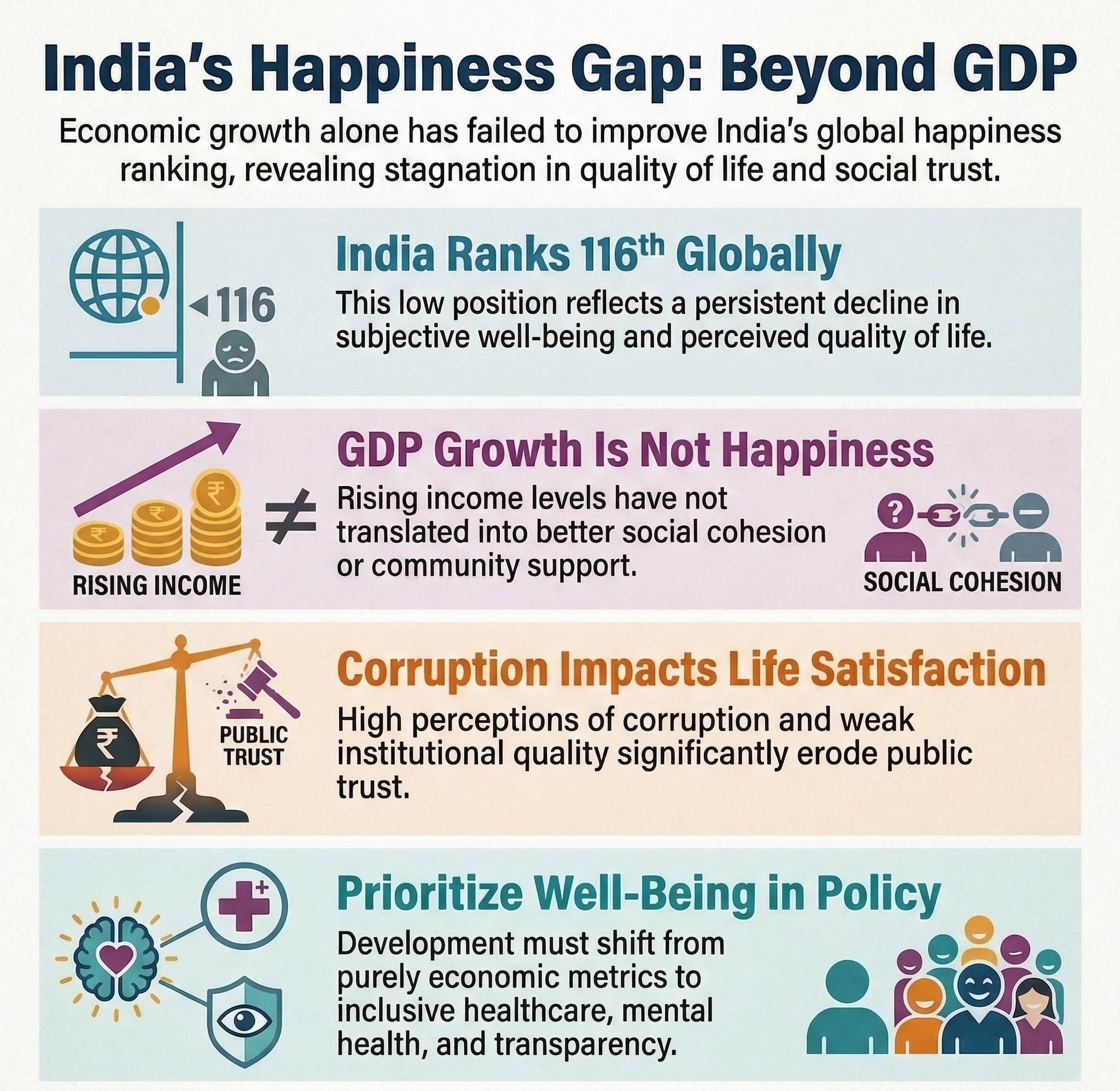
India ranks 116th, indicating weak performance in subjective well-being.
The ranking has declined over time, suggesting stagnation or deterioration in perceived quality of life.
B. Economic Growth Alone is Insufficient
GDP growth has not translated into happiness outcomes.
Despite improvements in income levels, other determinants like social trust and institutional quality lag behind.
C. Weak Social Support and Generosity Indicators
Low scores in social cohesion and community support.
Indicates weakening social capital and community-based networks.
D. Governance and Corruption Perception
High perception of corruption impacts trust in institutions.
This directly reduces citizens’ life satisfaction.
E. Comparative Underperformance
India lags behind neighbours and far behind Nordic countries.
Countries with strong welfare systems and social trust perform better.
2. Author’s Stance
Critical but data-driven
Implicit critique of development model
Questions growth-centric policy approach without corresponding social development.
Emphasis on holistic well-being
Advocates broader metrics beyond GDP.
3. Biases and Limitations
Over-reliance on subjective indicators
Happiness index is perception-based and may not fully capture objective improvements.
Cultural bias in measurement
Western frameworks of happiness may not align with Indian socio-cultural context.
Neglect of diversity within India
Large regional and socio-economic variations are not reflected in a single national ranking.
4. Strengths (Pros)
Highlights multidimensional development gaps
Moves beyond income to include governance, social trust, and health.
Encourages policy introspection
Pushes for inclusive and human-centric development.
Comparative global perspective
Provides benchmarks for improvement.
5. Weaknesses (Cons)
Simplistic correlation between rank and reality
Ranking alone may not reflect complex ground realities.
Insufficient causality analysis
Does not deeply examine why indicators like generosity or freedom are low.
Limited focus on recent improvements
Overlooks progress in infrastructure, digital inclusion, and welfare delivery.
6. Policy Implications
A. Shift to Well-being-Oriented Governance
Beyond GDP to quality of life metrics
Incorporate happiness and well-being indicators in policymaking.
B. Strengthening Social Capital
Community engagement and trust-building
Promote local institutions, civil society participation.
C. Governance Reforms
Reducing corruption and improving transparency
Digital governance, accountability mechanisms.
D. Health and Social Security
Improving healthcare access and mental well-being
Focus on both physical and psychological health.
E. Inclusive Growth
Reducing inequality
Ensuring benefits of growth reach all sections.
7. Real-World Impact
Societal Well-being
Rising stress, inequality, and dissatisfaction
Affects social harmony and cohesion.
Economic Productivity
Lower happiness can reduce workforce efficiency
Mental health impacts productivity.
Governance Legitimacy
Low trust weakens state-citizen relationship
Impacts policy compliance and participation.
Global Perception
Impacts India’s soft power and global image
Well-being rankings influence international perception.
8. UPSC GS Paper Linkages
GS Paper I (Society)
- Social capital
- Quality of life
- Inequality and well-being
GS Paper II (Governance)
- Transparency and accountability
- Welfare schemes and service delivery
GS Paper III (Economy)
- Inclusive growth
- Human development indicators
GS Paper IV (Ethics)
- Happiness, well-being, and ethics of governance
- Public service values
9. Balanced Conclusion
India’s low happiness ranking reflects structural gaps but must be interpreted with caution.
While it highlights genuine issues in governance and social well-being, methodological and cultural limitations of the index must also be acknowledged.
10. Future Perspective
Towards holistic development
Integrating economic growth with social and psychological well-being.
Data-driven governance reforms
Using well-being metrics for policy evaluation.
Strengthening institutions and trust
Key to improving long-term happiness outcomes.
Contextualising global indices
Adapting global frameworks to Indian realities.
Final Insight
True development lies not just in economic expansion, but in enhancing the lived experience and dignity of citizens.
