

Hidden Fragility of India’s Fertiliser Economy
Morning Standard
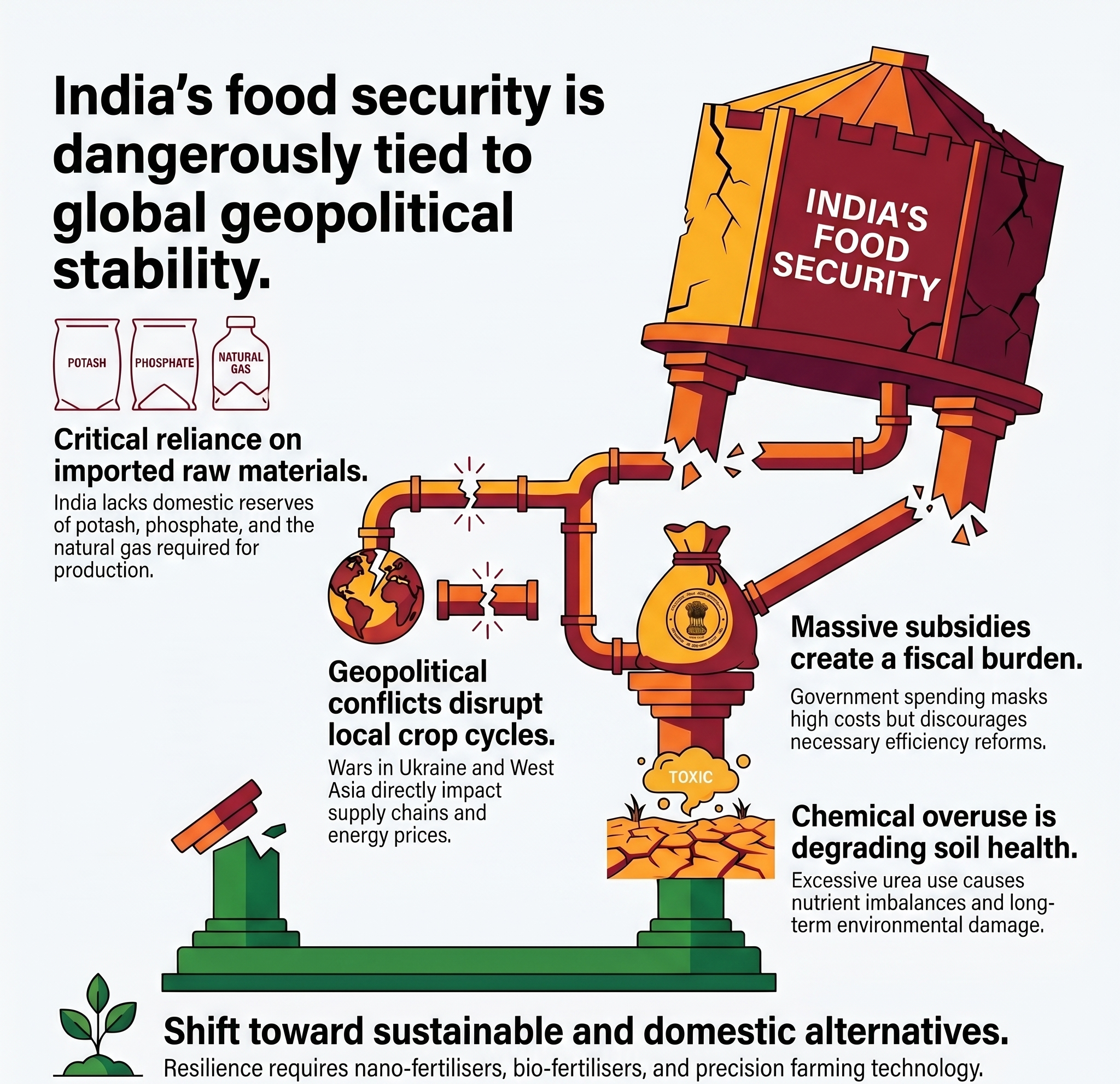
1. Core Issue and Context
The article critically examines the structural vulnerabilities within India’s fertiliser sector and argues that despite India’s agricultural achievements, the country remains heavily dependent on:
- Imported fertilisers
- Imported raw materials
- Global energy markets
- Geopolitical stability
The article particularly highlights how disruptions arising from:
- The Russia-Ukraine conflict
- West Asian instability
- Global supply-chain shocks
have exposed the hidden fragility of India’s fertiliser economy.
The discussion moves beyond agriculture and situates fertilisers within:
- Food security
- Energy security
- Economic sovereignty
- Geopolitical vulnerability
The core argument is:
India’s agricultural success is built upon an externally dependent fertiliser system vulnerable to global crises.
2. Key Arguments in the Article
India’s fertiliser sector is highly import-dependent
The article argues:
- India imports large quantities of:
- Fertilisers
- Natural gas
- Phosphatic and potassic inputs
This dependence exposes the country to:
- Global price shocks
- Supply disruptions
- Geopolitical tensions
Green Revolution created long-term structural dependence
The article suggests:
- India’s agricultural model became heavily fertiliser-intensive after the Green Revolution.
This increased:
- Productivity
but also created: - Chemical dependence
- Import vulnerability
- Soil degradation concerns
Geopolitical conflicts directly affect food security
The article links:
- Russia-Ukraine war
- West Asian instability
to disruptions in:
- Fertiliser supply chains
- Energy markets
- Shipping routes
thus affecting Indian agriculture.
Fertiliser subsidies mask deeper vulnerabilities
India’s subsidy system protects farmers from price shocks, but:
- It creates huge fiscal burdens
- It discourages efficiency reforms
- It may promote overuse of fertilisers
Need for sustainable alternatives
The article advocates:
- Organic inputs
- Precision farming
- Balanced nutrient use
- Domestic production diversification
3. Author’s Stance
Strongly critical of structural dependency
The article adopts:
- A cautionary and reform-oriented perspective
The author believes:
- India’s fertiliser security is strategically fragile.
The tone is:
- Analytical
- Geopolitically aware
- Sustainability-oriented
4. Underlying Biases
Strategic self-reliance perspective
The article strongly supports:
- Reducing external dependence
- Domestic resilience
Sustainability bias
The discussion favours:
- Ecological agriculture
- Efficient fertiliser use
- Long-term environmental stability
Critical view of subsidy-driven agriculture
The article appears sceptical of:
- Excessive subsidy dependence
- Input-intensive farming models
5. Structural Issues Highlighted
Import dependence for key fertiliser inputs
India lacks sufficient domestic reserves of:
- Potash
- Phosphate
- Natural gas
making imports unavoidable.
Energy-fertiliser linkage
Fertiliser production, especially urea, depends heavily on:
- Natural gas
Thus energy crises directly affect:
- Fertiliser availability
- Prices
Subsidy burden
India spends enormous amounts on:
- Fertiliser subsidies
This affects:
- Fiscal sustainability
- Public expenditure priorities
Soil degradation and ecological imbalance
Excessive chemical fertiliser use contributes to:
- Soil nutrient imbalance
- Declining soil fertility
- Environmental degradation
6. Pros (Positive Dimensions of India’s Fertiliser System)
Supports food security
Fertiliser availability played a major role in:
- Achieving food self-sufficiency
- Supporting Green Revolution gains
Protects farmers from global price shocks
Subsidies help:
- Stabilise agricultural costs
- Prevent rural distress
Boosts agricultural productivity
Fertiliser use significantly increased:
- Crop yields
- Food grain production
Supports national food stability
Reliable fertiliser access remains crucial for:
- Large-scale agricultural output
7. Cons and Concerns
High external vulnerability
India remains exposed to:
- Global conflicts
- Shipping disruptions
- Currency fluctuations
Unsustainable subsidy burden
Massive subsidies strain:
- Government finances
- Fiscal discipline
Environmental damage
Overuse of chemical fertilisers contributes to:
- Water pollution
- Soil degradation
- Greenhouse gas emissions
Nutrient imbalance
Indian agriculture often overuses:
- Urea
while underusing:
- Balanced nutrients
leading to declining soil health.
8. Policy Implications
Need for fertiliser diversification
India should:
- Expand domestic manufacturing
- Diversify import sources
- Develop alternative nutrients
Promoting sustainable agriculture
Policies should support:
- Organic farming
- Bio-fertilisers
- Precision agriculture
- Soil health management
Rationalising subsidies
Subsidy reforms may focus on:
- Efficient targeting
- Balanced nutrient incentives
Strengthening strategic reserves
India may require:
- Fertiliser security reserves
- Long-term supply agreements
Encouraging technological innovation
Need for:
- Nano fertilisers
- Efficient nutrient delivery systems
- AI-driven precision farming
9. Real-World Impact
Impact on farmers
Global price shocks affect:
- Input affordability
- Profitability
- Crop planning
Impact on food inflation
Fertiliser shortages or high costs may:
- Raise food prices
- Increase inflationary pressure
Impact on fiscal health
Subsidy expansion affects:
- Budgetary resources
- Development expenditure priorities
Impact on environmental sustainability
Current fertiliser practices influence:
- Long-term agricultural sustainability
- Water quality
- Soil productivity
10. UPSC GS Paper Linkages
GS Paper III (Agriculture)
Relevant themes:
- Fertiliser subsidy
- Food security
- Sustainable agriculture
- Green Revolution
GS Paper III (Economy)
Relevant themes:
- Subsidies
- Import dependence
- Fiscal burden
- Global supply chains
GS Paper III (Environment)
Relevant themes:
- Soil degradation
- Chemical pollution
- Sustainable farming
GS Paper II (International Relations)
Relevant themes:
- Geopolitical impact on trade
- Energy security
- Supply-chain vulnerability
Essay Relevance
Important themes:
- “Food security and sustainability”
- “Self-reliance versus globalisation”
- “Agriculture and environmental balance”
11. Critical Examination from UPSC Perspective
India’s food security rests on external dependencies
The article reveals a paradox:
India achieved food self-sufficiency while remaining externally dependent for critical agricultural inputs.
Green Revolution success created ecological challenges
The fertiliser-intensive agricultural model increased:
- Production
but also generated: - Environmental degradation
- Input dependency
Agriculture is now geopolitically linked
Modern agriculture depends not only on:
- Rainfall and land
but also on: - Energy markets
- Global trade routes
- International conflicts
Need for balanced agricultural transition
India cannot abruptly abandon chemical fertilisers because:
- Food security requirements remain enormous.
However, gradual transition toward:
- Sustainable and efficient agriculture
is necessary.
12. Balanced Conclusion
The article effectively highlights the hidden structural vulnerabilities within India’s fertiliser economy and demonstrates how agricultural security is deeply interconnected with:
- Energy markets
- Geopolitics
- Global supply chains
- Fiscal policy
While fertilisers played a vital role in achieving food self-sufficiency, excessive dependence on imports and subsidies has created long-term strategic and ecological concerns.
The challenge before India is:
- Not merely increasing fertiliser supply,
but ensuring: - Sustainable,
- resilient,
- environmentally balanced,
and - strategically secure agricultural systems.
13. Future Perspective
India’s future agricultural resilience will increasingly depend on:
- Domestic fertiliser innovation
- Green ammonia and alternative nutrients
- Precision agriculture
- Bio-fertilisers
- Balanced nutrient management
- Climate-resilient farming systems
Ultimately, true agricultural self-reliance will not come only from producing more food, but from building an ecologically sustainable and strategically resilient agricultural economy capable of withstanding global geopolitical and environmental shocks.
