

How Budget 2026 backs clean energy
Business Standard
Overview of the Article
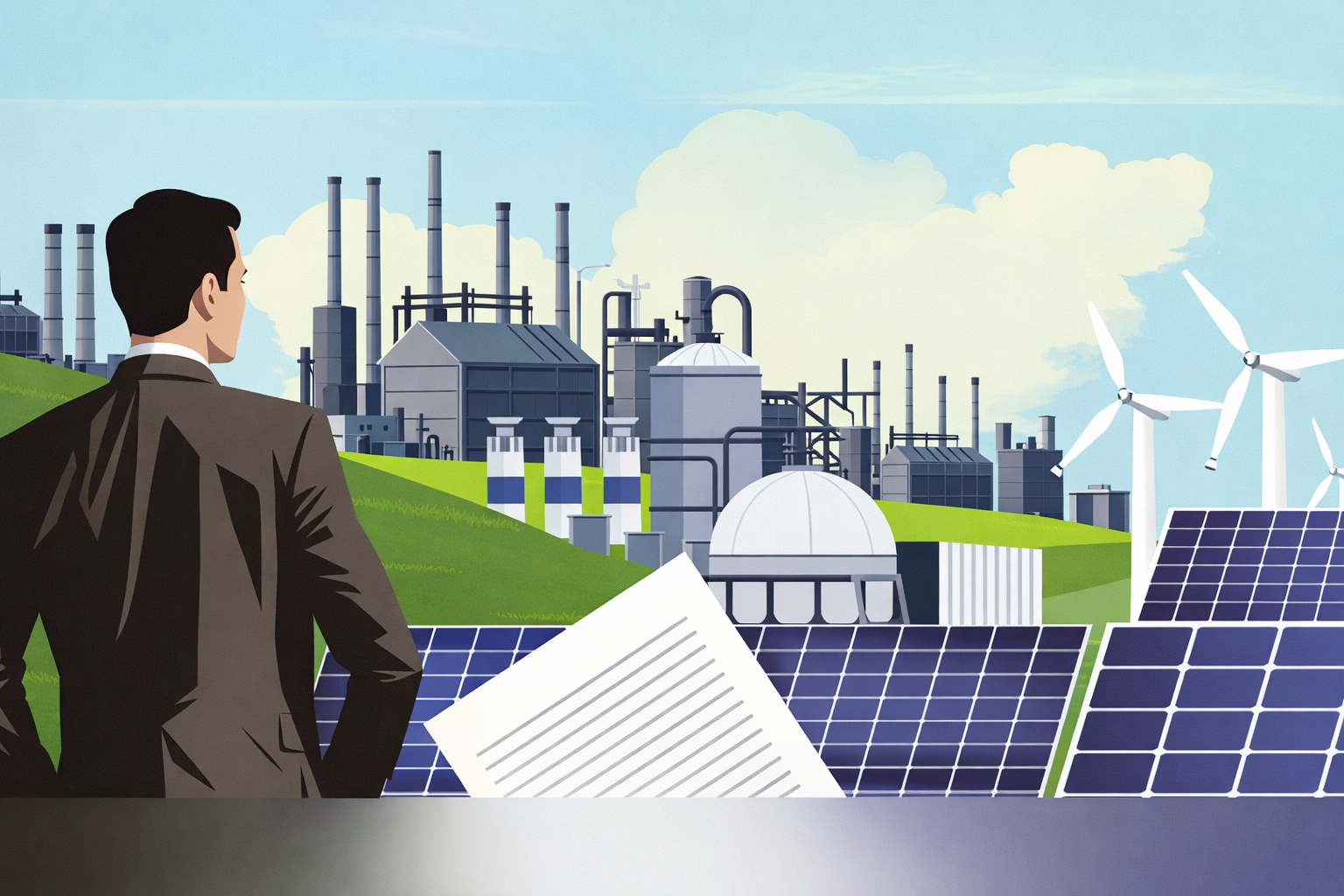
The article analyses Union Budget 2026 through the lens of India’s clean energy transition. It argues that the Budget signals a long-term strategic shift towards decarbonisation, energy security and supply-chain resilience rather than short-term subsidies. Clean energy is framed not only as an environmental imperative but also as an industrial and geopolitical strategy.
Key Arguments
Clean energy as strategic infrastructure
The Budget positions renewable energy, green hydrogen, energy storage and nuclear power as core pillars of India’s future growth and security architecture.
Supply-chain resilience over mere capacity addition
A central emphasis is on reducing import dependence—especially on critical minerals, battery components and clean-tech inputs—by strengthening domestic manufacturing and processing.
Balanced energy mix approach
Instead of an exclusive focus on renewables, the article highlights support for nuclear energy, storage technologies and grid stability to address intermittency challenges.
Industrial policy alignment
Customs duty rationalisation, incentives for domestic manufacturing and public–private partnerships are presented as tools to link clean energy goals with Make-in-India objectives.
Long-term transition signal
The Budget is portrayed as laying foundations for a decade-long transition rather than delivering immediate emission cuts.
Author’s Stance and Bias
Stance
The author adopts a broadly supportive and strategic stance, interpreting the Budget as coherent and forward-looking in its clean energy vision.
Biases
There is a noticeable optimism towards policy intent and industrial strategy. Ground-level implementation risks, state capacity constraints and affordability concerns are relatively underplayed.
Pros Highlighted
Policy coherence
The Budget aligns climate goals with industrial growth, energy security and geopolitical realities.
Focus on self-reliance
Reducing dependence on imported clean-tech components strengthens resilience against global shocks.
Technology diversification
Support for storage and nuclear alongside renewables reflects realism about grid stability and baseload needs.
Investment signalling
Clear signals to investors can crowd in private capital into clean energy and allied sectors.
Cons and Limitations
Execution challenges
Scaling domestic manufacturing of clean-tech components requires skills, infrastructure and regulatory clarity that remain uneven.
Fiscal and affordability concerns
The article does not deeply examine cost pass-through to consumers or fiscal risks of sustained incentives.
Uneven transition risks
Smaller firms, coal-dependent regions and informal workers may face adjustment pressures without adequate transition planning.
State-level bottlenecks
Land acquisition, grid integration and state utility finances are not sufficiently discussed.
Policy Implications
Integrated energy governance
Clean energy policy must coordinate across power, industry, mining, transport and finance ministries.
Critical minerals strategy
Securing supply chains for lithium, rare earths and other inputs becomes a strategic priority.
Just transition planning
Regions and workers dependent on fossil fuels require reskilling, social protection and alternative livelihoods.
Grid and storage investment
Renewable expansion must be matched by storage capacity and grid modernisation.
Real-World Impact
If effectively implemented, the Budget’s clean energy push can accelerate decarbonisation while enhancing energy security and industrial competitiveness. Poor execution, however, risks stranded assets, import substitution failures and uneven development outcomes across states and sectors.
UPSC GS Paper Linkages
GS Paper III – Environment & Climate Change
Decarbonisation, energy transition, mitigation strategies.
GS Paper III – Indian Economy
Industrial policy, energy security, manufacturing and infrastructure.
GS Paper II – Governance & International Relations
Strategic autonomy, global supply chains, climate commitments.
Conclusion and Future Perspective
The article convincingly frames Budget 2026 as a strategic inflection point in India’s clean energy journey—less about immediate gains and more about structural transformation. Its success will hinge not on announcements alone, but on coordinated execution, state capacity and a just transition framework. If these gaps are addressed, the Budget’s clean energy vision could redefine India’s growth model for the next decade.
