

How district cooling can ease India’s climate and urban planning troubles
The Hindu
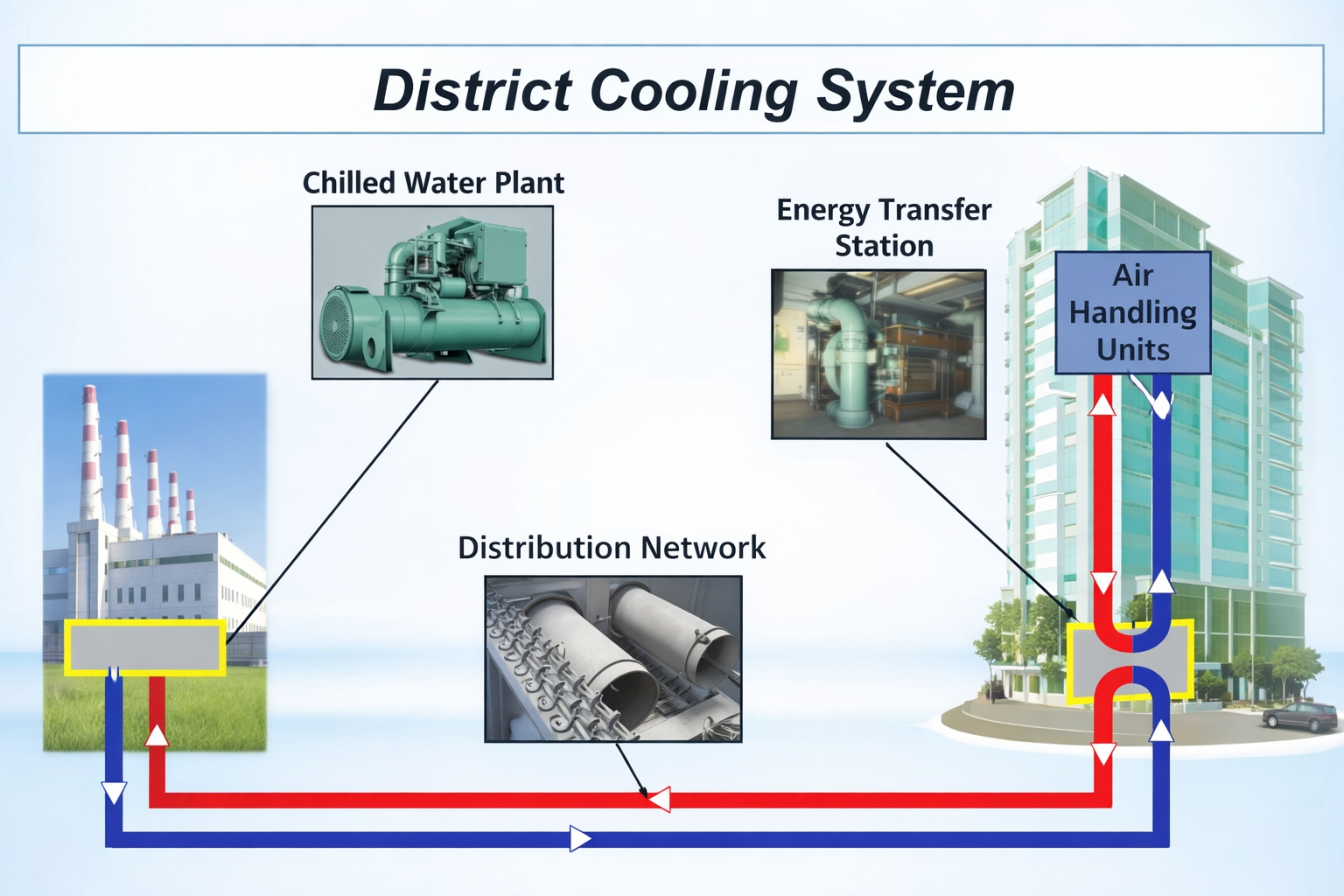
Central Thesis
The article argues that district cooling systems (DCS) — centralised cooling networks supplying chilled water to clusters of buildings — can significantly reduce energy demand, peak load stress, and greenhouse gas emissions in India’s rapidly urbanising and warming cities. It positions district cooling as a climate-resilient urban infrastructure solution rather than merely a technological alternative to air-conditioners.
Key Arguments
1. Cooling Demand is Surging
With rising temperatures, rapid urbanisation, and increasing incomes, India’s cooling demand is growing sharply, straining electricity grids and increasing emissions.
2. District Cooling as a Systemic Alternative
Instead of individual air-conditioning units in each building, a central plant distributes chilled water through insulated pipelines. This allows load optimisation, economies of scale, and efficiency gains.
3. Energy and Emission Benefits
District cooling can reduce peak electricity demand significantly, improve grid stability, and lower emissions — especially if integrated with renewable energy.
4. Urban Planning Integration
The system works best in dense, mixed-use developments and planned urban clusters, suggesting the need for integrated planning rather than retrofitting.
5. Policy and Regulatory Support Needed
The article calls for urban planning mandates, service standards, pricing models, and financing frameworks to mainstream district cooling.
Author’s Stance
The tone is solution-oriented and supportive of district cooling as a climate mitigation and adaptation tool. It emphasises long-term infrastructure thinking and systemic planning. The article adopts a techno-optimistic approach, suggesting DCS as an important component of sustainable urban development.
Possible Biases
Technocratic Optimism
The article may overstate feasibility in Indian cities with fragmented planning and informal settlements.
Capital-Intensive Model Assumption
Limited attention is given to financing constraints for smaller cities or municipal bodies with weak fiscal capacity.
Implementation Complexity Underplayed
Challenges such as coordination failures, land acquisition, and retrofitting costs receive limited scrutiny.
Advantages of District Cooling
- Reduces peak electricity load
- Enhances grid stability
- Improves energy efficiency
- Cuts greenhouse gas emissions
- Enables integration with renewable sources
- Reduces urban heat island effect indirectly
- Supports climate-resilient infrastructure
Challenges and Risks
- High upfront capital investment
- Requires strong urban planning frameworks
- Limited applicability in low-density areas
- Retrofitting existing cities is complex
- Requires regulatory clarity and pricing transparency
- Dependence on municipal governance capacity
Policy Implications
Urban Planning Reform
Master plans must incorporate cooling infrastructure at the design stage, especially in new townships and smart cities.
Energy Policy Integration
District cooling aligns with India’s renewable energy targets and energy efficiency commitments.
Climate Adaptation Strategy
As heatwaves intensify, cooling infrastructure becomes part of climate resilience planning.
Regulatory Architecture
Clear tariff models, concession agreements, and service standards are needed to attract private investment.
Public-Private Partnerships
Given capital intensity, PPP frameworks will be central to scaling deployment.
Real-World Impact
- Lower electricity demand reduces blackout risks during heatwaves.
- Improved air quality due to lower fossil fuel consumption.
- Reduced household cooling costs over the long term.
- Enhanced competitiveness of commercial districts through energy reliability.
However, equitable access remains a concern if district cooling is confined to premium developments.
UPSC GS Paper Linkages
GS Paper III – Environment and Climate Change
- Climate adaptation strategies
- Urban heat island mitigation
- Energy efficiency and emissions reduction
GS Paper III – Infrastructure and Energy
- Sustainable urban infrastructure
- Renewable integration
- Grid management
GS Paper II – Governance
- Urban local bodies
- Smart Cities Mission
- Regulatory frameworks
GS Paper I – Geography
- Urbanisation patterns
- Climate variability and heatwaves
Essay Themes
- “Climate-Resilient Urban Infrastructure”
- “Technology as an Enabler of Sustainable Development”
Balanced Conclusion and Future Perspective
District cooling represents a promising systems-level solution to India’s rising cooling demand and urban climate stress. Its success, however, hinges on integrated urban planning, regulatory clarity, financing innovation, and institutional capacity.
If implemented strategically — especially in new urban clusters and high-density zones — district cooling can reduce energy stress and emissions while strengthening climate resilience. Yet it must complement broader energy efficiency, building design reforms, and inclusive urban governance to deliver sustainable outcomes.
India’s urban future will depend not only on building more cities, but on building them smarter and cooler.
