

How India’s New Nuclear Rules Could Favour Russia

How India’s New Nuclear Rules Could Favour Russia
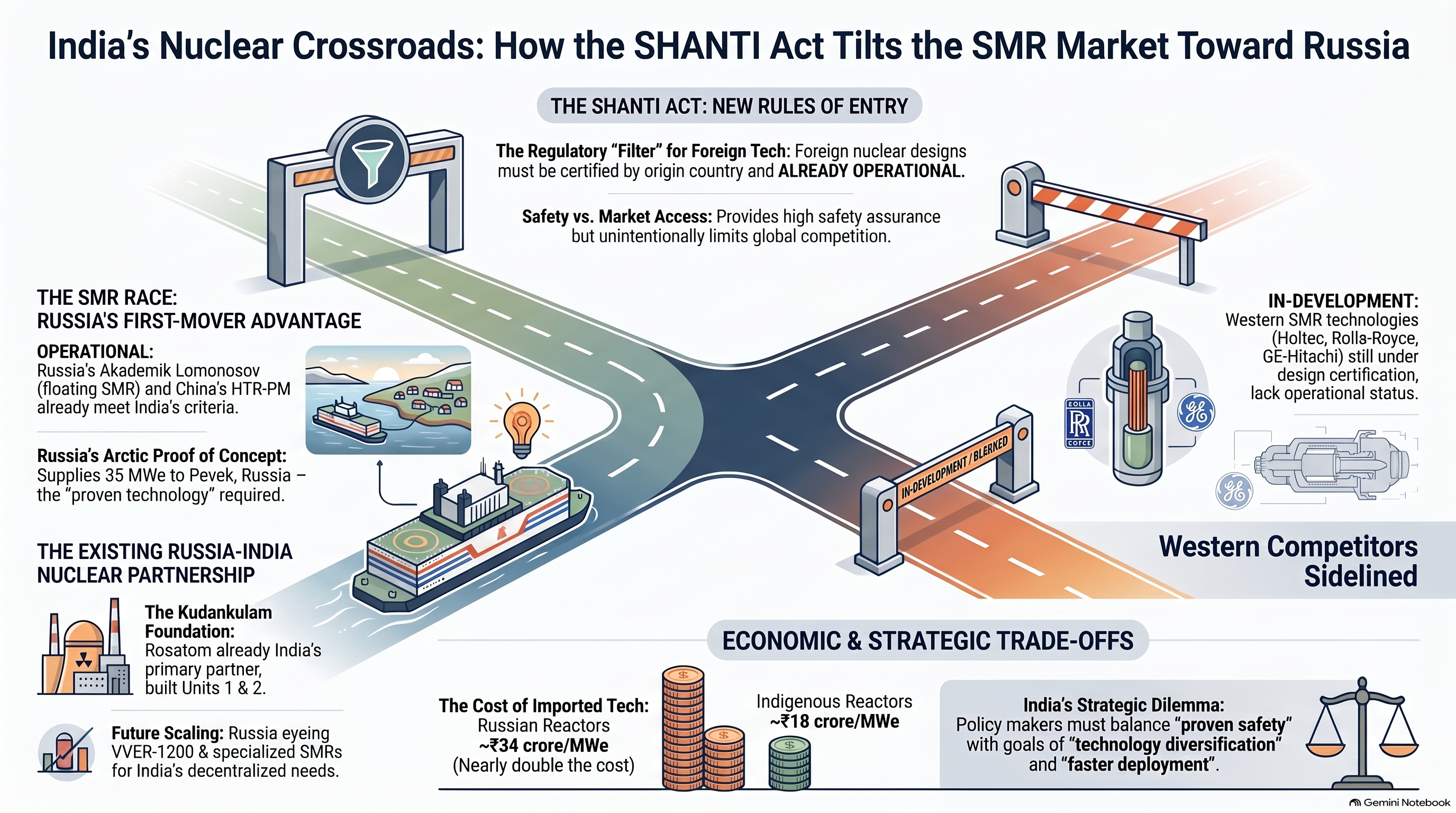
- Draft rules under the SHANTI Act could strengthen Russia’s position in India’s emerging nuclear energy market, particularly in Small Modular Reactors (SMRs).
- The draft rules reportedly require foreign nuclear technology used in an Indian nuclear power plant or reactor to:
- Have its design certified or approved by the regulatory authority of its country of origin.
- Already be operational in the country of origin or another foreign country.
- This requirement could favour Russia because several competing SMR technologies from companies such as Holtec International, Rolls-Royce SMR and GE-Hitachi are still undergoing design certification and have not yet received domestic regulatory approval.
- SMRs are advanced nuclear reactors with a smaller generating capacity than conventional reactors. They can provide relatively flexible, low-carbon baseload electricity and are being considered for:
- Remote areas with limited grid infrastructure.
- Energy-intensive industries.
- Data centres.
- Decentralised power generation.
- Russia has an early operational advantage in SMRs. Its Akademik Lomonosov floating nuclear power plant has two 35 MWe reactor modules and began commercial operation in 2020. It supplies electricity and heat to Pevek in Russia's Arctic region.
- China's HTR-PM is another operational SMR project. It was grid-connected in 2021 and began commercial operations in 2023.
- Russia is already a major nuclear partner of India through Rosatom. The Kudankulam Nuclear Power Project (KKNPP) in Tamil Nadu is the flagship example of India-Russia nuclear cooperation.
- Units 1 and 2 use Russian VVER-1000 light-water reactors.
- These units are connected to India's national grid and supply electricity to southern India.
- Russia is also seeking greater participation in the construction of new-generation VVER-1200 reactors in India.
- Cooperation is now potentially expanding to Russian-designed SMRs, including floating nuclear power technology. Russia currently has significant experience in this field.
- Russia may also enjoy a cost advantage in conventional light-water reactors. Industry estimates cited in the article place the cost of indigenous reactors at around ₹18 crore/MWe, compared with approximately ₹34 crore/MWe for Russian reactors, although both remain substantially dependent on high upfront capital investment.
- Nuclear power projects face major financial challenges because capital costs, financing costs and long construction periods significantly affect the final cost of electricity.
- The broader issue is that the SHANTI rules could unintentionally limit competition in India's nuclear sector if foreign technologies still under regulatory certification are unable to enter the Indian market.
- At the same time, the rules could improve safety and regulatory assurance by ensuring that imported reactor designs have already undergone approval and operational experience elsewhere.
For India, the challenge is therefore to balance nuclear safety and proven technology with competition, technology diversification and faster deployment of SMRs.
