

How stampedes happen, how they can be prevented

How stampedes happen, how they can be prevented
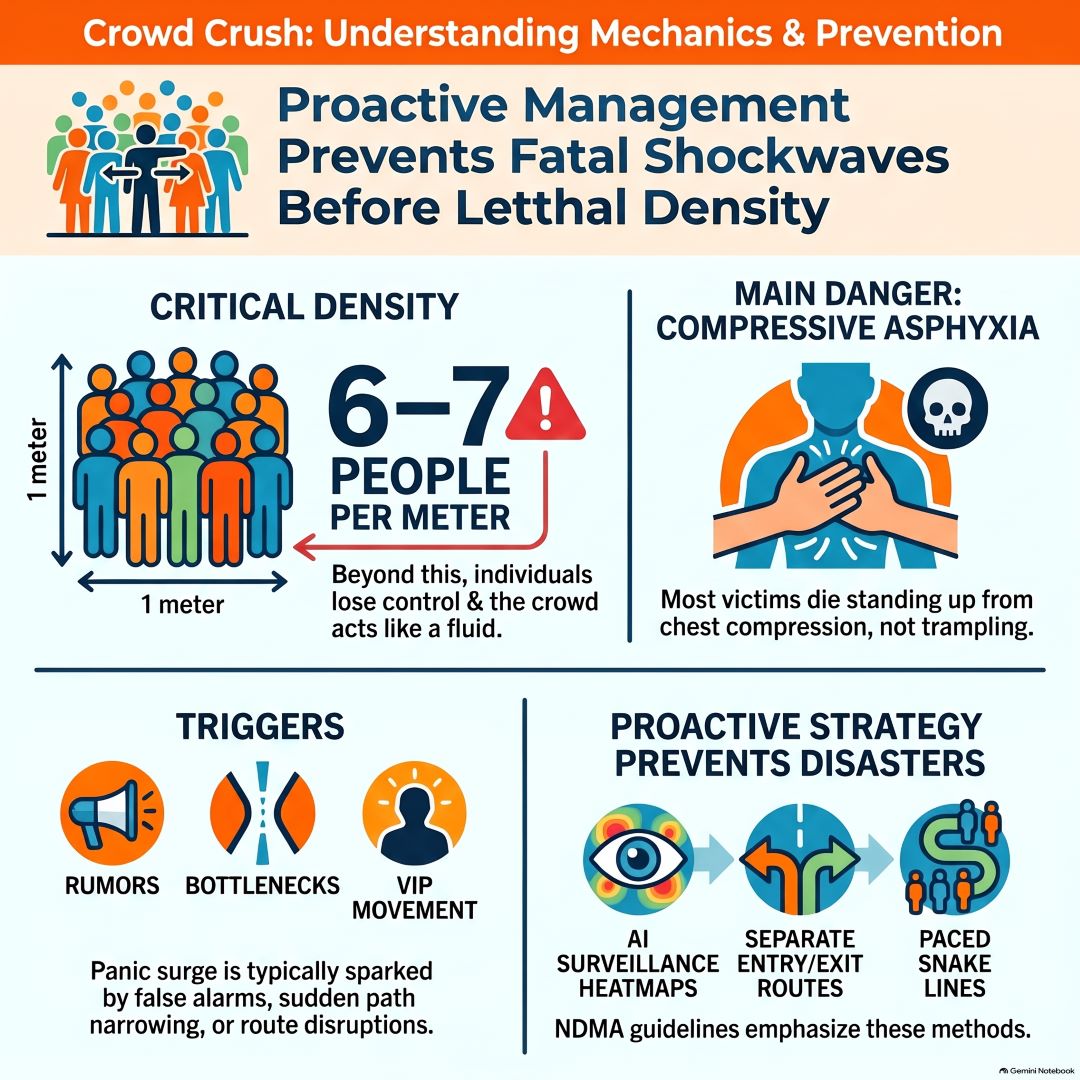
How Stampedes Happen: The Mechanics of Chaos
A stampede is rarely a simple case of people running; in modern disaster management, it is more accurately termed a "Crowd Crush."
- Critical Density: When crowd density exceeds 6–7 persons per square meter, individual control over movement is lost. The crowd begins to behave like a fluid (shockwaves).
- The "Triggers":
- Rumors: False alarms about fire, electrical short circuits, or structural collapse (e.g., a falling pole) cause sudden, panicked movement.
- Bottlenecks: Sudden narrowing of paths or locked exit gates (e.g., Uphaar Cinema tragedy) during a surge.
- VIP Movement: Abrupt changes in crowd flow to accommodate VIPs often result in "cross-flows" that destabilize the queue.
- Compressive Asphyxia: Most deaths occur because people are packed so tightly they cannot expand their chests to breathe. They die standing up, not just by being "trampled."
How to Prevent Stampedes: The NDMA Strategy
The National Disaster Management Authority (NDMA) guidelines emphasize shifting from "Crowd Control" (reactive) to "Crowd Management" (proactive).
1. Planning and Capacity Assessment
- Venue Mapping: Using GPS and drones to identify "choke points."
- Paced Entry: Implementing "Snake Lines" (zigzag queues) to break the momentum of a rushing crowd.
- Capacity Limits: Strictly enforcing a "One-in, One-out" policy once the venue reaches a safe threshold.
2. Technological Integration
- AI Surveillance: Using CCTV with Real-time Crowd Analytics to detect high-density "heatmaps" before they turn into crushes.
- PA Systems: Robust, multi-lingual Public Address systems to dispel rumors instantly.
- UAVs/Drones: For aerial monitoring of "hidden" bottlenecks in large processions like Kumbh Mela.
3. Structural and Administrative Fixes
- Separate Routes: Ensuring entry and exit paths never overlap.
- Banning Encroachments: Removing illegal vendors and stalls that narrow the effective width of the path.
- Emergency Exits: Must be clearly marked, well-lit, and never locked.
4. Behavioral Management
- Volunteer Training: Training local NGOs and 'Sevadars' (in religious contexts) to act as first responders.
- Public Awareness: Signages showing the "Do's and Don'ts"—such as staying calm and moving with the flow rather than against it.