

IMMUNITY TO THE CHIEF ELECTION COMMISSIONER AND ELECTION COMMISSIONERS: THE DEBATE

IMMUNITY TO THE CHIEF ELECTION COMMISSIONER AND ELECTION COMMISSIONERS: THE DEBATE
Context
The Supreme Court has issued notice to the Union Government on a petition filed by the Association for Democratic Reforms (ADR), challenging Section 16 of the Chief Election Commissioner and Other Election Commissioners (Appointment, Conditions of Service and Terms of Office) Act, 2023.
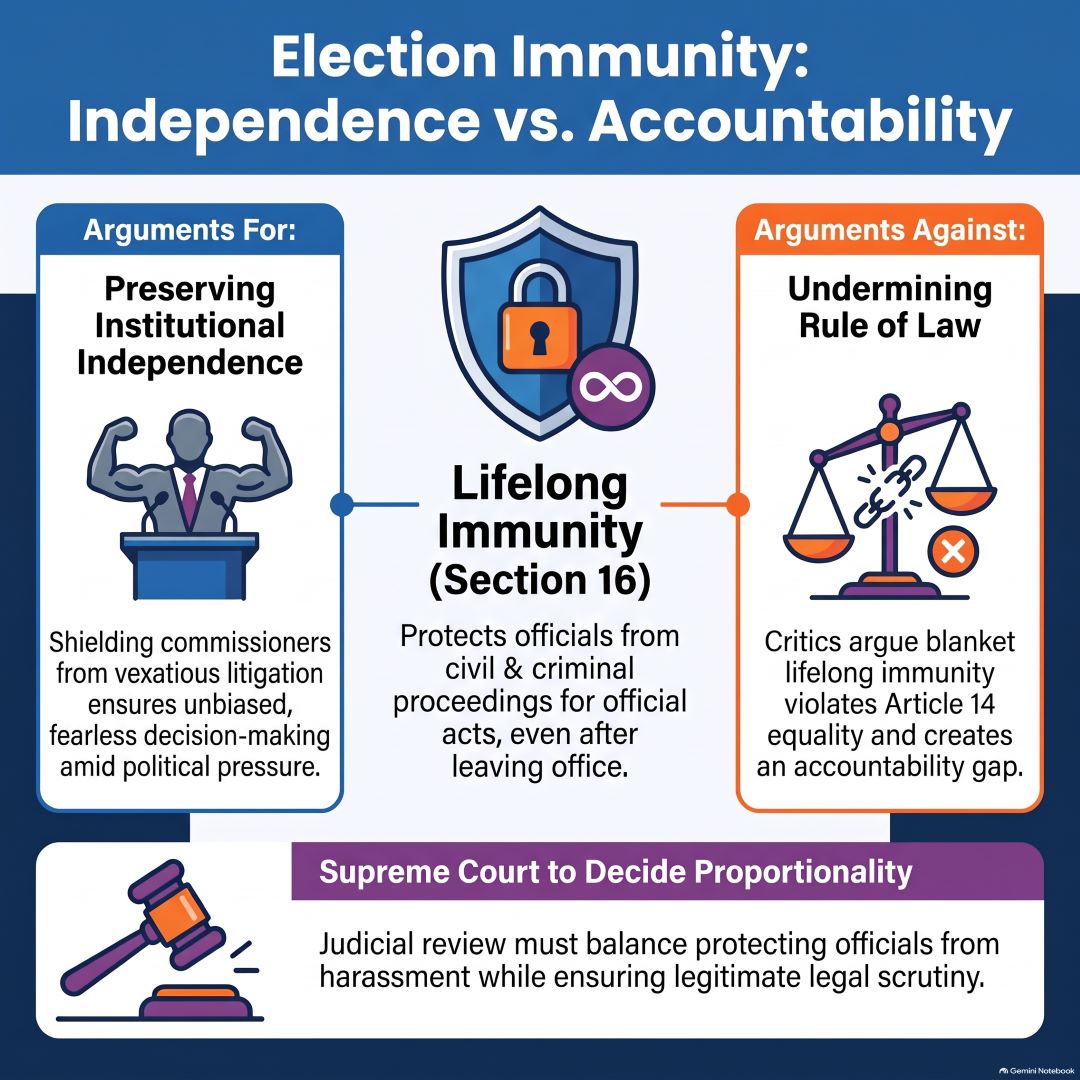
The provision grants the Chief Election Commissioner (CEC) and Election Commissioners (ECs) immunity from civil and criminal proceedings for acts done or purportedly done in the discharge of official duties, including after they leave office. The challenge raises questions about equality before the law, institutional independence and accountability.
Constitutional and Legal Framework
- Article 14 — Equality Before Law: Guarantees equality before the law and equal protection of the laws. Any classification that grants special treatment must have an intelligible basis and a rational connection with its objective.
- Article 324 — Election Commission: Vests the superintendence, direction and control of elections to Parliament, state legislatures, and the offices of President and Vice-President in the Election Commission of India.
- CEC and Other Election Commissioners Act, 2023: Section 16 provides protection against civil and criminal proceedings for current and former CECs and ECs concerning acts done or purportedly done in the discharge of official duties.
- Article 361 — President and Governors: Provides specified constitutional immunities during their term of office, including protection from criminal proceedings and arrest. It also lays down conditions for civil proceedings concerning personal acts.
- Articles 105 and 194 — Legislative Privileges: Protect parliamentary and state legislative privileges, including specified protections relating to speech and votes within the legislature.
What Is the Controversy?
- Lifelong Protection: Section 16 extends to former election commissioners, unlike the term-linked immunity available to the President and Governors under Article 361.
- Scope of Immunity: The provision covers acts done or purportedly done in the discharge of official duties. Critics argue that its breadth may make accountability difficult.
- Legislative History: According to the supplied article, the provision was introduced through an amendment in the Rajya Sabha on the day the Bill was passed there, rather than appearing in the original Bill.
- Government's Rationale: The Union Law Minister stated that the amendment was intended to enable the CEC and ECs to discharge their functions independently and without hindrance.
- Judicial Scrutiny: The Supreme Court's notice indicates that the constitutional challenge has been taken up for consideration; it does not, by itself, mean that Section 16 has been struck down.
Arguments Against the Provision
- Equality Before Law: Critics contend that lifelong immunity may create an unusually broad exception to Article 14 without sufficient justification.
- Accountability Gap: Blanket protection may make it harder to initiate legal proceedings concerning alleged misconduct linked to official duties.
- Disproportionate Protection: Several independent constitutional and statutory authorities, including judges, the Comptroller and Auditor General (CAG), Public Service Commission members and Information Commissioners, do not enjoy an identical blanket lifelong immunity.
- Absence of Clear Justification: Critics question whether permanent immunity is necessary to protect election commissioners from political pressure.
- Electoral Integrity: The Election Commission plays a central role in ensuring free and fair elections. Effective accountability is therefore important for public confidence in the electoral process.
Arguments in Favour of Immunity
- Functional Independence: Protection from potentially vexatious litigation may allow election commissioners to take impartial decisions without fear of retaliatory proceedings.
- Protection from Political Pressure: Election-related decisions can be politically contentious, increasing the possibility of complaints intended to intimidate officials.
- Institutional Stability: Appropriate legal safeguards can help preserve the independent functioning of constitutional institutions.
- Distinction Between Official and Personal Acts: Immunity linked to official functions can be defended as a mechanism to protect legitimate decision-making rather than personal conduct.
Comparison with Other Immunities
- President and Governors: Article 361 provides specified immunity during their term of office; it does not establish a general lifelong immunity for all official acts.
- Legislators: Articles 105 and 194 provide privileges relating to legislative functions, including freedom of speech and protection concerning votes, subject to constitutional interpretation.
- Diplomats: Diplomatic immunity under international law, including the Vienna Convention on Diplomatic Relations, is based on functional necessity and the reciprocal conduct of international relations.
- Other Public Authorities: Different constitutional and statutory offices have distinct protections. Their immunities vary in scope, duration and purpose, so they cannot be treated as legally identical.
Way Forward
- Judicial Review: The Supreme Court should examine whether Section 16 satisfies the requirements of Article 14 and whether its scope is proportionate to the objective of protecting institutional independence.
- Clearly Defined Scope: Any protection should distinguish bona fide official decisions from alleged actions that fall outside legitimate official functions.
- Safeguards Against Frivolous Cases: Appropriate procedural safeguards can protect election commissioners from harassment without creating unnecessary barriers to legitimate legal accountability.
- Legislative Clarity: Parliament should clearly explain the purpose, scope and duration of immunity provisions affecting independent constitutional institutions.
- Institutional Independence and Accountability: Reforms should protect the Election Commission from political interference while preserving lawful mechanisms for scrutiny and redress.
Conclusion
The debate over Section 16 reflects the constitutional tension between protecting independent election administration and ensuring accountability under the rule of law. The central question is whether lifelong immunity is necessary and proportionate to safeguard the Election Commission's independence. A balanced legal framework must protect bona fide official decisions without placing public officials beyond appropriate judicial scrutiny.