

In Opposing Creamy layer for SC/ST for what gov argued.

In Opposing Creamy layer for SC/ST for what gov argued.
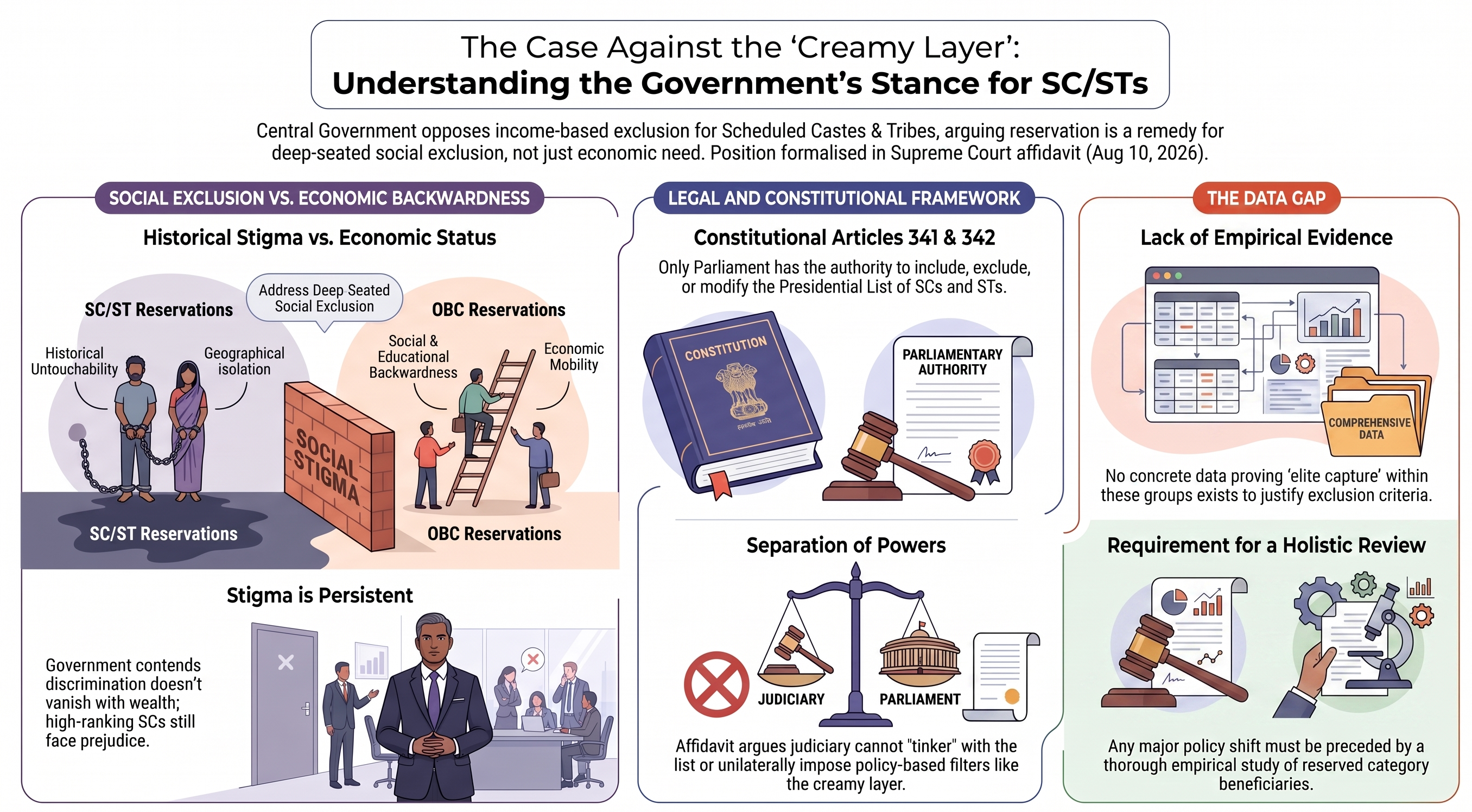
Context:
The Central Government has consistently maintained a firm stance against applying the "creamy layer" principle to Scheduled Castes (SCs) and Scheduled Tribes (STs), most recently in an affidavit filed before the Supreme Court on August 10, 2026.
The government's arguments focus on the distinction between economic status and the deep-seated social exclusion that these communities face.
1. Social Exclusion vs. Economic Backwardness
The Centre argues that the very basis of SC/ST reservation is fundamentally different from that of Other Backward Classes (OBCs).
- Historical Stigma: Reservation for SCs is rooted in the historical practice of untouchability, while for STs, it is based on geographical isolation and distinct cultural identity.
- Stigma is Persistent: The government contends that social discrimination does not vanish simply because a family achieves economic mobility. An SC individual in a high government position may still face social prejudice, which is not the case for the "creamy layer" of OBCs who are primarily identified through social and educational backwardness.
2. Legal and Constitutional Framework
The government relies on the literal interpretation of the Constitution to argue that the judiciary cannot unilaterally impose a creamy layer.
- Article 341 & 342: The Centre emphasizes that under these Articles, only Parliament has the power to include, exclude, or modify the list of SCs and STs. Any judicial direction to exclude a "creamy layer" would, in the government’s view, amount to "tinkering" with the Presidential List, which is constitutionally impermissible.
- Separation of Powers: The affidavit states that policy framing—especially regarding reservation—falls within the executive and legislative domains. The courts should not direct the government to adopt specific policies like an income-based filter.
3. Lack of Empirical Data
A significant pillar of the government’s opposition is the current lack of data.
- Need for Study: The Centre argued that any major shift, such as introducing a creamy layer, must be preceded by a holistic review and a thorough empirical study of socio-economic data concerning reserved category beneficiaries.
- Action Taken Report (ATR): In its recent submission, the government noted that without concrete data showing "elite capture" within these groups, imposing an exclusion criteria would be arbitrary.
