

INDIA AS A GLOBAL GROWTH PARTNER

INDIA AS A GLOBAL GROWTH PARTNER
Context
- Addressing the Bloomberg New Economy Forum 2026 in New Delhi, Prime Minister Narendra Modi presented India as a stable economic partner amid global conflicts, geopolitical uncertainty and disruptions in international trade.
- He emphasised that India’s reforms are driven by conviction rather than compulsion, highlighting economic resilience, structural reforms and the philosophy of “power to empower”.
India’s Economic Momentum
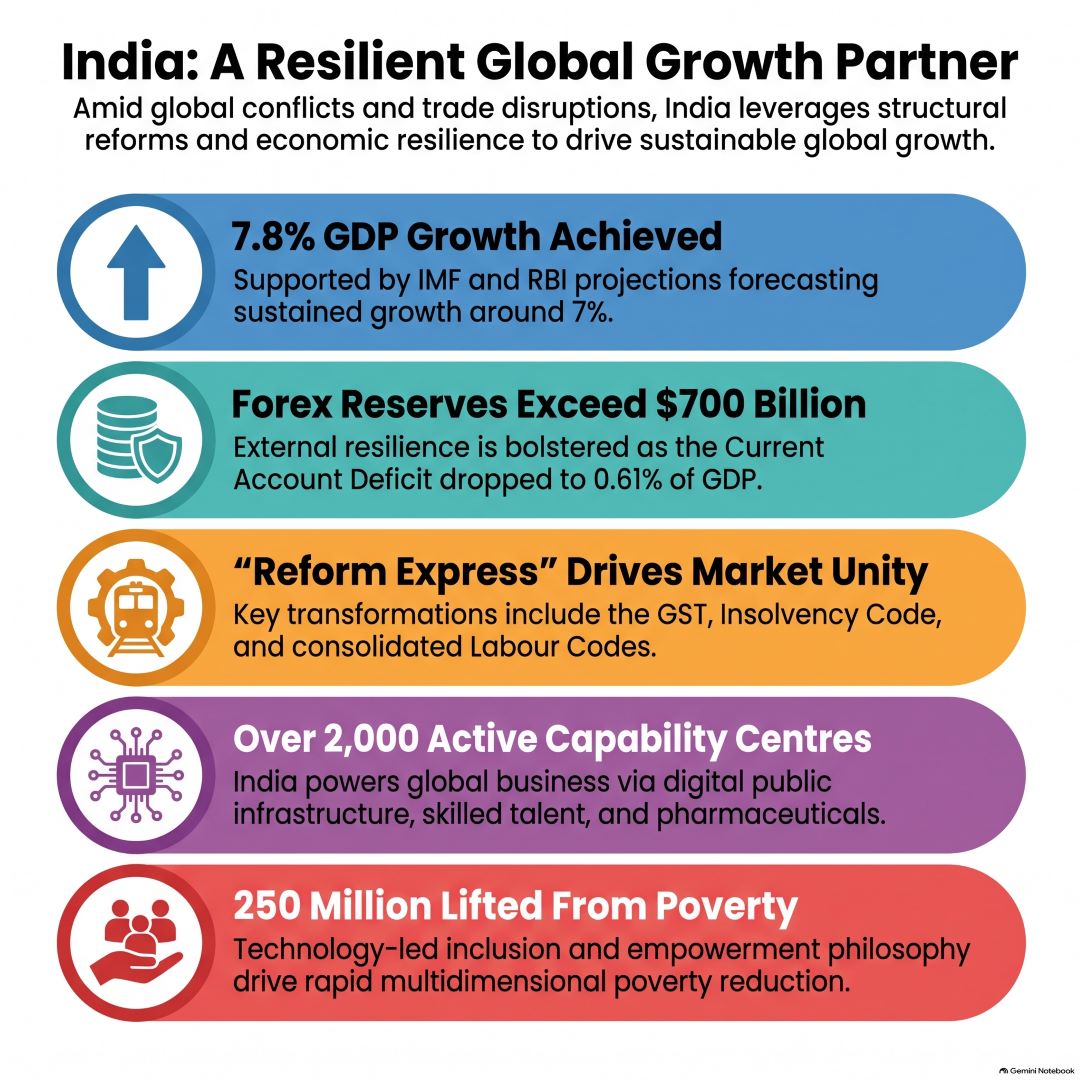
- GDP Growth: India recorded GDP growth of 7.8% during April–June 2026, according to the figures cited in the report.
- IMF Projection: The International Monetary Fund reportedly raised India’s GDP growth forecast for 2026–27 to 7%, from 6.4% in July 2026.
- RBI Projection: The Reserve Bank of India reportedly revised its growth projection to 7.1%.
- Current Account Deficit: India’s current account deficit declined from over 4% of GDP around 12–13 years ago to 0.61% in the previous financial year, according to the address.
- Foreign Exchange Reserves: Reserves were reported to exceed $700 billion, strengthening the country’s external-sector resilience.
- Banking Sector: Improvements in banking-sector stability and financial health were highlighted as contributors to economic confidence.
Key Economic Reforms: “Reform Express”
- Goods and Services Tax (GST): Established a unified indirect tax framework to facilitate a common national market.
- Insolvency and Bankruptcy Code (IBC): Introduced a time-bound framework for resolving insolvency and improving credit discipline.
- Four Labour Codes: Consolidated 29 central labour laws into four codes to simplify labour regulation.
- Decriminalisation of Minor Offences: Reduced criminal penalties for various minor business-related violations to improve the ease of doing business.
- Reform Philosophy: The government presented reforms as a continuous process driven by long-term economic objectives rather than external pressure.
Global Challenges: A Crisis of Trust
- Weaponisation of Interdependence: Supply chains, energy resources, critical minerals, payment systems and technology are increasingly being used as instruments of geopolitical pressure.
- Supply Chain Vulnerabilities: Trade routes and networks developed through globalisation can become strategic chokepoints during conflicts.
- Technological Transformation: Artificial intelligence (AI) is reshaping economic activity, industrial production and employment.
- Demographic Pressures: Ageing populations in several countries are creating challenges for labour supply, productivity and social security.
- Need for Cooperation: These developments underline the importance of diversified supply chains, resilient institutions and trust-based international partnerships.
India’s Approach: “Power to Empower”
- Affordable Medicines: India’s pharmaceutical industry supplies generic medicines to countries worldwide, supporting access to affordable healthcare.
- Digital Public Infrastructure (DPI): Platforms and systems associated with Aadhaar and UPI demonstrate India’s experience in digital identity and payments.
- Skilled Human Capital: India’s large talent pool supports global industries in information technology, research, engineering and professional services.
- Global Capability Centres (GCCs): More than 2,000 GCCs in India support multinational companies through technology, research, analytics and business services.
- Vaccine Diplomacy: During the COVID-19 pandemic, India supplied vaccines to more than 100 countries through its international vaccine cooperation initiatives, including Vaccine Maitri.
- Artificial Intelligence for Humanity: India’s AI-related initiatives emphasise the potential of AI to address human challenges and explore applications benefiting animals and the wider environment.
Governance Philosophy: Empowerment Over Dependency
- Citizen-Centric Governance: Government intervention should strengthen citizens’ capabilities rather than create unnecessary dependence on public institutions.
- Poverty Reduction: The Prime Minister cited an estimate that approximately 250 million people had moved out of multidimensional poverty over the preceding decade.
- Technology-Led Inclusion: Digital public infrastructure and direct benefit transfers can improve the delivery of public services and welfare benefits.
- Global South Cooperation: India seeks to share its technological capabilities, development experience and digital solutions with developing countries.
- Capacity Building: Cooperation based on knowledge-sharing and institutional development can help partner countries strengthen their own capabilities.
Significance for India
- Global Economic Leadership: Sustained growth and structural reforms can strengthen India’s role in international trade, investment and economic cooperation.
- Supply Chain Diversification: India can contribute to more diversified manufacturing and supply networks as businesses seek alternatives to concentrated production.
- Strategic Autonomy: Strong domestic capabilities in technology, energy, pharmaceuticals and manufacturing can reduce external vulnerabilities.
- Soft Power: Affordable medicines, digital solutions, humanitarian assistance and development partnerships can strengthen India’s international engagement.
- Inclusive Development: Linking domestic economic growth with international cooperation can expand opportunities for innovation, employment and human development.
Conclusion
India’s emergence as a global growth partner depends on combining sustained economic growth with structural reforms, technological capabilities and international cooperation. The philosophy of “power to empower” seeks to connect domestic development with global public benefits. Translating this vision into lasting outcomes will require productive employment, inclusive growth, institutional credibility and resilient economic partnerships.