

India-EFTA TEPA: One Year of a New-Generation Trade Partnership

India-EFTA TEPA: One Year of a New-Generation Trade Partnership
Why in News?
- Source: Vajiram & Ravi, Daily Editorial Analysis, 1 October 2026, "The India-EFTA Partnership, One Plus One Equals Three". The text does not name the original newspaper, so please add it if you know it.
- The Trade and Economic Partnership Agreement (TEPA) between India and the European Free Trade Association (EFTA) completes one year on 1 October 2026. It entered into force on 1 October 2025.
- The focus now is on turning the agreement into actual investment, jobs and technology partnerships, with Iceland as an example.
Background
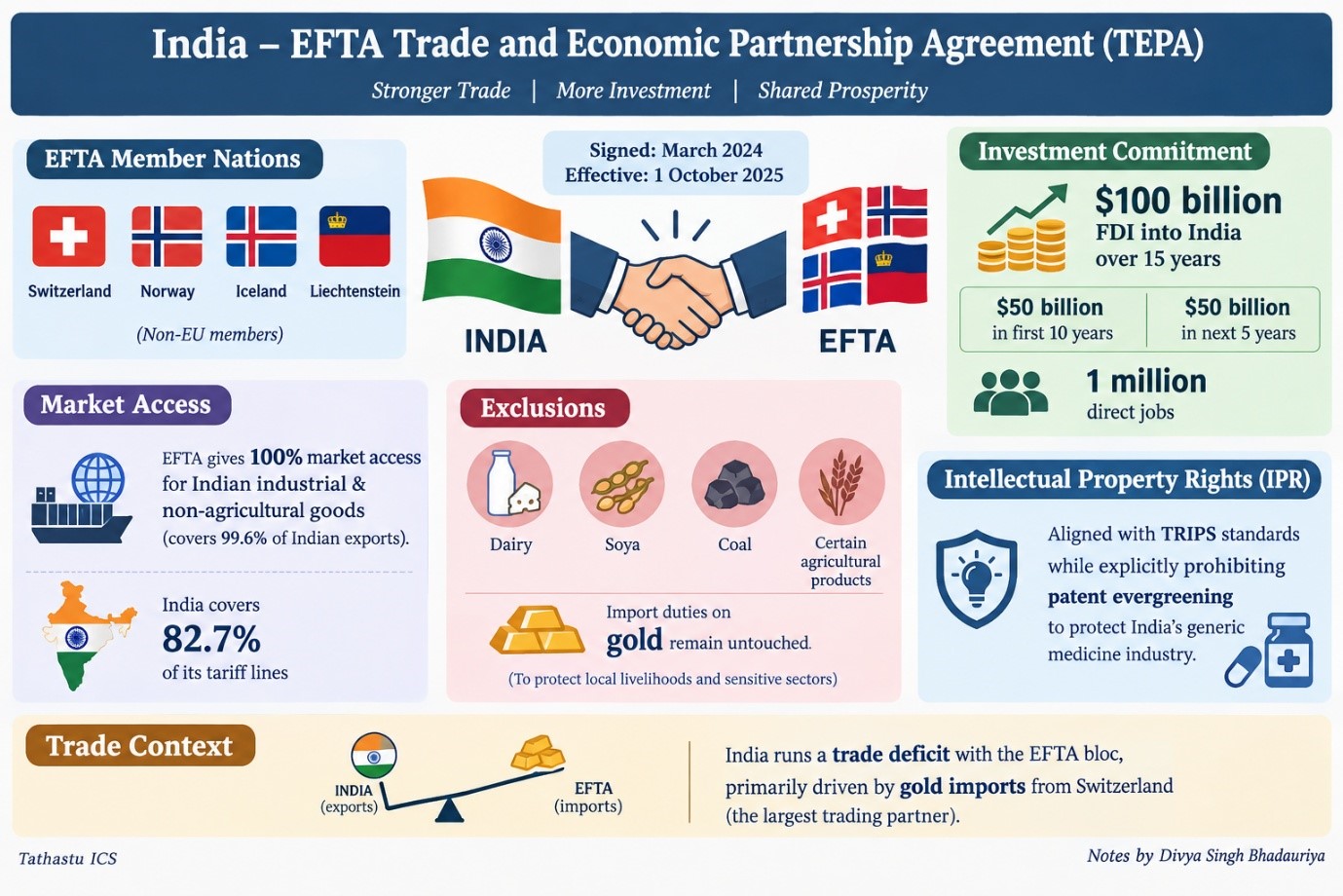
- EFTA has four members: Iceland, Liechtenstein, Norway and Switzerland. It is not part of the European Union.
- TEPA was signed in March 2024 after negotiations that began in 2008.
- It is India's first trade agreement with a dedicated chapter on investment promotion and job creation.
- Market access:
- EFTA offers concessions on 92.2% of tariff lines, covering 99.6% of the value of Indian exports.
- India offers concessions on 82.7% of tariff lines, covering 95.3% of EFTA exports.
- EFTA has committed to facilitating $100 billion of investment over 15 years and one million direct jobs in India.
Key Areas of Cooperation with Iceland
|
· Geothermal energy: o Iceland has long experience using geothermal heat for heating, farming and food processing. o At Tapri in Himachal Pradesh, an Indian-Icelandic venture uses geothermal heat to dry apples, so growers can store produce instead of selling during the harvest glut. o It can also improve energy security for remote Himalayan communities and border posts that depend on fuel brought through difficult routes. · Carbon capture, utilisation and storage (CCUS): o It is vital for hard-to-abate sectors such as steel, cement, refining, chemicals and power. o NITI Aayog estimates India could capture about 750 million tonnes of CO₂ a year by 2050. The Budget has allocated ₹20,000 crore over five years. o Iceland's CarbFix technology dissolves CO₂ in water and injects it into basalt rock, where it turns into stone. India's Deccan Trap basalt formations offer similar potential. o Iceland also converts captured CO₂ into methanol. · Fisheries and the blue economy: o Iceland uses about 90% of each cod landed, making medical products, oils and feed from skin, liver and bones. o India can raise income and exports by adding value to existing catches, not only by increasing fishing volumes. · Arctic cooperation: o Iceland is a founding member of the Arctic Council. India has been an Observer since 2013, released its Arctic Policy in 2022 and runs the Himadri research station at Svalbard.
|
Challenges and Way Forward
- Investment pledges must become real projects, jobs and skills, since the commitments are targets rather than binding obligations.
- Technologies like geothermal and CCUS need infrastructure, finance, clear regulation and trained manpower.
- India should focus on technology absorption and local capacity-building, with Indian firms and institutions as active partners rather than passive recipients.
- Pilot projects should be scaled up to commercial deployment.
Conclusion
- TEPA moves beyond tariff cuts to a partnership built on investment, technology, jobs and sustainability, and shows how countries of very different sizes can combine complementary strengths.
