

India Must Build, Not Just Trade

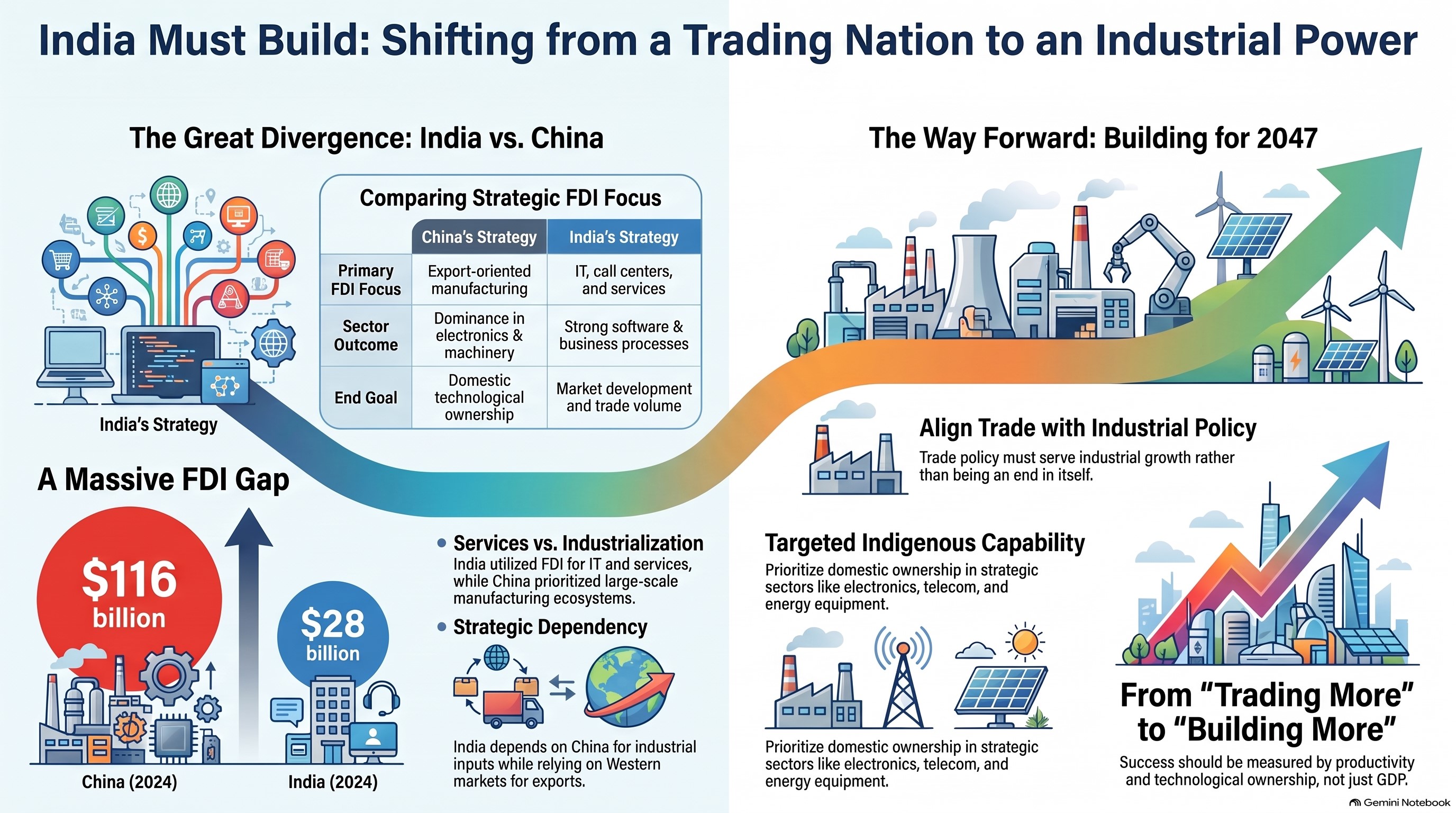
Core Argument
- India’s post-1991 growth strategy prioritised trade liberalisation and services but did not build manufacturing capabilities at a comparable scale.
- The article argues that trade expansion alone cannot make India economically or geopolitically self-reliant; industrial capability must become the foundation of trade policy.
- India–China trade illustrates this imbalance: India increasingly imported capital goods and industrial inputs from China while exporting primary commodities and other lower-value products.
- China simultaneously expanded its manufacturing base and technological capabilities, creating a widening industrial asymmetry between the two countries.
India–China Divergence
- Since 1991, China followed a strategy that combined market reforms with active industrial development, whereas India relied more heavily on liberalisation and market-led allocation.
- China’s manufacturing sector became vastly larger than India’s, enabling it to dominate global production of machinery, electronics, automobiles and other high-value products.
- India’s dependence on Chinese industrial inputs, particularly in sectors such as telecom, power equipment and electronics, has therefore acquired both economic and national-security implications.
- India faces a strategic vulnerability when it depends on China for critical industrial inputs while relying on the US and other countries for technology access and export markets.
FDI and Trade: Different Uses
|
China |
India |
|
Used FDI substantially as an instrument of industrialisation. |
FDI has been concentrated more strongly in services and market development. |
|
Attracted multinational firms to manufacture electronics, machinery, automobiles and other products. |
FDI has had a strong presence in IT services, call centres and business-process operations. |
|
Integrated foreign firms into export-oriented manufacturing ecosystems. |
Foreign investment has contributed less to the development of domestic manufacturing capabilities. |
|
Enabled technology acquisition, product development and greater domestic technological capability. |
Created strong services capabilities but comparatively weaker hardware and industrial ecosystems. |
- In 2000, FDI inflows were around $41 billion in China compared with $4 billion in India.
- Even in 2024, China attracted about $116 billion in FDI compared with around $28 billion for India.
- The key difference is therefore not merely the volume of FDI but what productive capabilities the investment creates.
Limitations of India’s Post-1991 Approach
- India rapidly integrated into the global trade regime, including GATS in 1995 and the Information Technology Agreement (ITA) in 1996.
- Zero or low tariffs on several IT products benefited India’s emerging software industry by providing access to affordable hardware, but also weakened incentives for some domestic hardware producers.
- Liberalisation increased GDP growth but did not automatically generate sufficient manufacturing depth, technological ownership or high-quality employment.
- Policy has often favoured importers, traders and services over building domestic industrial enterprises and technological capabilities.
- The central policy gap is therefore the absence of a sufficiently strong, long-term industrial strategy linking trade, FDI, technology and domestic production.
Way Forward: Build Industrial Capability
- India needs an industrial policy that directs trade policy rather than treating trade liberalisation as an end in itself.
- FDI should be increasingly channelled towards manufacturing, technology development, domestic supply chains and export-oriented production.
- Build indigenous capabilities in strategic sectors such as electronics, machinery, telecommunications, energy equipment and advanced manufacturing.
- Link imports and global integration with technology transfer, domestic value addition, skill development and R&D where appropriate.
- Strengthen Indian enterprises so that they can design, manufacture, innovate and own technologies rather than remaining dependent on imported components and foreign intellectual property.
- Policy success should be measured not only through GDP and trade volumes but also through productivity, wages, quality employment, technological capability and economic security.
- India’s goal of becoming a developed economy by 2047 requires a shift from simply “trading more” to “building more” — productive enterprises, technologies, industrial ecosystems and better jobs for its citizens.
