

India needs to shield its core interests
The Tribune
Key Arguments of the Article
Emergence of New Warfare Technologies
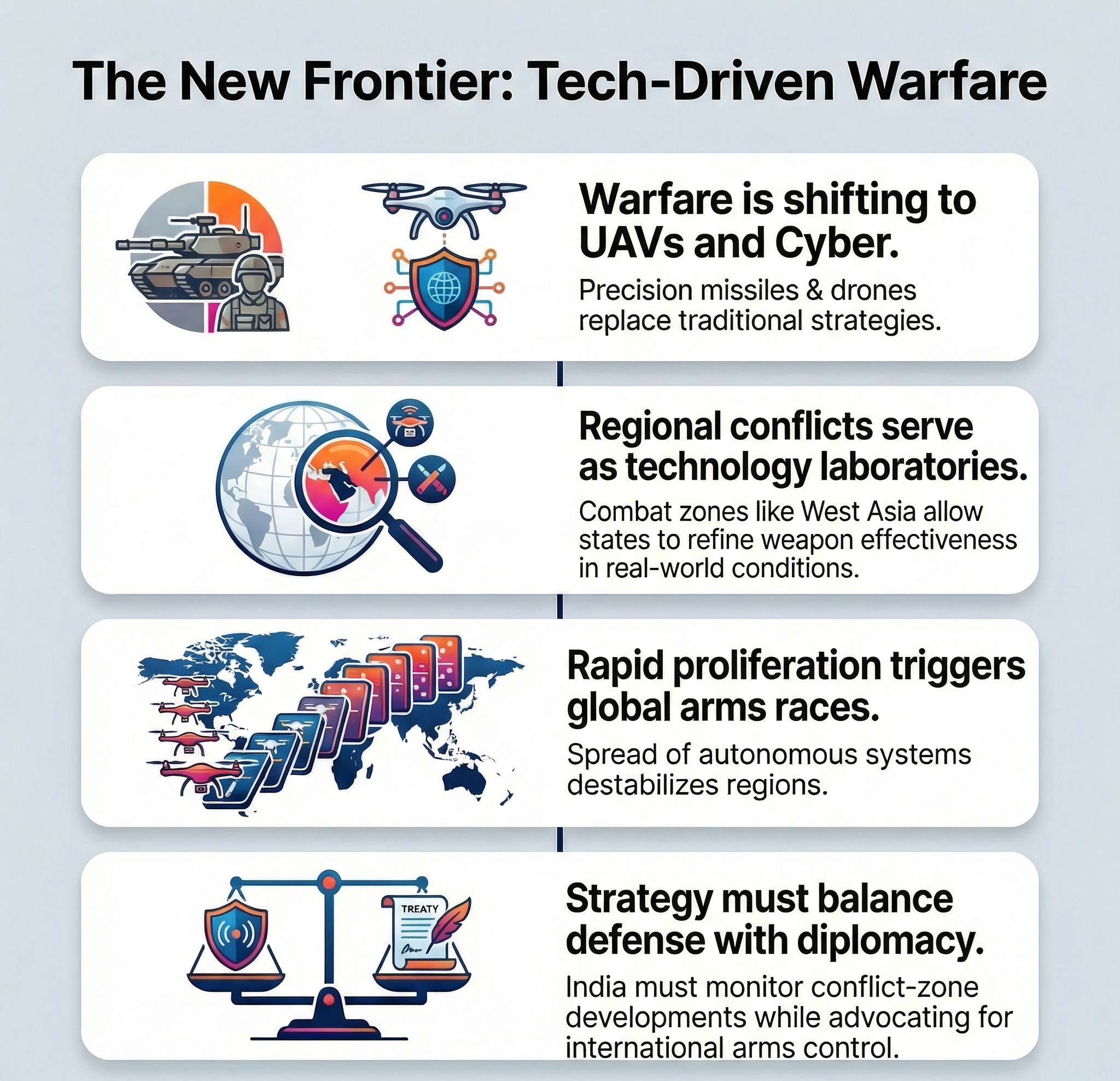
Modern conflicts increasingly involve advanced technologies such as unmanned aerial vehicles, precision-guided missiles, and cyber capabilities.
Iran has been actively developing and deploying such systems.
Regional Conflicts as Testing Platforms
The article argues that ongoing tensions in West Asia create opportunities for states to test new military technologies in real-world conditions.
Operational experience allows militaries to refine tactics and improve weapon effectiveness.
Influence on Global Military Trends
Developments in Iranian military capabilities have implications beyond the region. Drone warfare and asymmetric military strategies demonstrated in West Asia are influencing military doctrines worldwide.
Strategic Signalling and Deterrence
Testing advanced weapons also serves as a deterrence strategy, signalling military capability to adversaries.
This can alter the strategic balance in the region.
Author’s Stance
The article adopts an analytical security perspective. The tone reflects concern about the militarisation of regional conflicts and the broader implications of technological experimentation in warfare.
Possible Biases
Security-Centric Narrative
The analysis focuses heavily on military developments and strategic implications, with limited attention to humanitarian consequences.
Emphasis on State Actors
Non-state actors and proxy dynamics receive relatively limited discussion.
Advantages of the Analysis
Awareness of Emerging Military Trends
Understanding new warfare technologies is crucial for strategic planning.
Insight into Regional Security Dynamics
The article sheds light on how technological experimentation shapes military capabilities.
Risks and Concerns
Escalation of Regional Conflicts
Testing advanced weapons may intensify arms races and destabilise the region.
Proliferation of Military Technologies
Technologies such as drones can spread rapidly to other actors.
Civilian Impact
Advanced weapons used in conflicts often cause significant civilian casualties and infrastructure damage.
Policy Implications
Strengthening Defence Preparedness
Countries must adapt military strategies to evolving technologies.
Arms Control and Diplomacy
International cooperation is needed to regulate emerging weapon technologies.
Intelligence and Strategic Monitoring
Monitoring military developments in conflict zones is essential for national security planning.
UPSC GS Paper Alignment
GS Paper II
International relations, regional conflicts, global security architecture.
GS Paper III
Defence technology, internal and external security challenges.
GS Paper IV
Ethics of warfare, civilian protection, and responsible use of technology.
Balanced Assessment
The article highlights the growing role of technological experimentation in modern warfare. Iran’s military activities illustrate how regional conflicts can accelerate innovation in defence technology.
However, such developments also increase the risks of escalation and technological proliferation.
Future Perspective
The future of warfare will increasingly involve autonomous systems, cyber capabilities, and artificial intelligence. Policymakers must balance technological advancement with diplomatic efforts to prevent uncontrolled arms races.
For India and other countries, understanding these trends will be essential for strategic planning and national security preparedness.
