

India reduced investment in US Treasuries by over 18% in 2025
Indian Express
I. Core Context
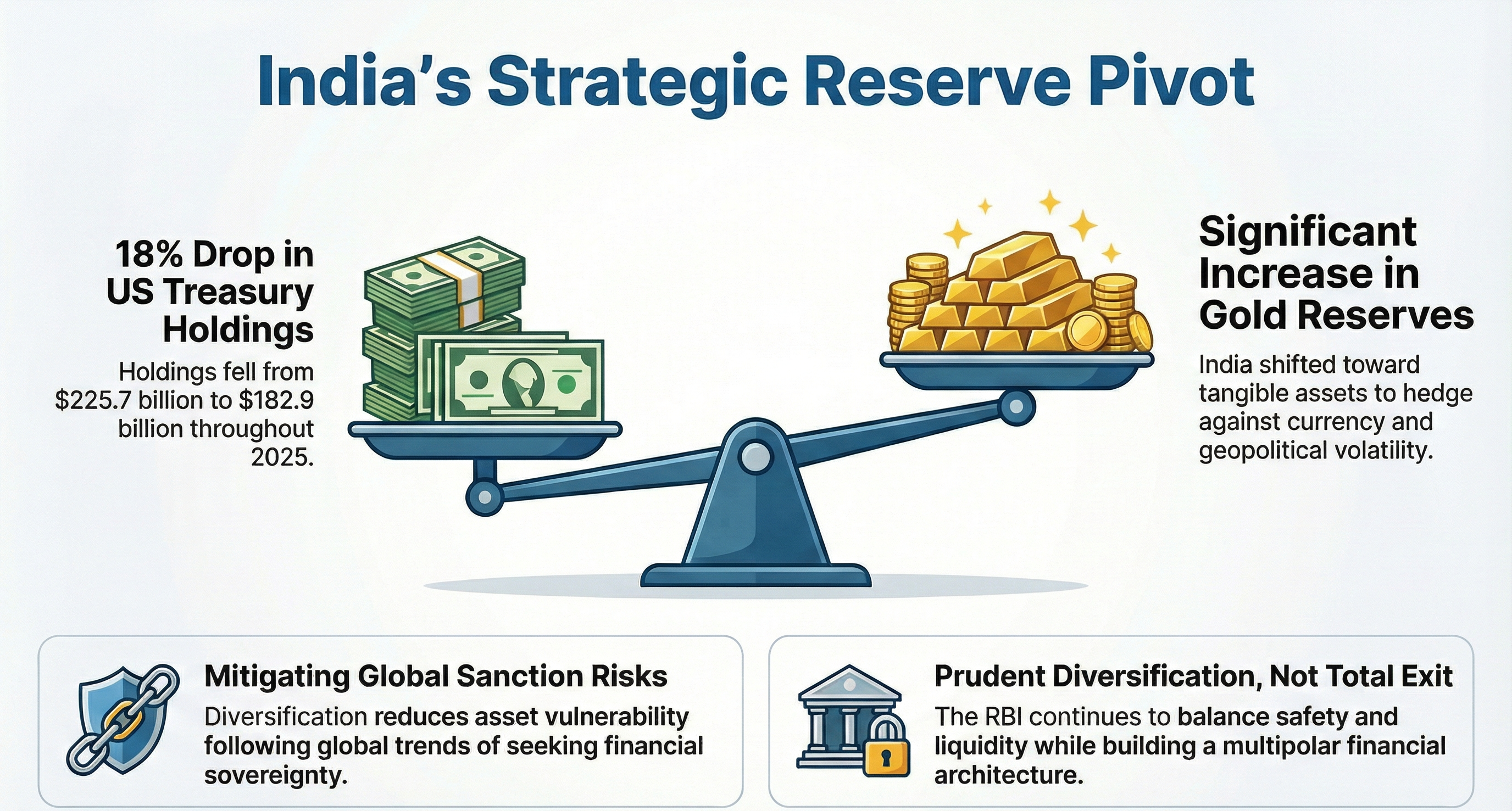
The article reports that India’s holdings in US Treasury securities declined by more than 18% in 2025, falling from approximately $225.7 billion in January 2025 to $182.9 billion by December 31, 2025.
The reduction is situated in the broader context of:
- Rising global geopolitical tensions
- US trade protectionism and tariff measures
- Currency management strategies
- India’s evolving foreign exchange reserve composition
II. Key Arguments Presented
1. Portfolio Rebalancing Amid Geopolitical Risk
The article suggests that India reduced US Treasury exposure in response to:
- Global trade uncertainties
- US tariff actions
- Concerns about financial sanctions and asset vulnerability
The reduction is framed as strategic diversification rather than panic withdrawal.
2. Rise in Gold Reserves
It highlights that India’s gold holdings increased significantly during the same period.
This implies:
- A hedge against currency and geopolitical risk
- Reduced overreliance on dollar-denominated assets
- A shift toward tangible reserve diversification
3. RBI’s Investment Strategy
The piece notes that the Reserve Bank of India invests reserves across:
- US Treasuries
- Deposits with central banks
- BIS (Bank for International Settlements)
- Other sovereign instruments
The US remains important but not exclusive.
4. Global Trend of De-Dollarisation
The article situates India’s move within a broader pattern:
- Some countries reassessing dollar exposure
- Sanctions risk highlighted by the Russia experience
- Search for financial sovereignty
However, the US dollar remains dominant in global finance.
III. Author’s Stance
The tone is analytical and strategic.
The article does not portray the reduction as hostile but as:
- A calibrated reserve management decision
- A response to geopolitical volatility
- A prudent diversification move
There is no overt anti-US framing, but subtle emphasis on autonomy.
IV. Possible Biases and Limitations
1. Overinterpretation of De-Dollarisation
While the decline is significant, US Treasuries remain:
- Highly liquid
- Deep and stable
- Benchmark safe assets
The article may imply stronger structural disengagement than evidence supports.
2. Limited Macro Context
The reduction may also reflect:
- Yield movements
- Dollar index fluctuations
- Domestic liquidity needs
- Exchange rate management
These technical drivers are not deeply analysed.
3. Short-Term Snapshot
Reserve movements can fluctuate monthly.
A single-year decline does not necessarily indicate a long-term structural shift.
V. Pros and Cons of the Development
Pros
• Diversifies reserve composition
• Reduces exposure to geopolitical sanction risk
• Enhances financial sovereignty
• Signals prudent risk management
Cons
• US Treasuries remain safest and most liquid assets
• Gold lacks yield
• Reduced Treasury holdings may limit liquidity flexibility
• Over-diversification may raise volatility
VI. Policy Implications
1. Reserve Management Strategy
India must balance:
- Safety
- Liquidity
- Returns
US Treasuries provide liquidity; gold provides hedge stability.
2. Geopolitical Risk Assessment
Sanctions risk has changed global reserve behaviour.
India must:
- Avoid overconcentration
- Maintain diversified currency basket
- Strengthen rupee internationalisation gradually
3. Exchange Rate Management
Reserve allocation influences:
- Rupee stability
- External sector confidence
- Investor perception
A balanced strategy is essential.
VII. Real-World Impact
Short-term:
- Limited direct impact on India–US relations
- Signals cautious macroeconomic posture
Medium-term:
- Strengthens resilience to external shocks
- Encourages domestic financial market development
Long-term:
- Gradual diversification without abandoning dollar dominance
- Incremental move toward multipolar financial architecture
VIII. UPSC Relevance
GS Paper II
• India–US relations
• Global financial governance
• Geopolitics of sanctions
GS Paper III
• Foreign exchange reserves
• External sector management
• De-dollarisation debates
• Monetary policy and central banking
Essay Themes
• Financial sovereignty in a multipolar world
• Geopolitics and global finance
• Risk management in uncertain times
IX. Balanced Conclusion and Future Perspective
The reduction in India’s US Treasury holdings reflects calibrated reserve diversification rather than strategic disengagement.
US Treasuries continue to anchor global finance. However, rising geopolitical uncertainties and sanctions risks are prompting central banks to reassess concentration risk.
India’s approach appears pragmatic:
- Maintain substantial exposure to dollar assets
- Increase gold reserves
- Diversify instruments
The real test will be whether India can gradually strengthen domestic financial markets and expand rupee settlement mechanisms—without destabilising external sector confidence.
Reserve diversification must enhance resilience, not compromise liquidity.
