

India’s Future Demographic Challenges
The Hindu
1. Key Arguments
A. Slowing Population Growth and Declining Fertility
India’s population growth is stabilising, with fertility rates approaching replacement levels.
Future growth will be slower, indicating the end of high-growth demographic advantage.
B. Ageing Population and Rising Dependency
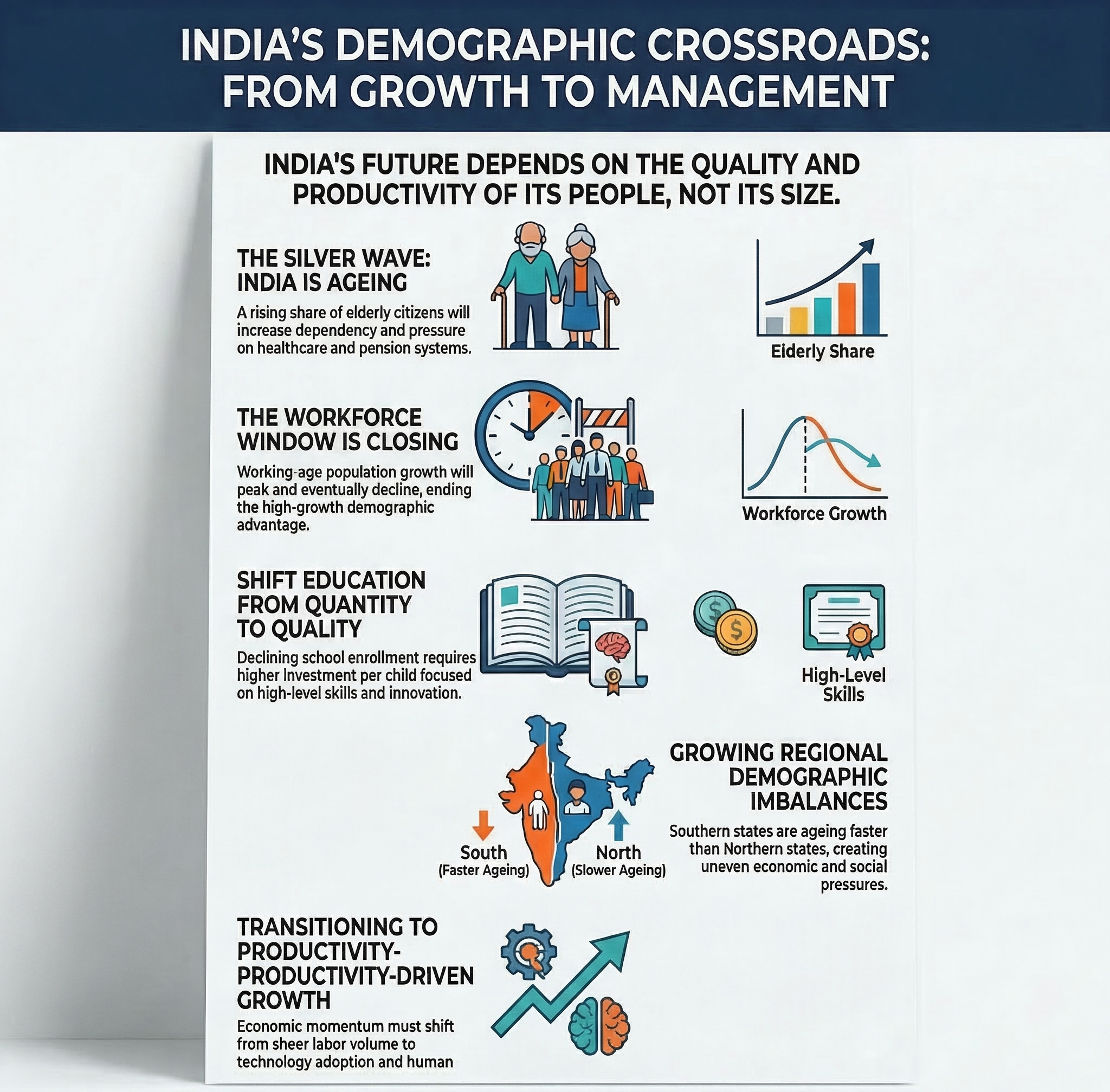
The share of elderly (60+) is increasing significantly.
This will raise the old-age dependency ratio, putting pressure on healthcare, pensions, and social security systems.
C. Shrinking Workforce in the Long Run
Working-age population growth will peak and eventually decline.
The demographic dividend window is limited and will close in coming decades.
D. Regional Demographic Imbalances
Southern states are ageing faster than northern states.
This creates uneven economic and social pressures across regions.
E. Education and Employment Challenges
Declining school enrolment due to lower birth rates
Simultaneously, the need for quality education and skill development is rising.
2. Author’s Stance
Cautious and reform-oriented
Balanced recognition of opportunity and risk
The author acknowledges the demographic dividend but warns of an impending demographic transition.
Policy urgency without alarmism
Tone is analytical, emphasising preparedness rather than crisis.
3. Biases and Limitations
Projection-heavy argumentation
Relies on forecasts which may vary due to migration, policy changes, or economic shifts.
Limited focus on migration dynamics
Internal and international migration could offset workforce decline but is underexplored.
Urban-centric lens
Rural demographic dynamics and informal economy impacts receive less attention.
4. Strengths (Pros)
Data-driven narrative
Uses credible demographic projections and trends.
Holistic coverage
Links population trends with education, employment, and healthcare.
Forward-looking approach
Anticipates long-term structural challenges rather than short-term issues.
5. Weaknesses (Cons)
Limited policy detailing
Broad recommendations without deep institutional or fiscal analysis.
Underdeveloped gender perspective
Female labour force participation and gendered ageing issues need more emphasis.
Insufficient global comparison
Lessons from ageing societies like Japan or Europe are not explored.
6. Policy Implications
A. Labour Market Reforms
Enhancing workforce participation
Focus on female labour participation, skill development, and job creation.
B. Education System Reorientation
Shift from quantity to quality
Fewer students but higher investment per child, focus on skills and innovation.
C. Healthcare and Social Security Expansion
Preparing for ageing population
Geriatric care, pension reforms, and universal healthcare coverage.
D. Regional Policy Differentiation
Tailored strategies for different states
Migration policies to balance labour shortages and surpluses.
E. Productivity Enhancement
From labour-driven to productivity-driven growth
Technology adoption and human capital investment.
7. Real-World Impact
Economic Growth
Potential slowdown if productivity is not enhanced
Shrinking workforce may reduce growth momentum.
Fiscal Pressure
Rising expenditure on pensions and healthcare
Increased burden on state finances.
Social Structure
Changing family systems and elderly care dynamics
Greater reliance on institutional care systems.
Education Sector
School closures vs need for better quality education
Shift in infrastructure and resource allocation.
8. UPSC GS Paper Linkages
GS Paper I (Society & Population)
- Demographic transition
- Ageing population
- Regional disparities
GS Paper II (Governance)
- Social sector policies (health, education)
- Welfare schemes and pension systems
GS Paper III (Economy)
- Demographic dividend
- Labour market dynamics
- Human capital and productivity
GS Paper IV (Ethics)
- Intergenerational equity
- Welfare of elderly
9. Balanced Conclusion
India stands at a demographic crossroads.
While the demographic dividend has driven past growth, future challenges will arise from ageing, declining fertility, and workforce shifts.
10. Future Perspective
From demographic dividend to demographic management
Policy must shift from exploiting population growth to managing population structure.
Investing in human capital
Education, skills, and health will determine future productivity.
Inclusive and adaptive governance
Policies must address regional and social disparities.
Sustainable economic transition
Focus on innovation, technology, and efficiency to offset workforce decline.
Final Insight
India’s demographic future will depend not on the size of its population, but on the quality and productivity of its people.
