

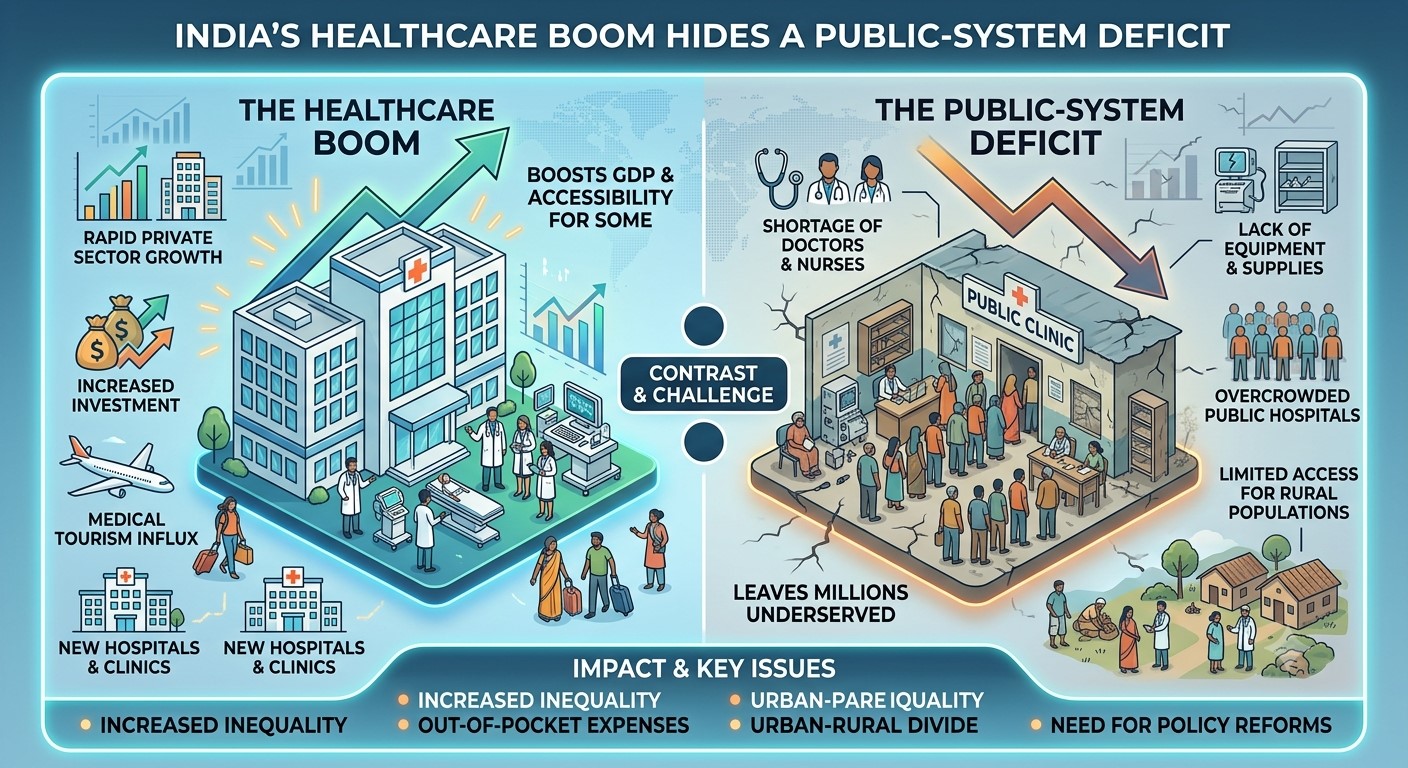
India’s Healthcare Boom Hides a Public-System Deficit

Healthcare Expansion vs Public Spending
- India has witnessed substantial expansion in visible healthcare infrastructure, including medical colleges, medical seats, AIIMS and Ayushman Bharat.
- However, government health expenditure was only 1.43% of GDP in 2022–23, below the 2.5% target of the National Health Policy, 2017.
- The key challenge is therefore not merely expanding healthcare capacity but ensuring that it is publicly accessible, affordable and geographically distributed.
- The Parliamentary Standing Committee on Health and Family Welfare has highlighted persistent gaps in capacity, affordability and regulation.
Medical Capacity: Numbers vs Distribution
- India now has 818 medical colleges and 1,28,875 undergraduate medical seats, indicating a major expansion in medical education.
- Yet substantial shortages persist at the primary and secondary healthcare levels:
- Rural Community Health Centres face specialist shortages of around 70–80%.
- 17,788 sub-centres reportedly function without their own buildings.
- The core problem is therefore not simply a shortage of doctors, but their uneven geographical distribution and inadequate supporting infrastructure.
- Growing private and PPP participation in medical education also makes regulatory quality and institutional accountability increasingly important.
Dominance of Private Healthcare and Affordability
- More than 60% of hospitalisations and around 70% of outpatient care are provided by the private sector, according to the cited NSSO data.
- Average hospitalisation expenditure is approximately:
- Government hospitals: ₹6,631.
- Private hospitals: ₹50,508.
- Weak public capacity effectively pushes households towards expensive private healthcare, even when the State does not directly charge them for treatment.
- Out-of-pocket expenditure (OOPE) has declined substantially but still constituted 43.4% of total health expenditure in 2022–23.
- More than 40 crore Indians, often described as the “missing middle”, remain outside comprehensive financial health protection.
Insurance and Private Capital: Limits and Opportunities
- Ayushman Bharat has expanded financial protection and enabled many vulnerable families to access hospital treatment.
- However, insurance primarily finances treatment; it does not necessarily control the underlying price of healthcare.
- Rising treatment costs can ultimately increase the financial burden on governments, insurers, employers and households.
- Private investment in healthcare is increasing through hospital chains, diagnostic networks and consolidation of healthcare businesses.
- Such investment can help bridge infrastructure gaps, but its social value depends on whether it:
- Expands capacity in underserved districts.
- Strengthens primary healthcare.
- Improves quality and affordability.
- Prevents excessive market concentration and cost escalation.
Way Forward: Public System as the Foundation
- Increase public health expenditure towards the National Health Policy target and prioritise primary and preventive healthcare.
- Address rural and underserved-area shortages through better deployment of specialists, infrastructure and incentives rather than focusing only on increasing medical seats.
- Strengthen regulation of medical education, hospitals, diagnostics and healthcare pricing to ensure commercialisation does not undermine quality or affordability.
- Expand comprehensive financial protection beyond the current insurance architecture to cover the “missing middle”.
- Use public and private capital to create additional healthcare capacity where it is most needed rather than concentrating investment in profitable urban markets.
- The broader goal should be a citizen-centred health system in which a family does not have to choose between an under-capacity public hospital and an unaffordable private hospital.
- Universal healthcare ultimately requires a strong publicly financed and publicly provided system, with private healthcare complementing rather than substituting for public capacity.
