

India’s Invisible Environmental Crisis: Lessons from Murshidabad’s Disappearing Wetlands
The Statesman
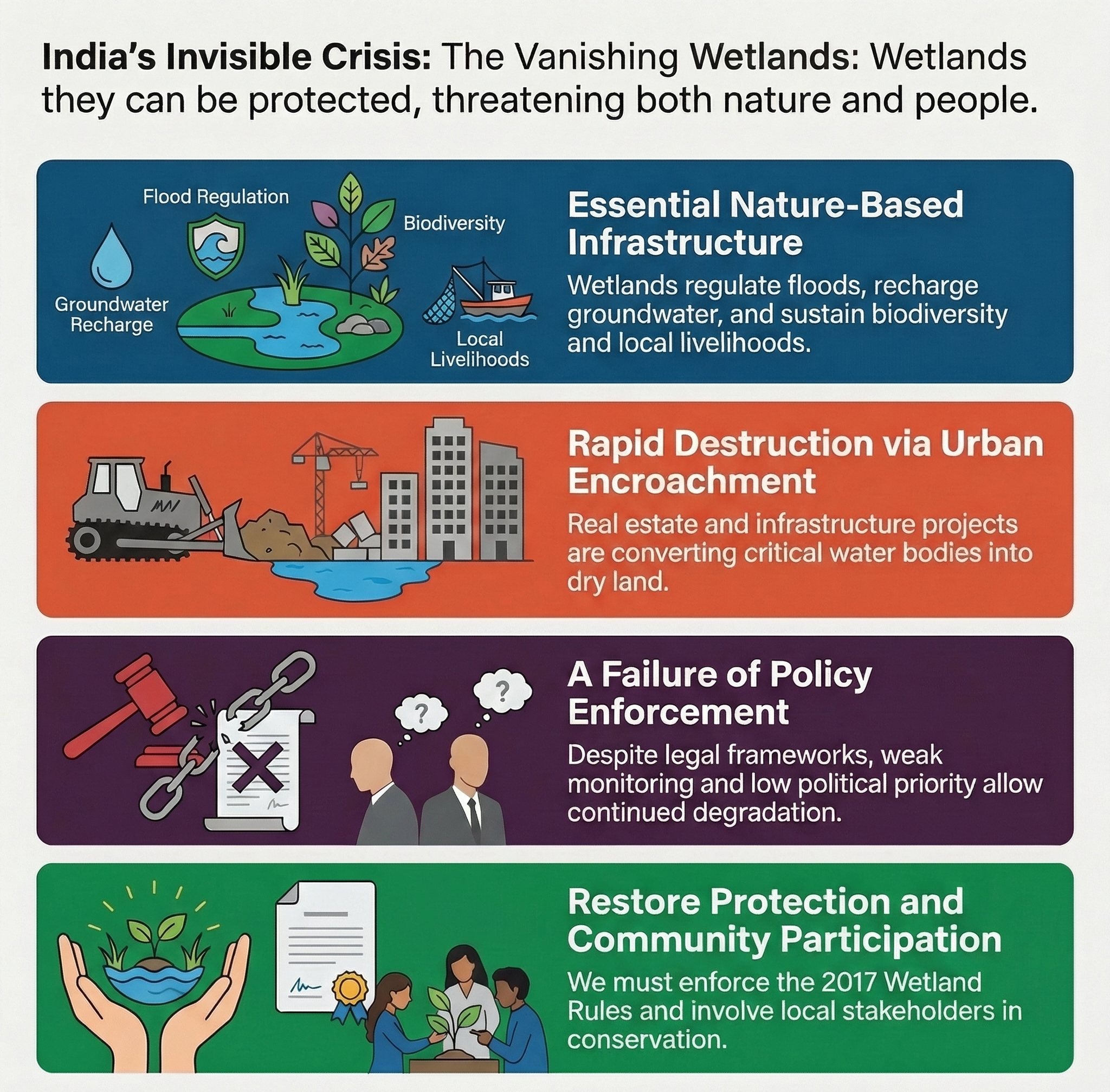
1. Key Arguments
A. Wetlands as Critical Ecological Assets
Wetlands perform essential ecosystem services.
They regulate floods, recharge groundwater, support biodiversity, and sustain livelihoods such as fishing and agriculture.
B. Rapid Degradation and Encroachment
Urban expansion and land-use change are destroying wetlands.
Conversion into real estate, agriculture, and infrastructure has led to shrinking wetland areas.
C. Governance and Policy Failures
Weak enforcement of environmental regulations.
Despite legal frameworks, lack of monitoring and coordination allows continued degradation.
D. Loss of Livelihoods and Local Impact
Communities dependent on wetlands face economic distress.
Fishing, farming, and allied activities are adversely affected.
E. Wetlands as ‘Invisible’ in Policy Priorities
Low political and administrative attention.
Unlike forests or rivers, wetlands are undervalued in development planning.

2. Author’s Stance
Strongly conservation-oriented
Advocacy for ecological protection
The author emphasises urgency in safeguarding wetlands.
Critical of governance lapses
Highlights administrative neglect and policy inefficiency.
3. Biases and Limitations
Limited developmental perspective
Economic pressures driving land conversion are underexplored.
Regional focus limitation
Murshidabad is used as a case study, but broader national variation is not deeply analysed.
Insufficient quantitative evidence
Lacks detailed data on extent of wetland loss.
4. Strengths (Pros)
Highlights a neglected environmental issue
Brings wetlands into mainstream environmental discourse.
Strong linkage between ecology and livelihoods
Connects environmental degradation with human impact.
Timely relevance
Important amid increasing climate change and urbanisation pressures.
5. Weaknesses (Cons)
Limited policy detailing
Does not fully elaborate on actionable solutions.
Absence of comparative examples
Could have referenced successful wetland conservation models.
Overemphasis on governance failure
Other factors like population pressure and economic needs are less explored.
6. Policy Implications
A. Strengthening Wetland Protection Laws
Effective implementation of Wetlands Rules, 2017
Clear demarcation and protection of wetland boundaries.
B. Integrated Land-Use Planning
Balancing development with ecological preservation
Incorporate wetlands into urban and rural planning.
C. Community Participation
Involving local stakeholders in conservation
Sustainable livelihood models linked to wetland protection.
D. Monitoring and Technology Use
Remote sensing and GIS-based tracking
Prevent encroachment and degradation.
E. Awareness and Valuation
Recognising economic value of ecosystem services
Integrating ecological accounting in policymaking.
7. Real-World Impact
Environmental Consequences
Increased flooding and water scarcity
Loss of natural buffers.
Biodiversity Loss
Decline in flora and fauna
Wetlands are critical habitats.
Economic Impact
Livelihood loss for dependent communities
Fishing and agriculture affected.
Climate Impact
Reduced carbon sequestration capacity
Exacerbates climate change effects.
8. UPSC GS Paper Linkages
GS Paper III (Environment)
- Wetlands ecosystem
- Conservation challenges
- Climate change
GS Paper I (Geography)
- Physical geography and ecosystems
- Human-environment interaction
GS Paper II (Governance)
- Environmental policy implementation
- Role of institutions
9. Balanced Conclusion
Wetland degradation is a critical yet under-recognised environmental challenge.
While development pressures are real, the long-term ecological and economic costs of wetland loss far outweigh short-term gains.
10. Future Perspective
Mainstreaming wetlands in development planning
Treat wetlands as critical infrastructure.
Strengthening institutional accountability
Clear roles and enforcement mechanisms.
Promoting sustainable livelihoods
Align conservation with economic incentives.
Adopting ecosystem-based approaches
Nature-based solutions for climate resilience.
Final Insight
Wetlands may be invisible in policy discourse, but their loss is deeply visible in environmental crises and human suffering.
