

India's Manufacturing Blind Spot: The Missing Industrial Backbone

India's Manufacturing Blind Spot: The Missing Industrial Backbone
Relevance: GS Paper III (Indian Economy, Industrial Policy, Manufacturing)
Context
- The author argues India's industrial strategy has a significant blind spot: while policymakers have rightly invested in semiconductors, EVs, batteries, drones, robotics, and AI, they have largely ignored the thousands of industrial products every successful manufacturing economy is built on.
- These include machine tools, bearings, pumps, valves, electric motors, compressors, gears, fasteners, industrial chemicals, transformers, cables, and countless other engineering products — the foundation of advanced manufacturing.
- Core argument: India should continue investing in frontier technologies, but unless it becomes globally competitive in these "industrial backbone" products, it will remain an assembly economy rather than a true manufacturing powerhouse.
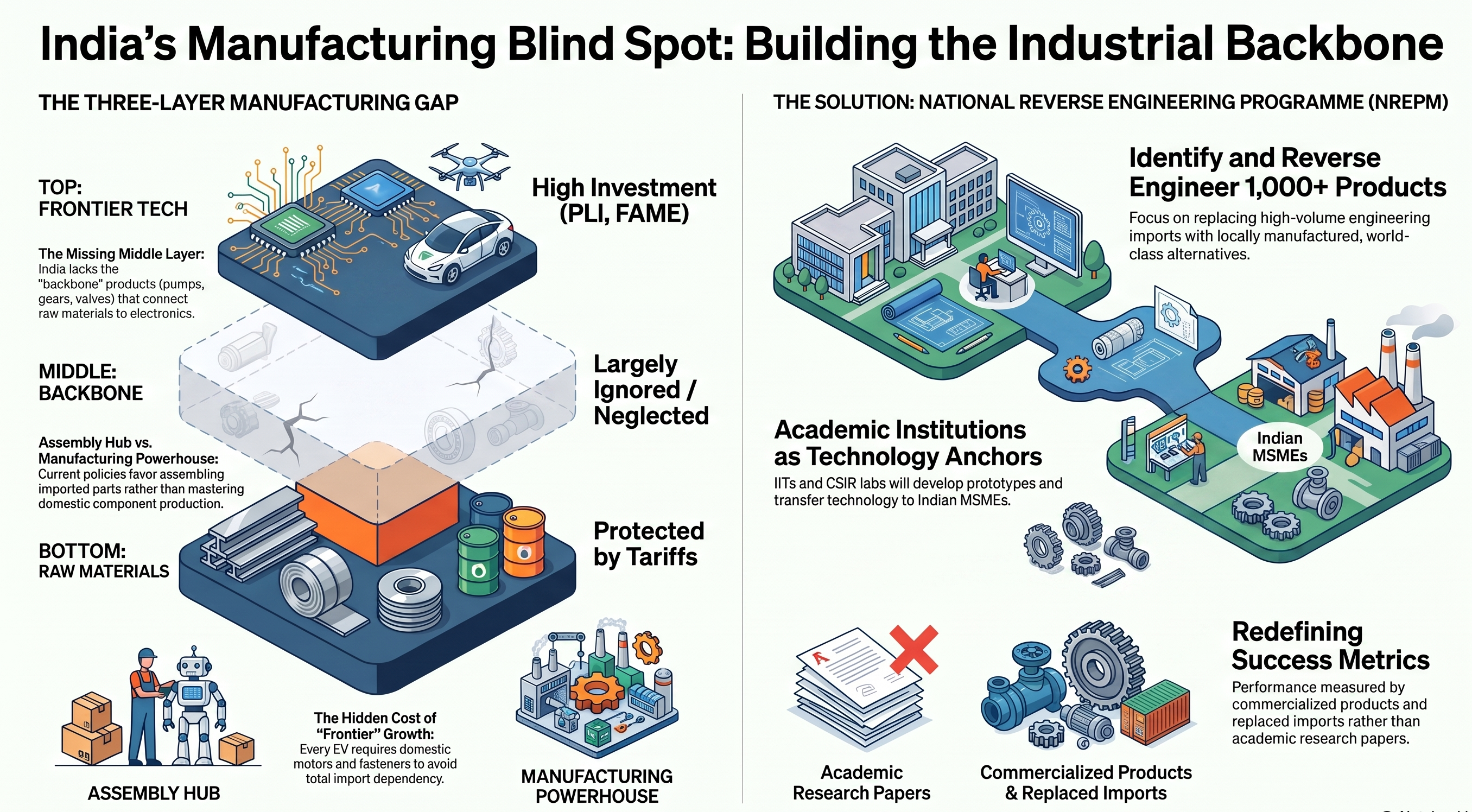
The Three-Layer Manufacturing Ecosystem
- Bottom layer: industrial raw materials (steel, aluminium, chemicals, petrochemicals).
- Top layer: frontier industries (semiconductors, AI, EVs, batteries, aerospace, robotics).
- Middle layer (the largest, and most neglected): industrial backbone products connecting raw materials to finished goods.
- Example: every EV requires motors, bearings, gears, fasteners, wiring, moulds, dies, and machine tools before reaching a customer. Ignoring this middle layer makes the entire manufacturing ecosystem dependent on imports.
India's Policy Focus So Far
- Over the past two decades, Indian industrial policy has focused overwhelmingly on frontier industries — through Make in India, Production-Linked Incentive (PLI) schemes, the India Semiconductor Mission, FAME, the National Green Hydrogen Mission, and electronics/drone programmes.
- This has produced real gains: electronics assembly has expanded, and start-ups are building battery systems, drones, robotics, medical devices, and semiconductor packaging solutions.
- However, much of this manufacturing remains assembly-based — India continues importing semiconductors, sensors, precision components, speciality materials, and industrial sub-assemblies because the domestic supplier ecosystem remains weak.
- Frequent duty exemptions on imported components further reduce incentives to manufacture them locally, keeping domestic value addition low.
- This policy focus has also shaped entrepreneurship patterns — most manufacturing start-ups target EVs, drones, satellites, and solar equipment, while few entrepreneurs aim to build world-class companies in "boring" industries like bearings, valves, machine tools, compressors, or precision components — despite these forming the foundation of Germany's Mittelstand, Japan's precision manufacturing, and China's status as the world's factory.
Lessons from China
- China did not become the world's factory by starting with semiconductors or EVs — it first mastered tens of thousands of industrial backbone products, building dense supplier networks, tooling companies, component manufacturers, and engineering firms.
- Only once that foundation was in place did consumer electronics, automotive, battery, and renewable energy industries expand rapidly.
- The author argues India is attempting nearly the reverse — promoting frontier sectors while leaving much of its industrial base underdeveloped.
- India and China started from broadly similar manufacturing levels in the late 1980s, but diverged after the 1990s — China steadily strengthened its manufacturing ecosystem, while India's industrial backbone weakened.
Why India's Industrial Backbone Weakened?
- India protected upstream industries (steel, aluminium, petrochemicals) through tariffs and other support — benefiting a few large producers but raising input costs for thousands of downstream manufacturers making machinery, components, and engineering goods.
- As Chinese manufacturing became cheaper and more efficient, many Indian firms found importing more profitable than local production — trading gradually replaced manufacturing in many sectors.
- Example: even India's pharmaceutical industry shifted from manufacturing many Active Pharmaceutical Ingredients (APIs) to importing them from China, focusing instead on producing finished medicines.
- Additional competitiveness constraints: high electricity tariffs, costly logistics, lending rates of 9-10%, regulatory uncertainty, and complex compliance requirements.
- The author's summary: China invested aggressively in emerging industries while continuing to strengthen its traditional manufacturing base; India lags in both.
Proposed Solution: National Reverse Engineering Programme for Manufacturing (NREPM)
- The objective: enable Indian firms to manufacture thousands of industrial products at world-class quality and globally competitive costs.
Task 1: Identify Priority Products
- Identify over a thousand industrial products accounting for most of India's engineering imports — bearings, pumps, nuts, bolts, compressors, machine tools, fasteners, etc.
- Most rely on mature technologies, where competitiveness depends on engineering precision, quality, reliability, and cost — not scientific breakthroughs.
- Thousands of Indian MSMEs and mid-sized firms already manufacture many of these products but often fall short of global standards; NREPM should help bridge this gap, replace imports, and build export competitiveness.
Task 2: Build Technology Capabilities
- Unlike PLI schemes, which assumed firms already possessed necessary technology, NREPM should focus on actively building those capabilities.
- IITs, NITs, CSIR laboratories, and other leading engineering institutions should serve as anchor institutions — each taking responsibility for a set of industrial products, studying the world's best designs, reverse engineering them, developing improved prototypes, and transferring technology to Indian manufacturers.
- Success should be measured by products commercialised, imports replaced, and exports generated — not research papers — with institutions/teams rewarded accordingly.
- Funding: could come from the government's Rs 1 trillion Research, Development and Innovation Fund (RDIF) under the Anusandhan National Research Foundation (ANRF), by expanding its mandate to finance manufacturing technology development alongside its existing industry-led research focus.
Task 3: Expand Beyond Engineering Products
- Once established, NREPM should extend to organic chemicals, pharmaceuticals, synthetic textiles, and other industrial inputs where India has manufacturing capability but remains heavily import-dependent.
The Author's Core Argument
India's goal should not be to become the world's assembly line for advanced products — it should aim to become the world's workshop for the industrial products that make those advanced products possible. That, the author argues, is the foundation on which every manufacturing superpower has been built.
