

India's Rice Economy: From Export Volume to Sustainable Value

India's Rice Economy: From Export Volume to Sustainable Value
Source: The Hindu
Why in news?
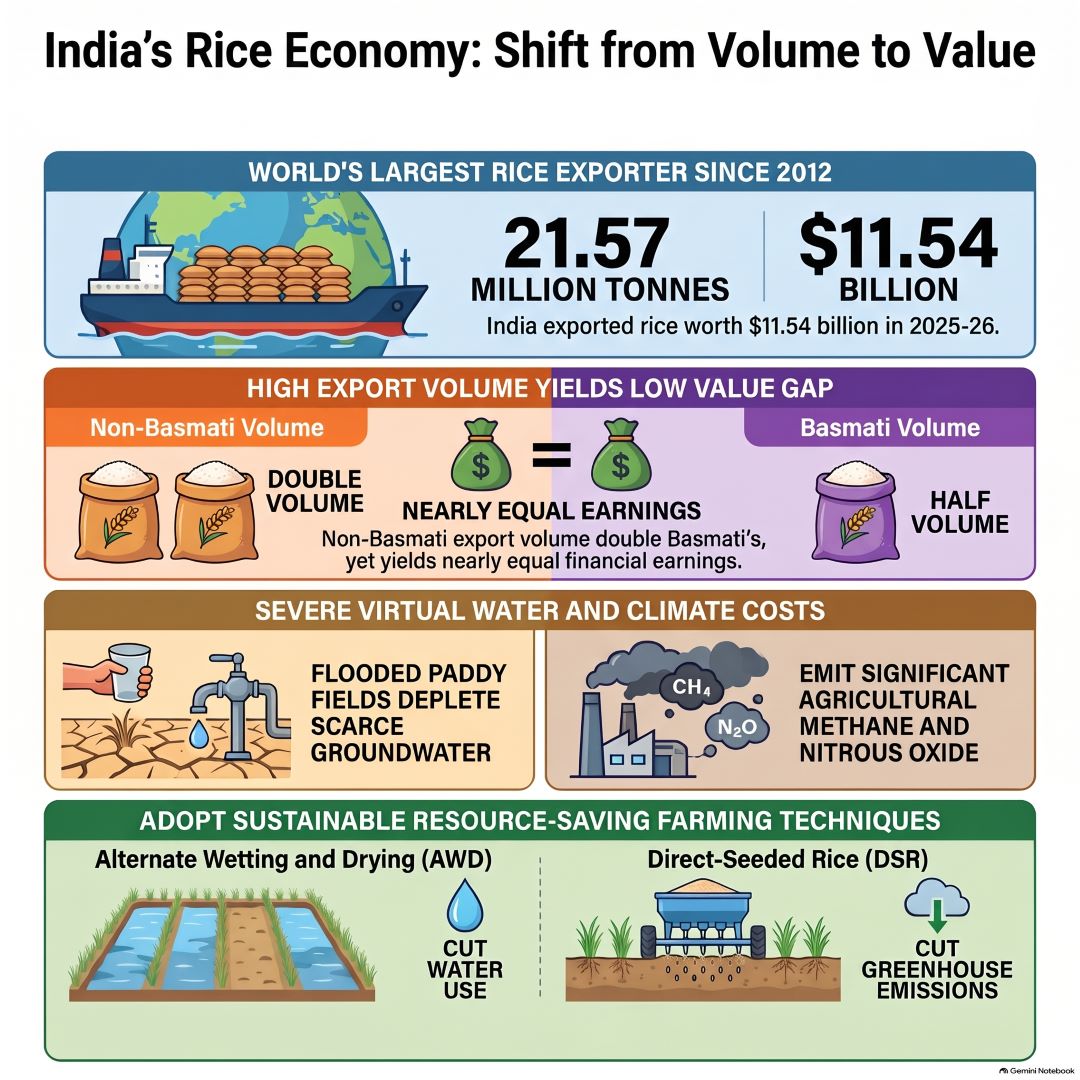
India has been the world's largest rice exporter since 2012, and this has renewed attention on the water, energy and environmental costs of rice. The argument is that agricultural policy should shift from export volumes towards sustainable value creation.
Static background
- Rice is a water-intensive kharif crop. Assured procurement at MSP, and in some States cheap power, have encouraged paddy in Punjab and Haryana.
- Punjab Preservation of Subsoil Water Act, 2009: Delays paddy transplanting to curb groundwater use.
- Greenhouse gases: Per tonne, methane and nitrous oxide trap far more heat than carbon dioxide.
- Geographical Indication (GI): Protects the name and quality link of regional products. Basmati has a GI tag.
India in the global rice market
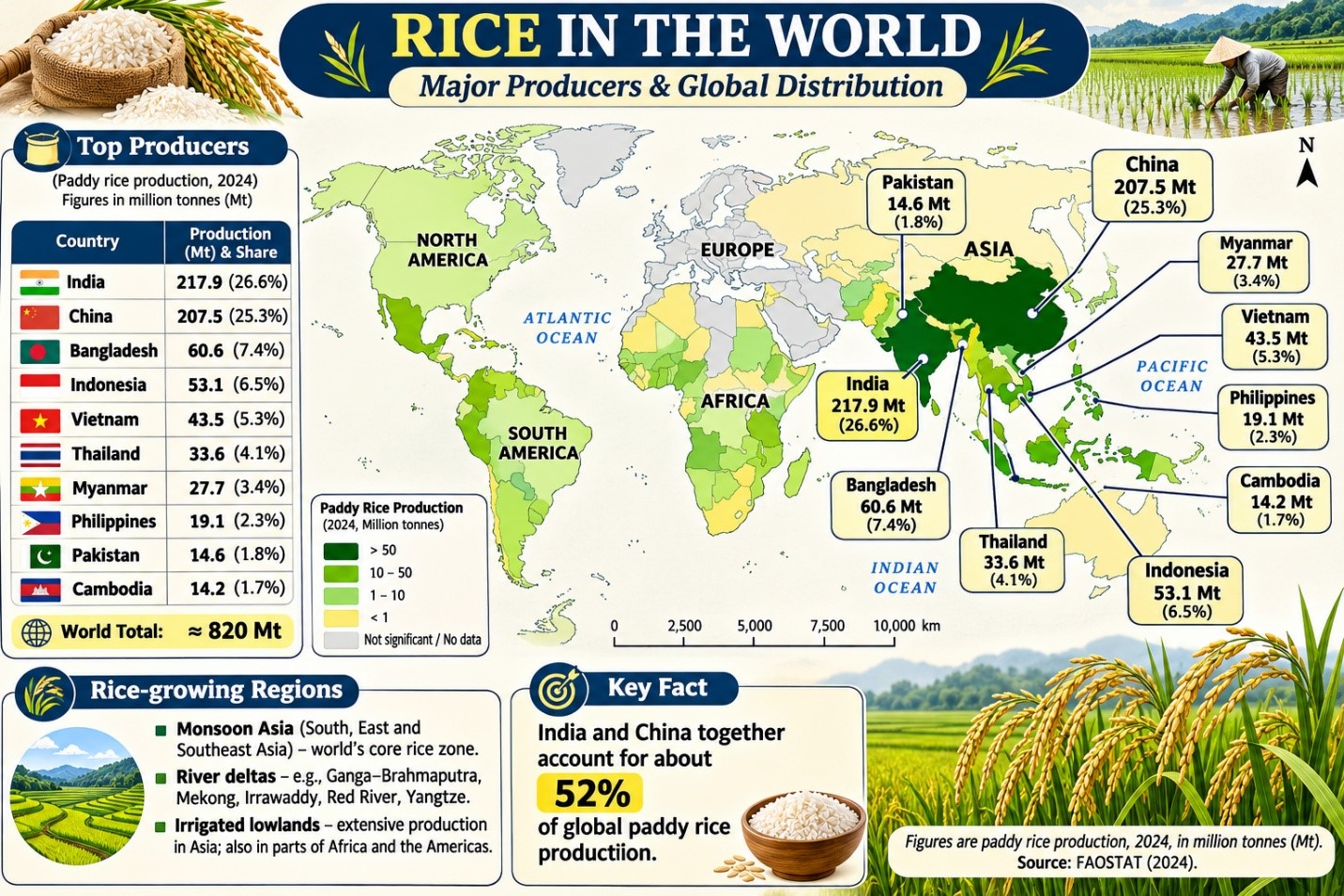
- India accounts for about 30-35% of global rice exports in recent years, and produced an estimated 154.02 million tonnes in 2025-26.
- Exports rose from 17.73 million tonnes in 2020-21 to 21.57 million tonnes in 2025-26, and export earnings from $8.82 billion to $11.54 billion.
- Major producing States: Uttar Pradesh, Telangana, West Bengal, Punjab, Chhattisgarh, Odisha, Madhya Pradesh, Bihar, Andhra Pradesh and Tamil Nadu.
|
2025-26 exports |
Volume |
Value |
|
Basmati |
6.52 million tonnes |
₹50,138 crore ($5.67 billion) |
|
Non-Basmati |
15.04 million tonnes |
₹51,892 crore ($5.86 billion) |
Non-Basmati rice has more than twice the volume of Basmati but only a slightly higher value. This shows that earnings can be raised through quality, branding and value addition rather than more volume.
The hidden resource cost: virtual water
- Virtual water trade is the water used to produce goods that are then traded internationally.
- Green water: Rainwater stored in soil and used by crops. Rain-fed rice puts relatively little pressure on local freshwater.
- Blue water: Water drawn from rivers, reservoirs and groundwater for irrigation. Heavy use depletes scarce water.
- The pressure is acute in Punjab, Haryana and western Uttar Pradesh. Groundwater-fed rice in parts of West Bengal, Bihar, Odisha, Chhattisgarh, Telangana, Andhra Pradesh, Tamil Nadu and Karnataka also adds to water stress.
- So sustainability cannot be judged by export earnings and volumes alone. The amount of scarce blue water used per tonne exported is equally important.
Rice and climate change
- Methane: Flooded paddy fields create oxygen-free conditions in which methane-producing microorganisms thrive, making rice a major source of agricultural methane.
- Nitrous oxide: Excess or wrong use of nitrogen fertilisers raises these emissions, and other intensive conventional practices add to emissions.
- Practices that save resources and cut emissions: Alternate Wetting and Drying (AWD), which lets fields dry periodically instead of staying flooded; Direct-Seeded Rice (DSR), where seeds are sown directly instead of being transplanted from nurseries; and Integrated Nutrient Management, which combines organic and inorganic nutrients.
- Their effect varies with agro-climatic and soil conditions, and trade-offs between different gases need context-specific assessment.
Water-carbon-value framework
The proposed indicators measure economic and environmental performance together:
- Export value per tonne of rice.
- Export value per cubic metre of blue water used.
- Groundwater used per tonne of rice produced.
- Irrigation water productivity.
- Greenhouse gas emissions per kilogramme of rice.
- Farmer income per unit of water.
- Groundwater trends across major rice-producing districts.
These would show whether higher export earnings come with better resource efficiency and sustainability.
Conclusion
India's rice exports are a strength, but their water and emission costs are rising. Moving from volume to value, with region-specific production and a water-carbon-value yardstick, can keep exports competitive while protecting groundwater and the climate.