

India's Rupee Billionaires Cross 500 for the First Time

India's Rupee Billionaires Cross 500 for the First Time
Relevance: GS Paper III (Indian Economy, Income Inequality, Taxation)
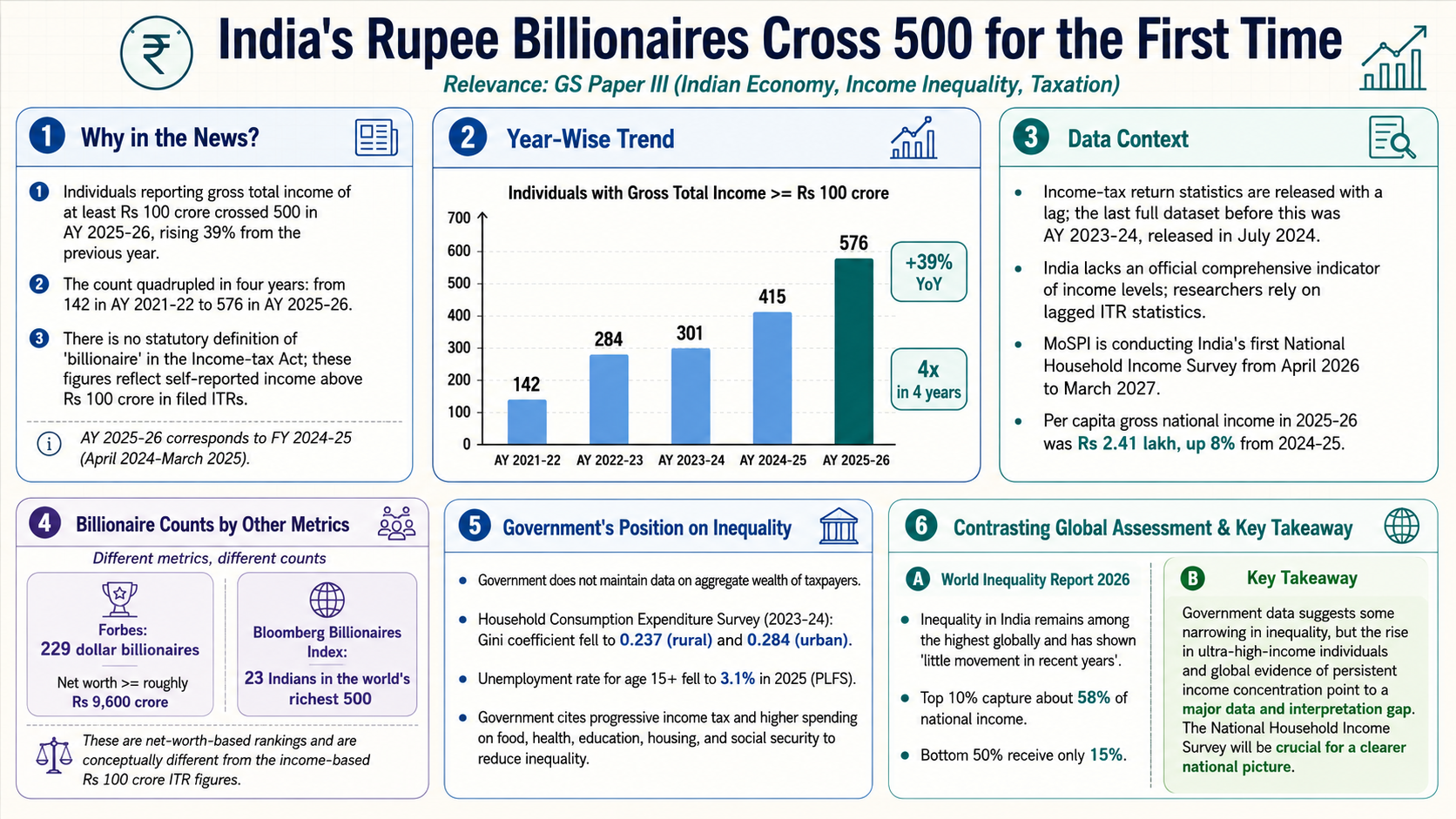
Why in the News?
- The number of individuals reporting a gross total income of at least Rs 100 crore crossed 500 in Assessment Year (AY) 2025-26, up 39% from the previous year — per the Finance Ministry's written reply in the Lok Sabha.
- This count has quadrupled in four years — from 142 in AY 2021-22 to 576 in AY 2025-26 (AY refers to the 12 months after the income year; AY 2025-26 corresponds to FY 2024-25, i.e., April 2024-March 2025).
- Minister of State for Finance Pankaj Chaudhary clarified there is no statutory definition of "billionaire" under the Income-tax Act, 2025, or the erstwhile Income-tax Act, 1961 — the figures simply reflect self-reported income above Rs 100 crore in filed ITRs.
Year-Wise Trend (Individuals with Gross Total Income ≥ Rs 100 crore)
- AY 2021-22: 142
- AY 2022-23: 284
- AY 2023-24: 301
- AY 2024-25: 415
- AY 2025-26: 576
Data Context
- Such figures are usually released as part of income tax return statistics, typically with a lag; the last full dataset before this was for AY 2023-24 (released July 2024).
- India currently lacks an official comprehensive indicator of income levels; researchers rely on lagged IT return statistics.
- MoSPI is conducting India's first-ever National Household Income Survey, started in April, running till March 2027, with results expected some months after.
- India's per capita gross national income in 2025-26 stood at Rs 2.41 lakh (current prices), up 8% from 2024-25.
Billionaire Counts by Other Metrics
- Forbes: India has 229 "dollar billionaires" by net worth (net worth ≥ roughly Rs 9,600 crore, at ~Rs 96/USD).
- Bloomberg Billionaires Index: 23 Indians feature among the world's richest 500 people (by net worth).
- Note: these net-worth-based rankings are conceptually different from the income-based Rs 100 crore figures reported to the Lok Sabha.
Government's Position on Inequality
- The government does not maintain data on the aggregate wealth of taxpayers.
- Citing the Household Consumption Expenditure Survey (2023-24), Chaudhary noted the Gini coefficient — the standard measure of inequality — declined to 0.237 (rural) and 0.284 (urban), suggesting a narrowing rural-urban gap.
- The unemployment rate for those aged 15+ fell to 3.1% in 2025 (Periodic Labour Force Survey), reflecting post-Covid labour market recovery.
- Cited government measures to reduce inequality: a progressive income-tax structure and increased spending on food, health, education, housing, and social security.
Contrasting Global Assessment
- Per the World Inequality Report 2026 (Paris School of Economics' World Inequality Lab), inequality in India remains among the highest globally and has shown "little movement in recent years."
- Its estimate: the top 10% of earners capture about 58% of national income, while the bottom 50% receive only 15%.
Key Takeaway
While government data (Gini coefficient, unemployment rate) suggests some narrowing of inequality, the sharp rise in ultra-high-income individuals alongside global assessments (World Inequality Report) pointing to persistently high income concentration highlights a data and interpretation gap — underscoring the significance of the upcoming National Household Income Survey for a clearer national picture.
