

India's Self-Reliant Nuclear Future: Indigenous Technology, SMRs & Risk Assessment
India's Self-Reliant Nuclear Future: Indigenous Technology, SMRs & Risk Assessment
Source: The Tribune (11-07-2026)
Why in News?
India is accelerating its nuclear energy programme to achieve energy security and decarbonisation, while emphasising indigenous reactor technology, Small Modular Reactors (SMRs), thorium utilisation and domestic nuclear safety systems.
Why Nuclear Energy is Important for India
- Supports India's target of 500 GW non-fossil fuel capacity by 2030.
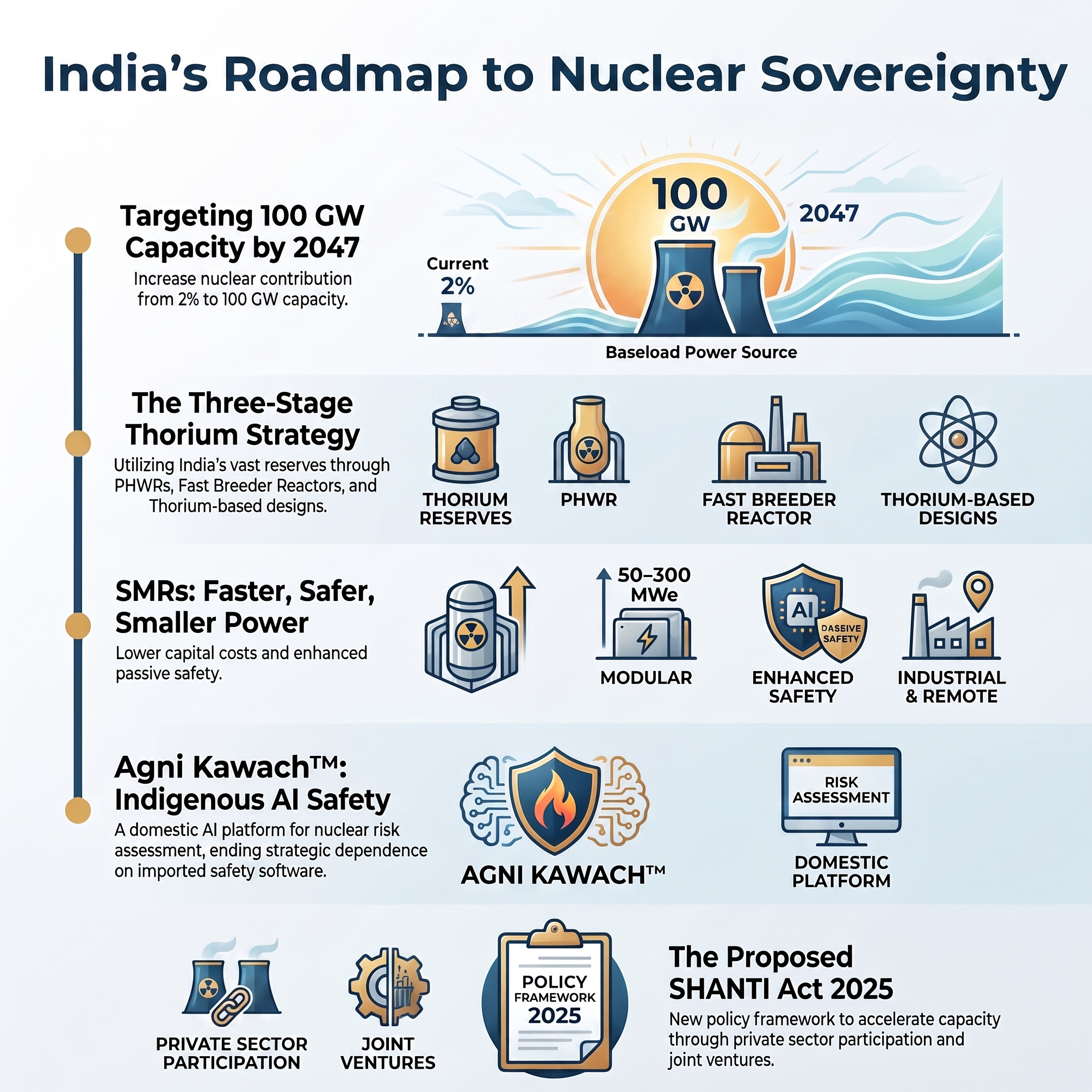
- Expected to contribute around 100 GW to India's projected 1,800 GW installed capacity by 2047.
- Provides reliable low-carbon baseload power unlike intermittent renewable energy.
- Enhances long-term energy security and reduces dependence on imported fossil fuels.
India's Nuclear Power Status
- Nuclear contributes only 2–3% of India's electricity generation.
- Global comparison:
- France: ~70%
- South Korea: ~30%
- USA: ~20%
- Russia: ~20%
- Canada: ~15%
- China: ~6%
India's Three-Stage Nuclear Programme
Designed to utilise India's limited uranium and abundant thorium reserves.
Stage I
- Pressurised Heavy Water Reactors (PHWRs).
- Fuel: Natural uranium.
Stage II
- Fast Breeder Reactors (FBRs).
- Fuel: Plutonium and depleted uranium.
- Produce more fissile material than they consume.
Stage III
- Thorium-based reactors.
- Fuel: Uranium-233 derived from thorium.
- Intended to fully utilise India's vast thorium reserves.
Major Achievements
- APSARA (1956): India's first research reactor.
- Development of CIRUS, ZERLINA and PURNIMA research reactors.
- Indigenous PHWR technology expanded from 220 MWe to 700 MWe.
- Self-reliance in heavy water production.
- Prototype Fast Breeder Reactor (PFBR) (500 MWe).
- VVER-1000 reactors at Kudankulam through India-Russia cooperation.
- Continued advancement of thorium reactor research.
Policy Shift
SHANTI Act, 2025 (Proposed)
Sustainable Harnessing and Advancement of Nuclear Energy for Transforming India
Proposes:
- Greater private sector participation.
- Joint ventures in civil nuclear power.
- Faster expansion of nuclear capacity.
Small Modular Reactors (SMRs)
What are SMRs?
- Advanced reactors of 50–300 MWe capacity.
- Factory-manufactured and modular.
Advantages
- Lower capital cost.
- Faster construction.
- Enhanced passive safety.
- Suitable for remote and industrial locations.
- Lower land and water requirements.
- Better grid stability alongside renewable energy.
Need for Indigenous Nuclear Safety Infrastructure
Expansion of nuclear energy requires robust risk assessment and safety systems.
India currently depends on imported industrial safety software such as:
- DNV PHAST
- Gexcon FLACS
- ANSYS CFD
- Shell FRED
- Flydyn
This creates:
- Technology dependence.
- Licensing constraints.
- Strategic vulnerabilities in critical infrastructure.
Agni Kawach™
An indigenous AI-enabled industrial and nuclear risk assessment platform developed by INDRAX Safety and Energy Solutions.
Capabilities
- Gas dispersion modelling.
- Fire and explosion analysis.
- Vapour cloud explosion simulation.
- Blast wave and thermal radiation modelling.
- Multi-hazard industrial accident assessment.
- AI-driven hazard forecasting.
- Automated regulatory compliance.
Applications
- Nuclear power plants.
- Hydrogen economy.
- LNG terminals.
- Refineries.
- Defence installations.
- Chemical industries.
Regulatory Alignment
Designed to support compliance with:
- Atomic Energy Regulatory Board (AERB).
- Petroleum and Explosives Safety Organisation (PESO).
- Oil Industry Safety Directorate (OISD).
- Manufacture, Storage and Import of Hazardous Chemicals (MSIHC) Rules.
Significance
- Strengthens energy security.
- Supports climate commitments and Net Zero transition.
- Promotes Atmanirbhar Bharat in strategic technologies.
- Reduces dependence on imported nuclear technologies.
- Positions India as a future exporter of advanced nuclear reactors and SMRs.
- Builds sovereign capability in nuclear safety and industrial risk management.
Challenges
- Limited domestic uranium reserves.
- High capital cost of nuclear projects.
- Nuclear waste management.
- Public concerns regarding reactor safety.
- Dependence on imported safety software.
- Slow deployment of advanced reactor technologies.
Way Forward
- Accelerate commercial deployment of SMRs, particularly fast breeder and thorium-based designs.
- Strengthen indigenous development of reactors, components, instrumentation and safety software.
- Promote domestic manufacturing under Make in India.
- Introduce incentives linked to indigenous content in SMR projects.
- Expand investment in AI-enabled nuclear safety and risk assessment platforms.
- Position India as a global supplier of advanced nuclear technologies by 2047.
Conclusion
India has built one of the world's most comprehensive long-term nuclear strategies centred on energy security, technological self-reliance and thorium utilisation. The next phase requires rapid deployment of advanced reactors, greater private participation and indigenous digital safety infrastructure to support a secure, low-carbon energy future.
Final Takeaway
India's nuclear ambitions extend beyond reactor construction. Long-term leadership will depend on mastering the complete nuclear ecosystem—from fuel cycles and SMRs to indigenous AI-driven safety platforms—making nuclear energy a cornerstone of Atmanirbhar Bharat and India's clean energy transition.
