

India's Urea Self-Reliance Drive

Source: Hindustan Times, 26 September 2026 — “India's urea self-reliance drive draws ₹2 trillion investments” by Vijay C. Roy.
Why in News?
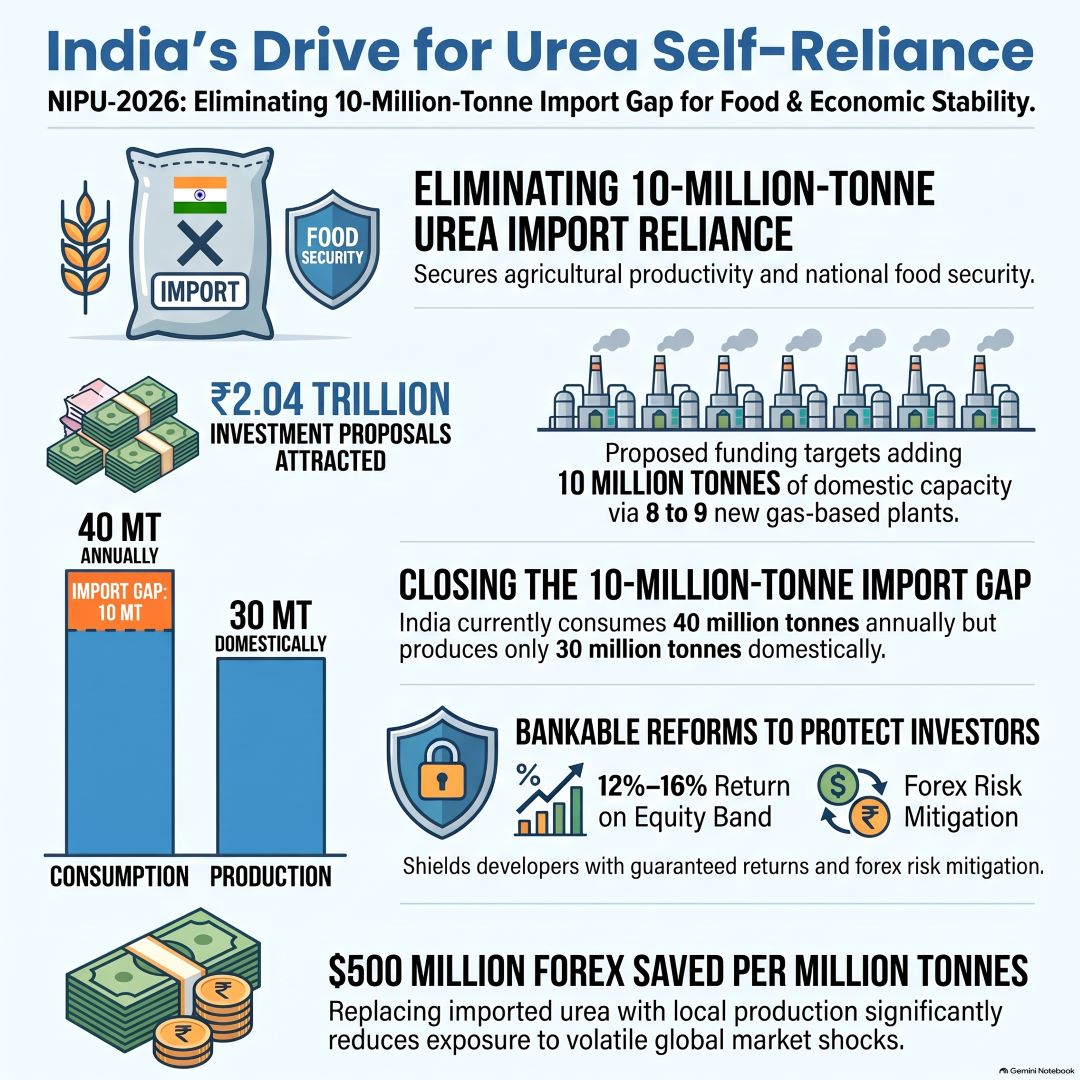
India's efforts to reduce dependence on imported urea have attracted investment proposals worth up to ₹2.04 trillion. The proposals are being examined under the National Investment Policy for Urea (NIPU), 2026, approved by the Union Cabinet in July 2026.
The policy seeks to increase domestic urea production capacity by 10 million tonnes per annum through new plants as well as expansion of existing facilities. This assumes significance because India continues to import a substantial share of its urea requirement, exposing its agricultural sector to international price volatility, geopolitical disruptions and global supply shocks.
India's Urea Dependence and the Need for Self-Reliance
· Urea is the most widely used nitrogenous fertiliser in India and is closely linked with agricultural productivity and food security. India's annual urea requirement is around 40 million tonnes, while domestic production is around 30 million tonnes, leaving roughly 10 million tonnes to be met through imports. Demand is also increasing at around 5% annually.
· India's urea production has increased from about 24.6 million tonnes in FY2021 to 29.3 million tonnes in FY2026. However, imports have remained significant, increasing from around 9.8 million tonnes to 10.3 million tonnes during the same period.
· This dependence creates vulnerability because international fertiliser prices and supplies are influenced by factors such as energy prices, geopolitical conflicts, trade restrictions and disruptions in global supply chains.
· The recent volatility in global fertiliser markets following disruptions associated with the West Asia conflict has further highlighted this vulnerability.
· Therefore, increasing domestic urea capacity is being pursued as part of India's broader objective of strengthening fertiliser security and, consequently, food security.
National Investment Policy for Urea, 2026
|
Objectives and Vision The primary goal of NIPU-2026 is to achieve complete self-sufficiency in urea production, aligning with the Atmanirbhar Bharat mission.
Key Features & Reforms The 2026 policy is a structural evolution of the New Investment Policy (NIP) 2012, introducing mechanisms to make projects more bankable:
|
Economic and Food-Security Significance
· Greater domestic production can reduce India's dependence on imported urea and thereby reduce its exposure to fluctuations in international markets. Experts cited in the article estimate that replacing 1 million tonnes of imported urea with domestic production could save around $500 million annually in foreign exchange.
· The policy therefore has implications beyond fertiliser manufacturing. Lower import dependence can improve external-sector resilience, while more predictable domestic availability can support farmers during periods of global supply disruption.
· Urea is also closely connected with India's fertiliser subsidy system, which constitutes a significant component of government support to agriculture. Hence, the expansion of domestic capacity has implications for both agricultural input security and public expenditure.
· However, self-reliance in urea production should not be equated with complete self-sufficiency in fertilisers. India also needs to address the problem of imbalanced fertiliser use, particularly the excessive application of nitrogen relative to phosphorus and potassium. A sustainable fertiliser strategy therefore requires both adequate domestic availability and movement towards balanced nutrient application and efficient fertiliser use.
Broader Significance
· India's urea policy reflects a broader shift from dependence on volatile international supply chains towards domestic production capacity in strategically important agricultural inputs.
· The issue connects fertiliser security with food security, while also highlighting the trade-offs between increasing production, reducing import dependence, managing the fertiliser subsidy burden and ensuring sustainable soil management.
· The policy can therefore be understood through the broader chain:
· Domestic urea capacity → lower import dependence → reduced exposure to global shocks → greater fertiliser security → stronger agricultural and food security, while simultaneously requiring attention to balanced fertiliser use and fiscal sustainability.
· In 191, we faced both both an economic as well as External Relations crisis
· The year 1991 was a watershed moment in Indian history, often described as the "year of the twin crisis." India faced a precarious Balance of Payments (BoP) emergency alongside a massive geopolitical shift caused by the end of the Cold War.
· This double crisis forced New Delhi to abandon decades of protectionism and ideological rigidity in favor of pragmatic survival.
The Intersection of Both Crises
The economic crisis was not just domestic; it was exacerbated by foreign policy shifts. The collapse of Soviet markets meant Indian exports had nowhere to go, while the Gulf War drained the foreign exchange needed to buy energy.
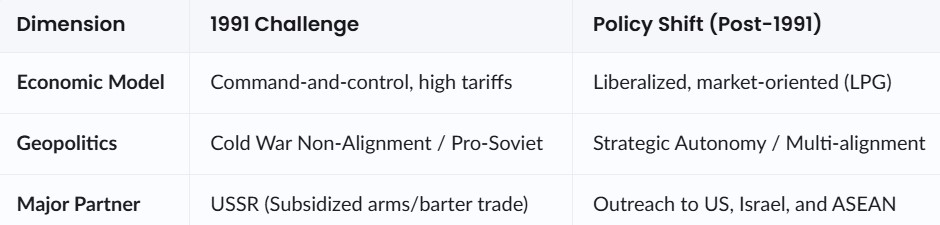

The resolution of the 1991 crisis transformed India from a closed, inward-looking state into a global economic player, demonstrating that in modern statecraft, economic security is inseparable from national security.
