

Inter-State Migration in India: South India Interstate Migration Survey 2026

Inter-State Migration in India: South India Interstate Migration Survey 2026
1. Key Findings
- The South India Interstate Migration Survey 2026 studied 1,824 migrant workers in Karnataka, Kerala and Tamil Nadu.
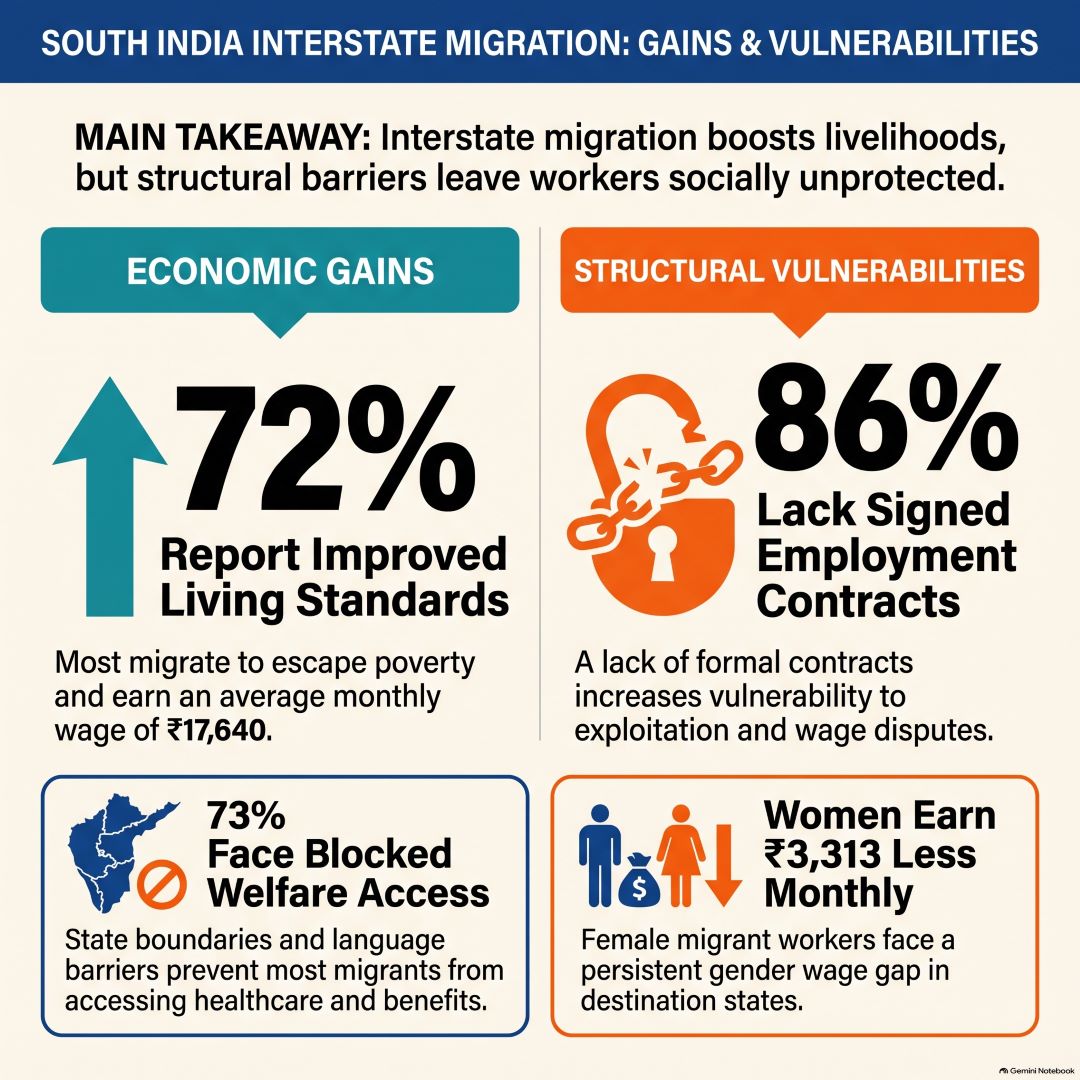
- Nearly 72% said migration improved their standard of living, while around 57% intended to continue working in their destination state.
- Major reasons for migration include low wages, lack of employment, irregular work, poverty, debt and better livelihood opportunities.
- More than 92% of surveyed migrants came from West Bengal, Bihar, Assam, Odisha, Uttar Pradesh and Jharkhand.
- Average monthly wage was around ₹17,640, while the average working day was 9.87 hours.
- Women migrant workers earned around ₹3,313 less per month than men, highlighting a persistent gender wage gap.
2. Major Vulnerabilities
- Over 86% of workers had no signed employment contract, increasing vulnerability to exploitation and wage-related disputes.
- Around 73% faced difficulties accessing welfare benefits and nearly 69% faced problems accessing healthcare.
- Only about 19% could easily access welfare benefits after moving across states; around 45% could barely access them.
- Language, communication and social barriers further restrict migrants' access to services.
- Although 88.2% were covered by formal financial services, financial exclusion remained significant among certain groups and in Karnataka.
3. Migration and India's Development
- Migration reflects both livelihood insecurity at the source and employment opportunities at the destination.
- Interstate migration helps redistribute labour towards sectors and regions experiencing labour demand.
- However, migrants often remain outside formal employment systems, creating a gap between economic contribution and social protection.
- The findings highlight the need to view migrants not merely as temporary labour but as an important part of India's urbanisation, labour mobility and economic growth.
4. Welfare Portability and Governance
- One Nation One Ration Card (ONORC) is important because it enables eligible beneficiaries to access subsidised foodgrains across states.
- Welfare portability needs to extend beyond food security towards healthcare, social security, labour protections and other essential services.
- Multilingual help desks can address language barriers.
- Stronger labour inspection can improve compliance with employment and workplace regulations.
- Better coordination between origin and destination states is essential for protecting migrant workers.
5. Way Forward
India needs a portable and rights-based social protection system in which benefits follow the worker rather than being restricted by state boundaries. Registration of migrant workers, written employment contracts, effective labour inspections, multilingual assistance and interstate coordination can reduce vulnerability. Improving women's wages and workplace conditions should form an important part of migration policy. The larger objective should be to convert migration from a survival strategy into a pathway for secure employment, social mobility and inclusive development.