

Italy & India: Strategic Push for the Indo-Mediterranean
Morning Standard
1. Core Issue and Context
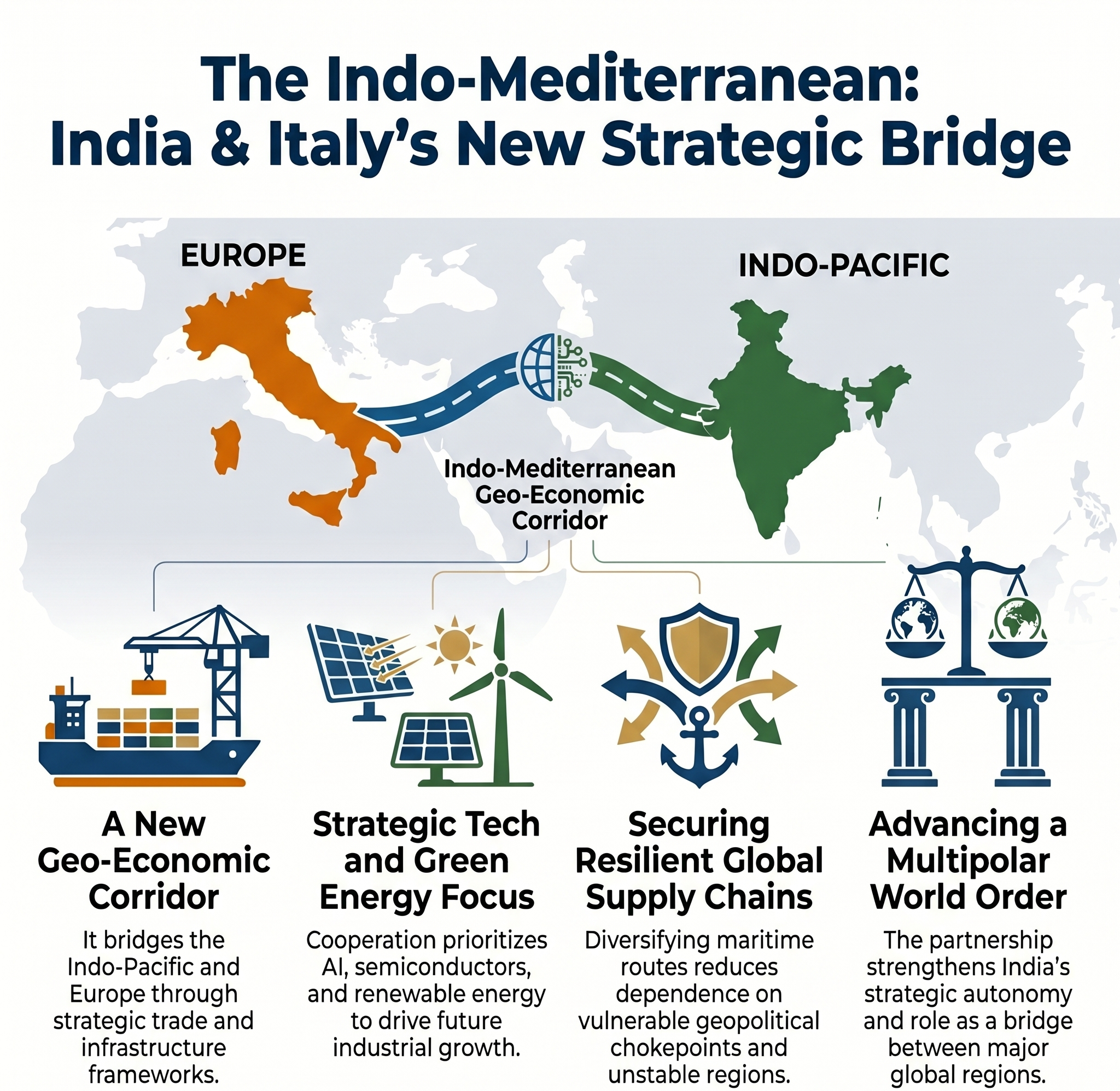
The article analyses the emerging strategic partnership between India and Italy and situates it within the broader geopolitical framework of the proposed Indo-Mediterranean connectivity and cooperation architecture.
The article argues that:
- India and Italy are attempting to deepen collaboration beyond traditional diplomacy into:
- Trade,
- Technology,
- Energy,
- Infrastructure,
- Maritime connectivity,
- Defence,
- Artificial Intelligence,
- Supply-chain resilience.
At a broader level, the article presents the Indo-Mediterranean idea as:
A new geopolitical and geo-economic corridor linking the Indo-Pacific with Europe through strategic partnerships and connectivity frameworks.
The article reflects changing global realities:
- Fragmented supply chains,
- Geopolitical competition,
- Energy insecurity,
- Technological realignment,
- Multipolar diplomacy.
2. Key Arguments in the Article
India–Italy relations are entering a strategic phase
The article argues:
- Bilateral ties are expanding beyond cultural and diplomatic exchanges into strategic cooperation.
Key areas include:
- Technology,
- Manufacturing,
- Defence,
- Maritime trade,
- Energy transition.
The Indo-Mediterranean is an emerging geopolitical space
The article conceptualises:
- Indo-Pacific and Mediterranean regions as increasingly interconnected.
This creates opportunities for:
- Trade corridors,
- Infrastructure integration,
- Strategic supply chains.
Economic and technological collaboration is central
The article emphasises:
- Green energy,
- AI,
- Digital infrastructure,
- Innovation ecosystems,
- Advanced manufacturing.
These are presented as:
- Drivers of future cooperation.
Connectivity and supply chains are strategic priorities
The article links cooperation with:
- Resilient trade routes,
- Alternative supply chains,
- Reduced dependence on vulnerable geopolitical chokepoints.
India seeks stronger European partnerships
The article positions Italy as:
- A key European partner in India’s broader strategic diversification strategy.
3. Author’s Stance
Strongly optimistic and strategic
The article adopts:
- A highly positive and forward-looking perspective.
The author views India–Italy ties as:
- Part of a larger geopolitical transformation.
The tone is:
- Diplomatic,
- Strategic,
- Partnership-oriented.
4. Underlying Biases
Strategic partnership bias
The article strongly favours:
- Deeper international cooperation,
- Connectivity diplomacy,
- Multipolar partnerships.
Geo-economic optimism
The discussion assumes:
- Connectivity and trade integration will generate mutual strategic gains.
Technology-driven development perspective
The article strongly supports:
- Innovation-led partnerships,
- AI cooperation,
- Industrial integration.
5. Geopolitical and Economic Dimensions
Rise of the Indo-Mediterranean concept
The article suggests:
- Traditional geopolitical divisions between Europe and Indo-Pacific are becoming interconnected through trade and maritime systems.
Supply-chain diversification
Global crises such as:
- Pandemic disruptions,
- Russia-Ukraine conflict,
- West Asian instability,
have accelerated demand for:
- Alternative supply chains.
Maritime strategic importance
Sea connectivity through:
- Indian Ocean,
- Suez route,
- Mediterranean Sea,
remains crucial for:
- Energy trade,
- Commercial shipping,
- Strategic influence.
Energy transition cooperation
India and Italy are expected to collaborate on:
- Renewable energy,
- Green technologies,
- Sustainable industrial systems.
6. Pros (Positive Dimensions of the Partnership)
Strengthens India’s global strategic positioning
Closer ties with European powers improve:
- India’s diplomatic diversification,
- Strategic flexibility,
- Global influence.
Boosts technology and industrial cooperation
Collaboration may improve:
- Manufacturing capabilities,
- Innovation ecosystems,
- AI and digital development.
Enhances connectivity and trade resilience
Alternative corridors reduce dependence on:
- Single trade routes,
- Geopolitical chokepoints.
Supports clean-energy transition
Joint work on:
- Green technologies,
- Renewable energy,
may accelerate sustainable development.
Encourages multipolar global cooperation
The partnership reflects:
- Movement away from rigid bloc politics.
7. Cons and Concerns
Connectivity projects face implementation challenges
Large transnational projects often encounter:
- Funding constraints,
- Political instability,
- Coordination problems.
Geopolitical competition may complicate partnerships
Rivalries involving:
- China,
- NATO dynamics,
- Regional conflicts,
may affect strategic corridors.
Uneven economic gains
Benefits may disproportionately favour:
- Large corporations,
- Advanced industrial sectors.
Strategic overdependence risks
Deep economic interdependence can create:
- New vulnerabilities during geopolitical crises.
8. Policy Implications
Need for resilient connectivity infrastructure
India must invest in:
- Ports,
- Logistics,
- Digital corridors,
- Maritime infrastructure.
Strengthening technology partnerships
Strategic cooperation should prioritise:
- Semiconductor ecosystems,
- AI governance,
- Cybersecurity,
- Innovation networks.
Enhancing maritime diplomacy
India’s maritime strategy must increasingly integrate:
- European partnerships,
- Mediterranean engagement,
- Blue economy cooperation.
Balancing strategic autonomy
India must maintain:
- Independent foreign policy flexibility
while deepening global partnerships.
9. Real-World Impact
Impact on trade and economy
Improved connectivity may:
- Reduce logistical costs,
- Expand exports,
- Diversify markets.
Impact on strategic positioning
India may strengthen its role as:
- A bridge between Europe and Indo-Pacific.
Impact on energy security
Collaborative renewable-energy systems can improve:
- Energy diversification,
- Sustainability.
Impact on global governance
Such partnerships contribute to:
- Emerging multipolar international order.
10. UPSC GS Paper Linkages
GS Paper II (International Relations)
Relevant themes:
- India-Europe relations
- Strategic partnerships
- Connectivity diplomacy
- Multipolarity
GS Paper III (Economy)
Relevant themes:
- Supply chains
- Trade corridors
- Technology partnerships
- Industrial development
GS Paper III (Infrastructure & Energy)
Relevant themes:
- Green energy
- Maritime infrastructure
- Logistics connectivity
GS Paper III (Science & Technology)
Relevant themes:
- Artificial Intelligence
- Digital cooperation
- Innovation ecosystems
Essay Relevance
Important themes:
- “Globalisation and strategic autonomy”
- “Connectivity and geopolitics”
- “Technology and diplomacy”
11. Critical Examination from UPSC Perspective
Connectivity is becoming geopolitical
The article correctly reflects:
- Trade routes and infrastructure are no longer merely economic tools but strategic instruments.
India’s foreign policy is becoming multi-aligned
India increasingly pursues:
- Simultaneous partnerships across regions
without joining rigid blocs.
Economic security and national security are interconnected
Supply chains, energy systems, and technology networks now directly influence:
- Strategic autonomy.
Partnerships require institutional depth
Strategic declarations alone are insufficient. Long-term success depends upon:
- Institutional coordination,
- Investment,
- Policy continuity,
- Technological competitiveness.
12. Balanced Conclusion
The article presents the India–Italy strategic partnership as part of a broader geopolitical transition toward an interconnected Indo-Mediterranean space linking Europe and the Indo-Pacific.
The partnership reflects contemporary priorities:
- Supply-chain resilience,
- Technology cooperation,
- Green energy transition,
- Maritime connectivity,
- Multipolar diplomacy.
While the vision is ambitious and strategically promising, implementation challenges, geopolitical instability, and economic asymmetries remain important constraints.
The real significance of the partnership lies not merely in bilateral cooperation, but in how India is repositioning itself within evolving global economic and geopolitical networks.
13. Future Perspective
The future of India’s external engagement will increasingly depend upon:
- Connectivity diplomacy,
- Strategic technology partnerships,
- Maritime cooperation,
- Green industrial transitions,
- Multipolar balancing.
The Indo-Mediterranean framework may emerge as:
- A new geopolitical corridor shaping trade, energy, and strategic alignments across Europe, West Asia, and the Indo-Pacific.
For India, the challenge will be to convert strategic vision into:
- Sustainable infrastructure,
- Technological capability,
- Economic competitiveness,
- Long-term geopolitical influence.
