

ITC’s 25 Years of Liberalisation: From Diversification to Responsible Competitiveness

ITC’s 25 Years of Liberalisation: From Diversification to Responsible Competitiveness
1. Liberalisation and Transformation of Indian Business
- Economic liberalisation shifted Indian companies from a relatively protected environment to a competitive and globally integrated economy.
- ITC had to replace older technologies and practices with world-class manufacturing processes.
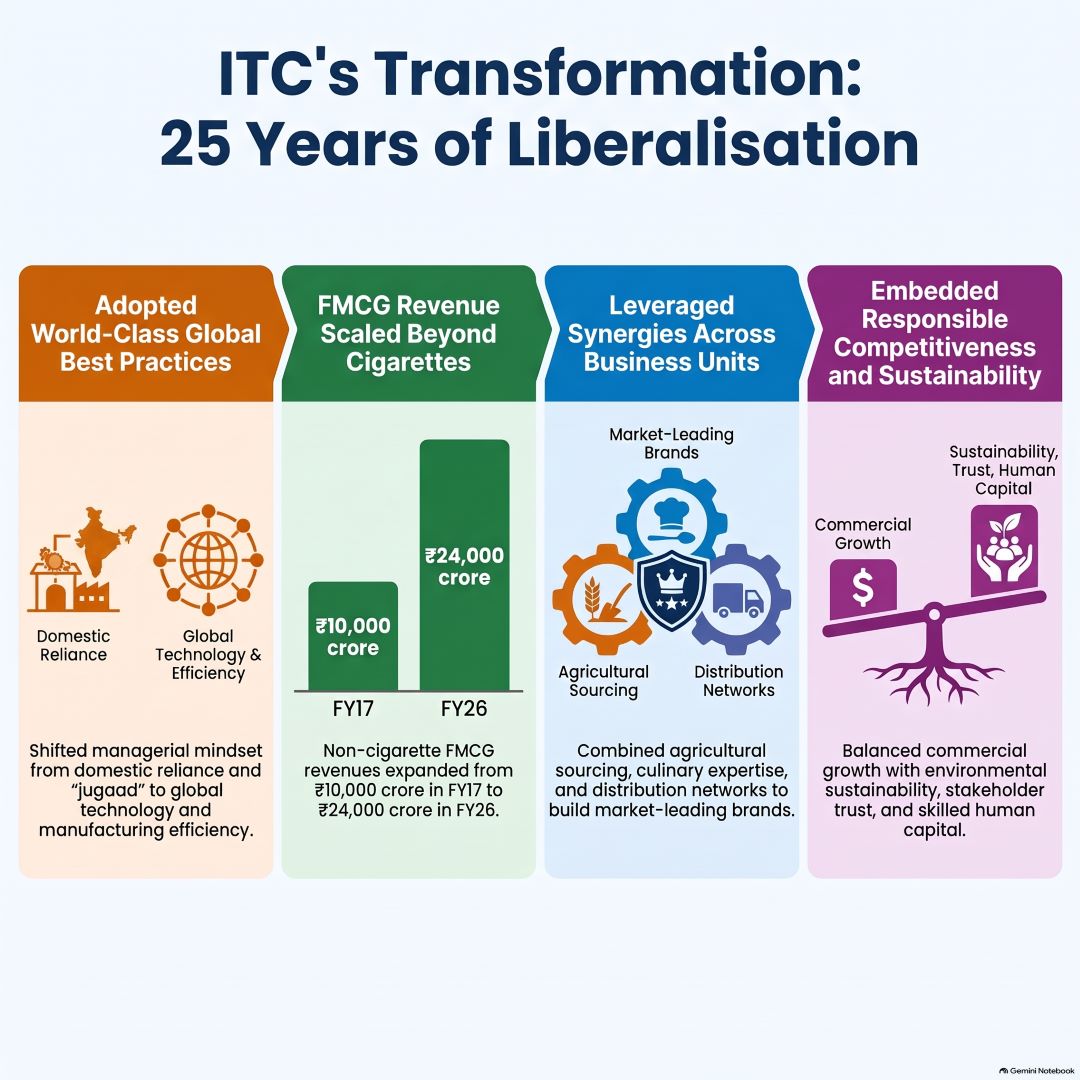
- The transition required a change in managerial mindset—from dependence on limited domestic options and “jugaad” towards global best practices, technology and efficiency.
- ITC's experience reflects how Indian firms adapted to liberalisation, globalisation and rising competition.
2. Diversification and ITC Next
- ITC expanded beyond cigarettes into FMCG, agriculture, paperboards, hotels and information technology.
- Major milestones:
- Lifestyle retailing began in 2000.
- Aashirvaad was launched in 2002.
- Personal care entered in 2005.
- Non-cigarette FMCG revenues increased from about ₹10,000 crore to ₹24,000 crore between FY17 and FY26, reflecting faster growth after greater strategic focus.
- The ITC Next strategy focuses on strengthening growth and profitability across businesses.
- The company's experience demonstrates the importance of diversification with strategic focus, rather than diversification for its own sake.
3. Competitiveness Through Institutional Synergies
- ITC entered markets dominated by established domestic and multinational brands by leveraging its existing strengths.
- Aashirvaad benefited from synergies between:
- Agricultural sourcing
- Hotel and culinary expertise
- Distribution networks
- Research and technology
- In paperboards, ITC developed a domestic fibre value chain through plantations, pulping technology and larger manufacturing capacities, reducing dependence on imported pulp.
- The broader lesson is that Indian firms can improve competitiveness by combining local resources, technology, innovation and supply-chain capabilities.
4. Responsible Competitiveness and Sustainability
- ITC describes its approach as “responsible competitiveness”, combining commercial performance with long-term stakeholder value.
- Competitiveness increasingly depends on:
- Innovation
- Technology
- Quality
- Sustainability
- Skilled human capital
- The company's emphasis on developing entrepreneurial talent highlights the importance of human capital and organisational learning in sustaining competitiveness.
- Building trust with customers, employees, partners and other stakeholders can become a long-term source of competitive advantage.
5. Lessons for Indian Economy and Enterprises
- Liberalisation creates opportunities but also exposes firms to global competition and technological disruption.
- Indian enterprises need to continuously upgrade technology, develop skilled talent and invest ahead of the curve.
- Diversification should be supported by core institutional capabilities and market opportunities.
- Domestic value chains can improve resilience and reduce excessive import dependence.
- The ITC experience illustrates the broader transition of Indian businesses from protection-driven competitiveness to innovation-driven and globally benchmarked competitiveness.
