

It’s time to bring fathers into fold of parental leave
Indian Express
1. Key Arguments
A. Judicial Shift Towards Inclusive Caregiving
Supreme Court interpretation broadens the scope of parental rights.
Recognition that maternity benefits are not limited to biological mothers and can extend to adoptive and non-biological caregivers.
B. Gendered Nature of Care Work
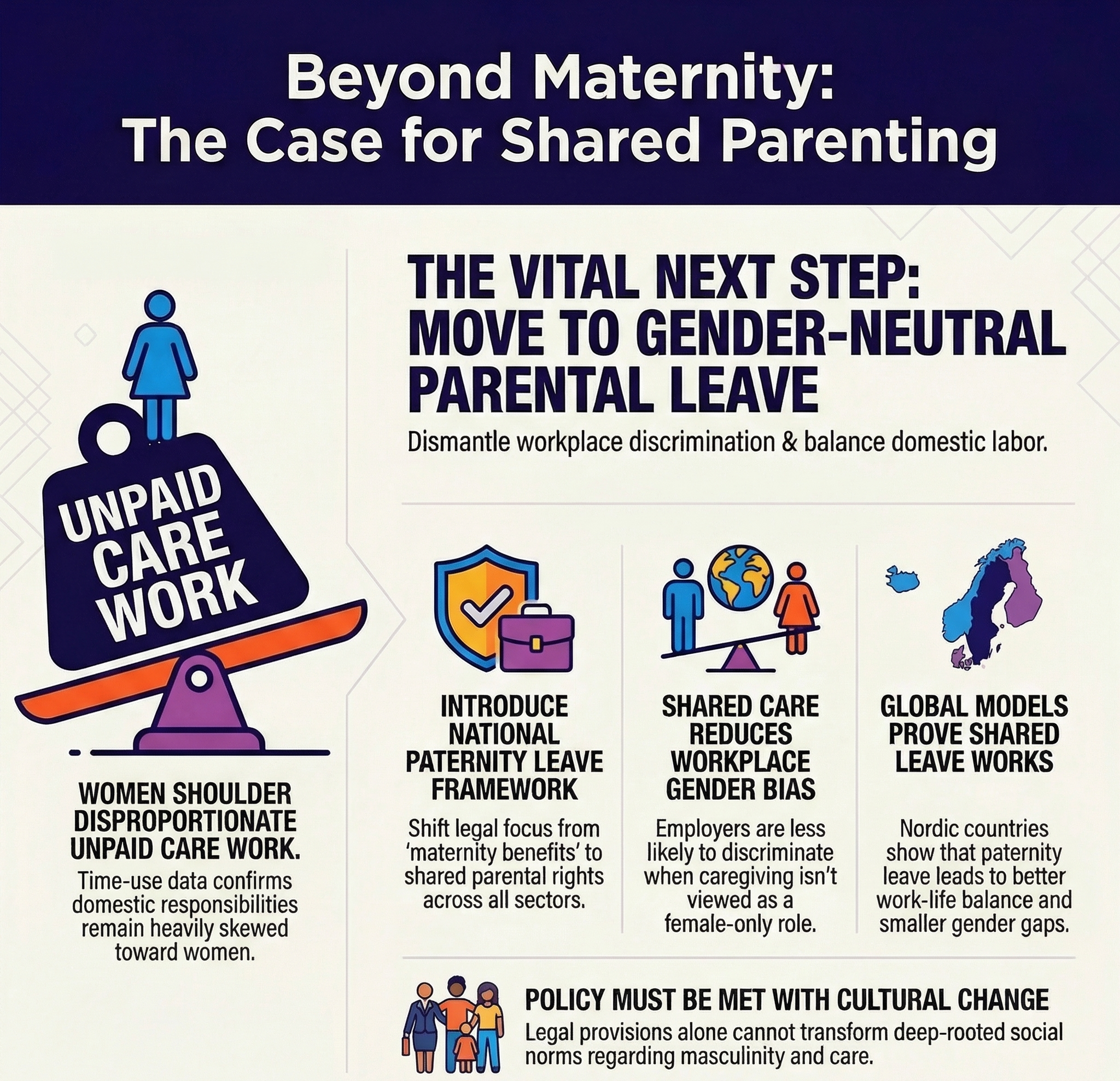
Caregiving remains disproportionately borne by women.
Time-use data indicates women spend significantly more time on unpaid domestic and care work.
C. Paternity Leave as a Tool for Equality
Including fathers can redistribute care responsibilities.
Helps reduce gender bias in hiring and workplace discrimination against women.
D. Limitations of Policy Without Social Change
Legal provisions alone cannot transform deep-rooted norms.
Cultural expectations often discourage men from taking caregiving roles.
E. Global Evidence and Comparative Perspective
Countries with paternity leave show better gender outcomes.
Nordic models demonstrate improved work-life balance and reduced gender gaps.
2. Author’s Stance
Strongly reformist and gender-equity oriented
Advocacy for shared parenting responsibility
The author clearly supports expanding parental leave to fathers.
Critical of existing gender norms
Highlights structural inequality in unpaid labour distribution.
3. Biases and Limitations
Urban and formal sector bias
Focus on organised workforce; informal sector realities are underexplored.
Policy optimism
Assumes that introducing paternity leave will significantly change behaviour.
Limited economic analysis
Does not deeply examine cost implications for employers and government.
4. Strengths (Pros)
Strong constitutional and ethical grounding
Links parental leave to equality and dignity.
Evidence-based argument
Uses time-use surveys and global comparisons.
Contemporary relevance
Aligns with debates on gender equality and labour participation.
5. Weaknesses (Cons)
Limited implementation strategy
Does not detail how policies can be enforced effectively.
Neglect of informal economy
Majority of Indian workforce may not benefit directly.
Behavioural challenges underestimated
Social norms may resist policy-driven change.
6. Policy Implications
A. Introduction of Paternity Leave Framework
Legal provision for paid paternity leave
Applicable across public and private sectors.
B. Gender-Neutral Parental Leave
Shift from maternity to parental leave model
Equal sharing of caregiving responsibilities.
C. Workplace Reforms
Flexible work arrangements and childcare support
Encourage both parents to participate in caregiving.
D. Awareness and Social Campaigns
Changing societal norms around masculinity and care
Promoting shared parenting as a norm.
E. Inclusion of Informal Sector
Extending benefits through welfare schemes
Ensuring broader coverage.
7. Real-World Impact
Gender Equality
Reduction in workplace discrimination against women
Employers less likely to view women as sole caregivers.
Labour Force Participation
Improved female workforce participation
Shared responsibilities enable women to remain in jobs.
Child Development
Better parental involvement
Positive outcomes for child well-being.
Economic Impact
Short-term cost vs long-term productivity gains
Balanced workforce participation enhances economic growth.
8. UPSC GS Paper Linkages
GS Paper I (Society)
- Gender roles
- Changing family structures
- Women and work
GS Paper II (Governance)
- Labour laws
- Social justice and equality
- Role of judiciary
GS Paper III (Economy)
- Workforce participation
- Human capital development
GS Paper IV (Ethics)
- Gender justice
- Equality and fairness
9. Balanced Conclusion
Expanding parental leave to fathers is a necessary but not sufficient step towards gender equality.
While policy reform can create enabling conditions, deeper societal transformation is essential for meaningful change.
10. Future Perspective
Towards gender-neutral caregiving policies
Shift from maternity-centric to family-centric frameworks.
Behavioural and cultural transformation
Encouraging men’s participation in domestic roles.
Inclusive policy design
Extending benefits beyond formal sector.
Long-term economic and social gains
Balanced workforce and stronger family systems.
Final Insight
True gender equality begins when caregiving is seen not as a woman’s duty, but as a shared human responsibility.
